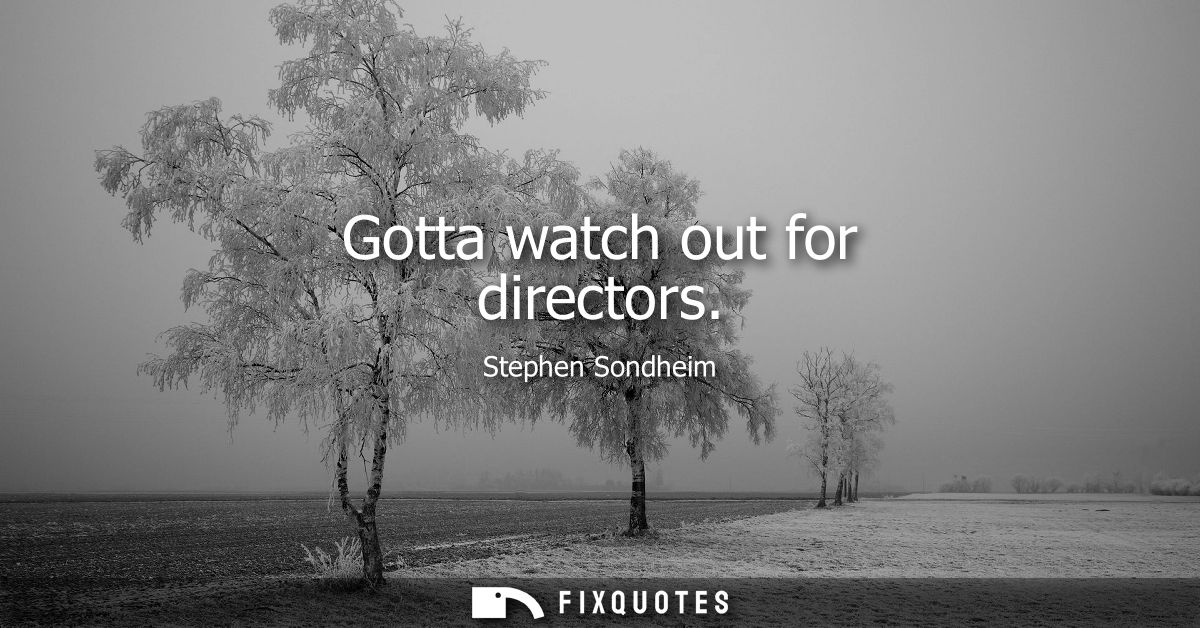
"Gotta watch out for directors"
About this Quote
"Gotta watch out for directors" lands like a throwaway aside, which is exactly why it cuts. Sondheim, the composer-lyricist who treated musical theater like an exacting craft rather than a vibe, is compressing a whole ecology of backstage power into six words. "Gotta" signals shop talk, not theory: this is a veteran warning the young, delivered with the casualness of someone who has seen the same accident too many times. And "watch out" isn’t paranoia; it’s professional self-defense.
The subtext is about authorship in a medium that pretends to be collaborative while constantly renegotiating who gets to be the author. Directors can be visionaries, yes, but they’re also the ones with the room, the rehearsal schedule, the bodies, the authority to reframe a show’s meaning in real time. For a composer, that can mean your carefully engineered rhythm of laughs and dread gets treated like raw material for someone else’s concept. Sondheim’s work is famously precise; change the staging, pace, or emphasis and you don’t just alter tone, you break the mechanism.
Context matters: Sondheim came up in an era when the modern director-as-auteur was ascendant on Broadway, when "interpretation" could become a kind of soft conquest. His warning isn’t anti-director so much as anti-amnesia. It’s a reminder that charisma and "vision" are not neutral forces; they have consequences for story, for music, for who the audience believes is responsible. Under the humor is a hard-earned boundary: collaboration is beautiful, but it isn’t innocent.
The subtext is about authorship in a medium that pretends to be collaborative while constantly renegotiating who gets to be the author. Directors can be visionaries, yes, but they’re also the ones with the room, the rehearsal schedule, the bodies, the authority to reframe a show’s meaning in real time. For a composer, that can mean your carefully engineered rhythm of laughs and dread gets treated like raw material for someone else’s concept. Sondheim’s work is famously precise; change the staging, pace, or emphasis and you don’t just alter tone, you break the mechanism.
Context matters: Sondheim came up in an era when the modern director-as-auteur was ascendant on Broadway, when "interpretation" could become a kind of soft conquest. His warning isn’t anti-director so much as anti-amnesia. It’s a reminder that charisma and "vision" are not neutral forces; they have consequences for story, for music, for who the audience believes is responsible. Under the humor is a hard-earned boundary: collaboration is beautiful, but it isn’t innocent.
Quote Details
| Topic | Witty One-Liners |
|---|---|
| Source | Help us find the source |
| Cite |
Citation Formats
APA Style (7th ed.)
Sondheim, Stephen. (2026, January 16). Gotta watch out for directors. FixQuotes. https://fixquotes.com/quotes/gotta-watch-out-for-directors-102492/
Chicago Style
Sondheim, Stephen. "Gotta watch out for directors." FixQuotes. January 16, 2026. https://fixquotes.com/quotes/gotta-watch-out-for-directors-102492/.
MLA Style (9th ed.)
"Gotta watch out for directors." FixQuotes, 16 Jan. 2026, https://fixquotes.com/quotes/gotta-watch-out-for-directors-102492/. Accessed 27 Mar. 2026.
More Quotes by Stephen
Add to List