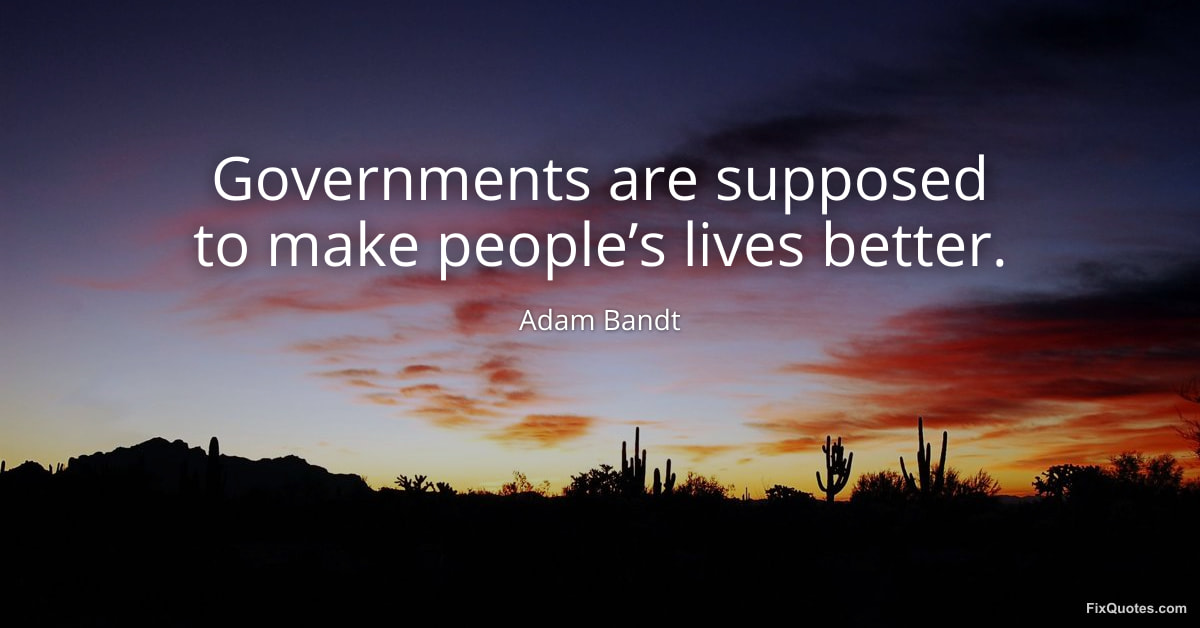
"Governments are supposed to make people’s lives better"
About this Quote
The line looks almost insultingly obvious, and that’s the point. Adam Bandt is weaponizing simplicity to expose how far contemporary politics has drifted from first principles. In an era when governments justify themselves with process (“fiscal responsibility”), posture (“tough on crime”), or market deference (“letting business create jobs”), “make people’s lives better” yanks the debate back to a moral scoreboard ordinary voters can recognize: Are you materially safer, healthier, more secure?
Bandt’s intent is both clarifying and accusatory. Clarifying, because it reframes government as a service provider, not a referee guarding an abstract “economy” that never quite reaches households. Accusatory, because it implies a breach: if people’s lives aren’t improving, then the government is failing at its core job, regardless of balanced budgets or GDP graphs.
The subtext also contains a quiet argument about power. “Supposed to” signals that the current system is performing a different function: managing decline, protecting incumbents, insulating wealth, outsourcing responsibility to markets, or treating suffering as an unfortunate but acceptable byproduct. It’s a Greens-style rejection of austerity and incrementalism, compressing policy disputes about housing, wages, climate, and healthcare into a single legitimacy test.
Contextually, it reads as a populist counter to technocracy: a sentence built for repetition on doorsteps and in clips, where moral commonsense beats procedural nuance. The genius is its trap-like quality: disagreeing sounds inhuman; agreeing invites the follow-up Bandt wants - then why aren’t you doing it?
Bandt’s intent is both clarifying and accusatory. Clarifying, because it reframes government as a service provider, not a referee guarding an abstract “economy” that never quite reaches households. Accusatory, because it implies a breach: if people’s lives aren’t improving, then the government is failing at its core job, regardless of balanced budgets or GDP graphs.
The subtext also contains a quiet argument about power. “Supposed to” signals that the current system is performing a different function: managing decline, protecting incumbents, insulating wealth, outsourcing responsibility to markets, or treating suffering as an unfortunate but acceptable byproduct. It’s a Greens-style rejection of austerity and incrementalism, compressing policy disputes about housing, wages, climate, and healthcare into a single legitimacy test.
Contextually, it reads as a populist counter to technocracy: a sentence built for repetition on doorsteps and in clips, where moral commonsense beats procedural nuance. The genius is its trap-like quality: disagreeing sounds inhuman; agreeing invites the follow-up Bandt wants - then why aren’t you doing it?
Quote Details
| Topic | Justice |
|---|---|
| Source | Help us find the source |
| Cite |
Citation Formats
APA Style (7th ed.)
Bandt, Adam. (2026, January 15). Governments are supposed to make people’s lives better. FixQuotes. https://fixquotes.com/quotes/governments-are-supposed-to-make-peoples-lives-173060/
Chicago Style
Bandt, Adam. "Governments are supposed to make people’s lives better." FixQuotes. January 15, 2026. https://fixquotes.com/quotes/governments-are-supposed-to-make-peoples-lives-173060/.
MLA Style (9th ed.)
"Governments are supposed to make people’s lives better." FixQuotes, 15 Jan. 2026, https://fixquotes.com/quotes/governments-are-supposed-to-make-peoples-lives-173060/. Accessed 10 Feb. 2026.
More Quotes by Adam
Add to List