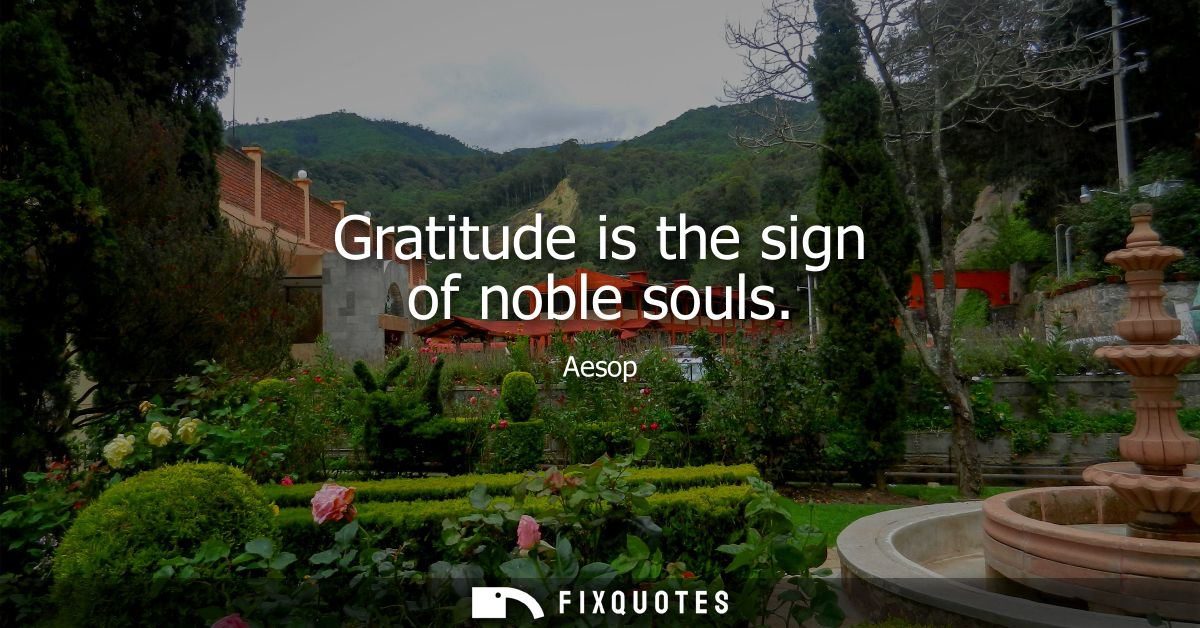
"Gratitude is the sign of noble souls"
About this Quote
Gratitude isn’t framed here as a polite accessory; it’s a class marker. Aesop’s line turns a soft social gesture into a hard moral diagnostic: if you can give thanks, you’re not merely well-mannered, you’re “noble.” The word choice matters. “Sign” implies evidence, not performance; gratitude is treated like a symptom you can’t fake for long. “Noble souls” shifts nobility away from bloodlines and into inner life, a quiet democratic sabotage of aristocratic status. In a world where rank was inherited and power was loud, Aesop suggests the real hierarchy is psychological.
The subtext is sharper than it looks. Gratitude requires admitting dependence, which bruises ego. To thank someone is to concede you didn’t do it all yourself, that you were helped, spared, gifted. That’s why Aesop links gratitude to nobility: it takes strength to be unembarrassed by obligation. The petty person keeps score; the “noble” person recognizes a gift without turning it into a debt contract.
Contextually, this fits Aesop’s broader project: moral education through simple stories aimed at people without formal power. Many fables hinge on reciprocity betrayed or honored, warning that social life collapses when benefits are met with entitlement. Read this way, gratitude becomes a social technology. It oils alliances, curbs resentment, and publicly acknowledges invisible labor. Aesop isn’t selling sentiment; he’s outlining how character shows up under the pressure of receiving.
The subtext is sharper than it looks. Gratitude requires admitting dependence, which bruises ego. To thank someone is to concede you didn’t do it all yourself, that you were helped, spared, gifted. That’s why Aesop links gratitude to nobility: it takes strength to be unembarrassed by obligation. The petty person keeps score; the “noble” person recognizes a gift without turning it into a debt contract.
Contextually, this fits Aesop’s broader project: moral education through simple stories aimed at people without formal power. Many fables hinge on reciprocity betrayed or honored, warning that social life collapses when benefits are met with entitlement. Read this way, gratitude becomes a social technology. It oils alliances, curbs resentment, and publicly acknowledges invisible labor. Aesop isn’t selling sentiment; he’s outlining how character shows up under the pressure of receiving.
Quote Details
| Topic | Gratitude |
|---|---|
| Source | Help us find the source |
| Cite |
Citation Formats
APA Style (7th ed.)
Aesop. (2026, January 17). Gratitude is the sign of noble souls. FixQuotes. https://fixquotes.com/quotes/gratitude-is-the-sign-of-noble-souls-63382/
Chicago Style
Aesop. "Gratitude is the sign of noble souls." FixQuotes. January 17, 2026. https://fixquotes.com/quotes/gratitude-is-the-sign-of-noble-souls-63382/.
MLA Style (9th ed.)
"Gratitude is the sign of noble souls." FixQuotes, 17 Jan. 2026, https://fixquotes.com/quotes/gratitude-is-the-sign-of-noble-souls-63382/. Accessed 21 Mar. 2026.
More Quotes by Aesop
Add to List