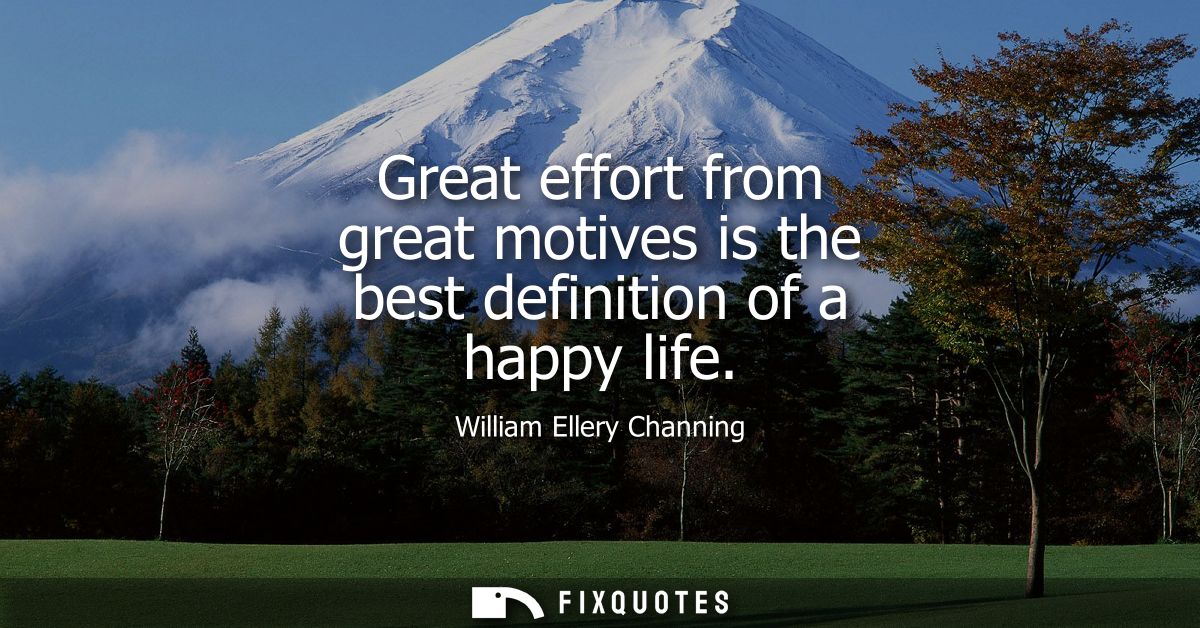
"Great effort from great motives is the best definition of a happy life"
About this Quote
Happiness, for Channing, isn’t a mood you stumble into; it’s the afterglow of moral exertion. “Great effort from great motives” turns the sentimental pursuit of happiness into something closer to conscience-work: a life measured less by comfort than by the integrity of what drives you. The line is built like a Puritan engine - effort first, motive as the fuel, happiness as the byproduct. That ordering matters. It quietly demotes pleasure, luck, even “success” to secondary status, and promotes the inner ledger: Why did you do it? What did it cost you?
Channing was a leading Unitarian voice in early-19th-century America, writing against both Calvinist despair and a culture already flirting with self-help optimism. His intent is reformist: rescue happiness from mere gratification and tie it to character, agency, and social responsibility. The subtext is a rebuke to lives that are busy but hollow - ambition without ethics, productivity without purpose. “Great motives” implies a hierarchy of desires, and by extension a moral critique of the era’s market churn: you can work hard and still live poorly if the motive is small.
What makes the sentence work is its disciplined compression. It offers a definition, not advice, which gives it authority; yet it’s also aspirational, because “great” is a moving target. Channing leaves you with a provocative standard: if you’re unhappy, it’s not only about what happened to you, but about what you’ve decided your life is for.
Channing was a leading Unitarian voice in early-19th-century America, writing against both Calvinist despair and a culture already flirting with self-help optimism. His intent is reformist: rescue happiness from mere gratification and tie it to character, agency, and social responsibility. The subtext is a rebuke to lives that are busy but hollow - ambition without ethics, productivity without purpose. “Great motives” implies a hierarchy of desires, and by extension a moral critique of the era’s market churn: you can work hard and still live poorly if the motive is small.
What makes the sentence work is its disciplined compression. It offers a definition, not advice, which gives it authority; yet it’s also aspirational, because “great” is a moving target. Channing leaves you with a provocative standard: if you’re unhappy, it’s not only about what happened to you, but about what you’ve decided your life is for.
Quote Details
| Topic | Happiness |
|---|---|
| Source | Help us find the source |
More Quotes by William
Add to List