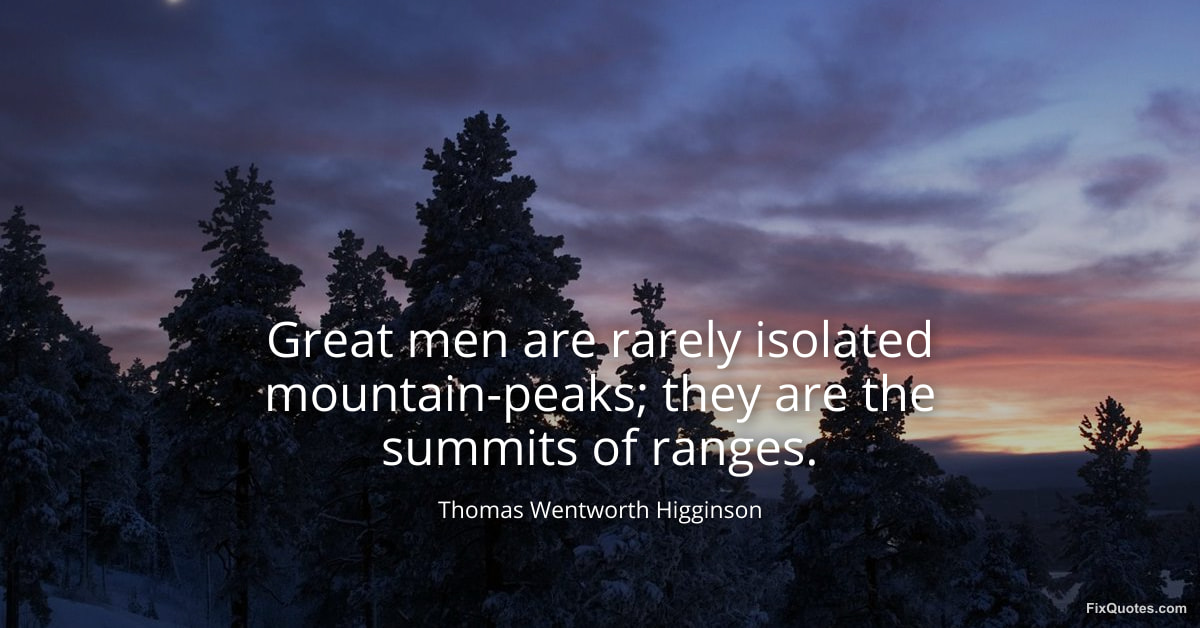
"Great men are rarely isolated mountain-peaks; they are the summits of ranges"
About this Quote
The specific intent is corrective. Higginson isn’t denying individual brilliance; he’s relocating its source. “Rarely isolated” keeps room for the occasional meteor, but the emphasis falls on “ranges” - networks of teachers, institutions, debates, patrons, rivals, and moral climates that make certain kinds of leadership possible and legible. Great men, in his telling, are not self-creating; they are the highest visible point of collective pressure.
The subtext also reads as a quiet rebuke to personality worship. Calling someone a “summit” is flattering, but it also implies dependence: remove the ridge line beneath, and the peak isn’t a peak. In a 19th-century culture increasingly addicted to “great man” history, Higginson offers a counter-theology of influence. Providence, reform, and progress look less like lightning striking one chosen figure and more like a slow accumulation of forces that finally breaks the surface in a person we can name.
Quote Details
| Topic | Leadership |
|---|---|
| Source | Help us find the source |
| Cite |
Citation Formats
APA Style (7th ed.)
Higginson, Thomas Wentworth. (2026, January 16). Great men are rarely isolated mountain-peaks; they are the summits of ranges. FixQuotes. https://fixquotes.com/quotes/great-men-are-rarely-isolated-mountain-peaks-they-125449/
Chicago Style
Higginson, Thomas Wentworth. "Great men are rarely isolated mountain-peaks; they are the summits of ranges." FixQuotes. January 16, 2026. https://fixquotes.com/quotes/great-men-are-rarely-isolated-mountain-peaks-they-125449/.
MLA Style (9th ed.)
"Great men are rarely isolated mountain-peaks; they are the summits of ranges." FixQuotes, 16 Jan. 2026, https://fixquotes.com/quotes/great-men-are-rarely-isolated-mountain-peaks-they-125449/. Accessed 1 Apr. 2026.