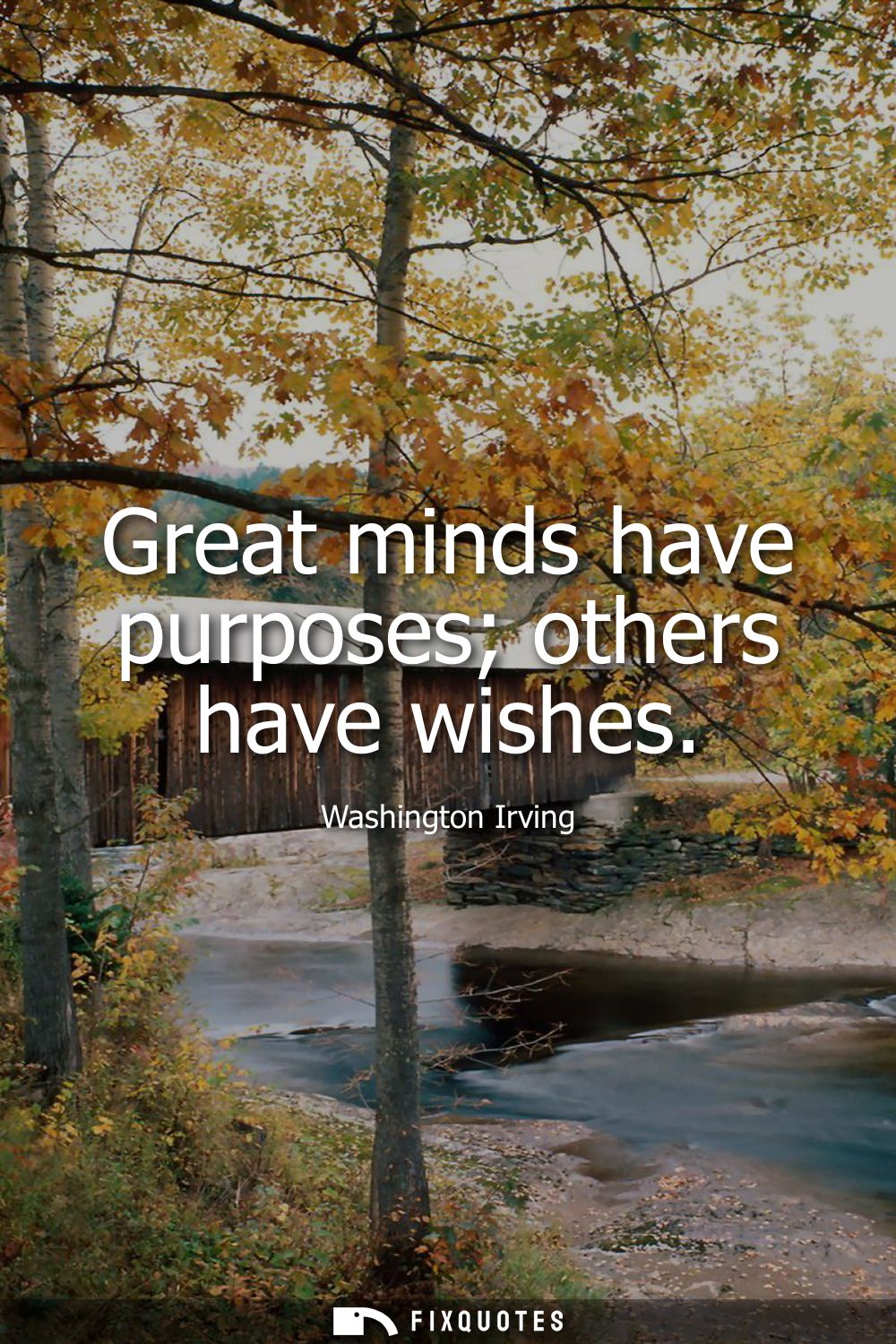
"Great minds have purposes; others have wishes"
About this Quote
Irving draws a razor-thin line that still cuts: purpose versus wish. The elegance is in how quickly it turns a flattering category ("great minds") into a behavioral standard. He is not praising IQ, education, or even talent. He is praising agency. A purpose implies architecture: an end, a plan, a willingness to trade comfort for coherence. A wish is frictionless. It costs nothing, demands nothing, and therefore carries no proof of character.
The subtext is moral, almost Calvinist in its suspicion of idle yearning. Irving wrote in an early American culture that prized self-making and distrusted aristocratic entitlement. "Wishes" sound like the old world: hoping for favor, luck, inheritance, destiny. "Purposes" sound like the new: deliberate effort, chosen direction, the Protestant work ethic smuggled into a single sentence. He frames it as a mental difference, but the real target is a cultural one: the temptation to confuse desire with commitment.
Rhetorically, the quote works because it offers a clean binary that readers can’t comfortably sit outside. Nobody wants to be filed under "others". That little word is doing heavy social work, turning the line into a quiet insult and a dare. It's also shrewdly aspirational: "great minds" becomes less a birthright than a practice. You can move categories, but only by turning your wants into decisions that have consequences.
The subtext is moral, almost Calvinist in its suspicion of idle yearning. Irving wrote in an early American culture that prized self-making and distrusted aristocratic entitlement. "Wishes" sound like the old world: hoping for favor, luck, inheritance, destiny. "Purposes" sound like the new: deliberate effort, chosen direction, the Protestant work ethic smuggled into a single sentence. He frames it as a mental difference, but the real target is a cultural one: the temptation to confuse desire with commitment.
Rhetorically, the quote works because it offers a clean binary that readers can’t comfortably sit outside. Nobody wants to be filed under "others". That little word is doing heavy social work, turning the line into a quiet insult and a dare. It's also shrewdly aspirational: "great minds" becomes less a birthright than a practice. You can move categories, but only by turning your wants into decisions that have consequences.
Quote Details
| Topic | Motivational |
|---|---|
| Source | Quote as attributed to Washington Irving — listed on Wikiquote: "Great minds have purposes; others have wishes." (Wikiquote: Washington Irving) |
| Cite |
Citation Formats
APA Style (7th ed.)
Irving, Washington. (2026, January 18). Great minds have purposes; others have wishes. FixQuotes. https://fixquotes.com/quotes/great-minds-have-purposes-others-have-wishes-2286/
Chicago Style
Irving, Washington. "Great minds have purposes; others have wishes." FixQuotes. January 18, 2026. https://fixquotes.com/quotes/great-minds-have-purposes-others-have-wishes-2286/.
MLA Style (9th ed.)
"Great minds have purposes; others have wishes." FixQuotes, 18 Jan. 2026, https://fixquotes.com/quotes/great-minds-have-purposes-others-have-wishes-2286/. Accessed 31 Mar. 2026.
More Quotes by Washington
Add to List