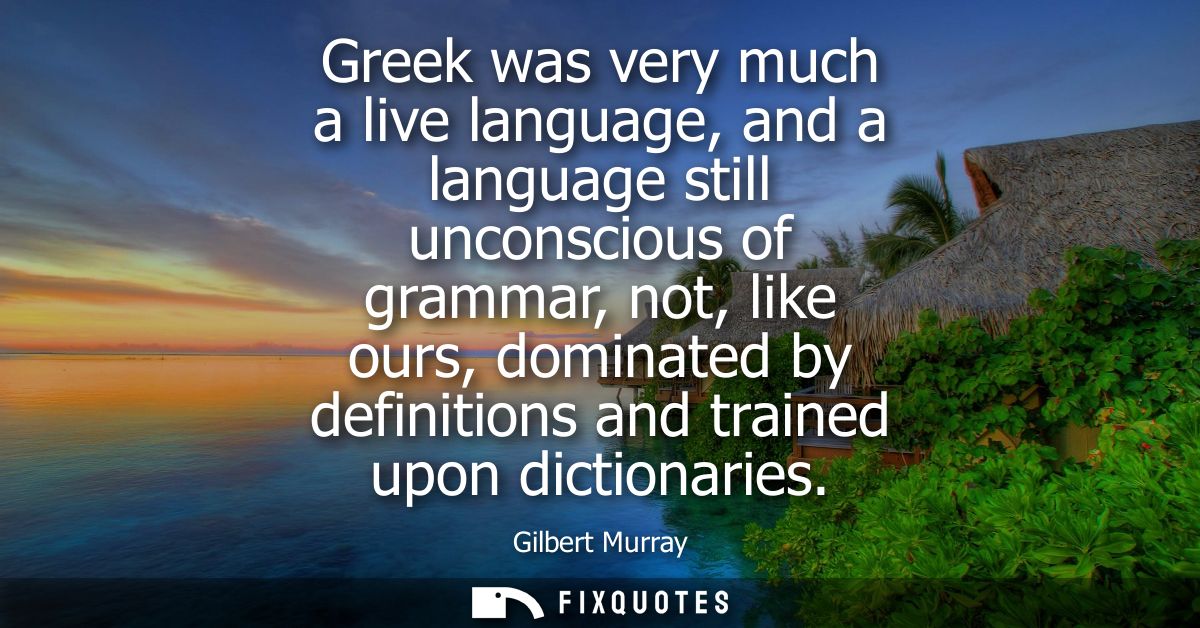
"Greek was very much a live language, and a language still unconscious of grammar, not, like ours, dominated by definitions and trained upon dictionaries"
About this Quote
The subtext is about power. "Dominated" and "trained" are the verbs of discipline, suggesting a modern culture that mistrusts improvisation and prefers standardization, credentialing, and textual authority. Murray is praising Greek not only for its expressiveness, but for the social world it implies: speakers oriented toward rhetoric, debate, and public life, less toward bureaucratic correctness. That idealization fits a certain early-20th-century classicist mood, where antiquity becomes a mirror for anxieties about mechanization, mass education, and administrative modernity.
Context matters: Murray was a celebrated Hellenist as well as a diplomat, and diplomacy lives or dies on nuance, ambiguity, and the strategic use of language. His admiration for a "live language" doubles as a professional yearning for speech that can move quickly, persuade, and adapt, unhampered by the anxious micromanagement of words. It's not just nostalgia; it's a warning about what gets lost when language becomes a compliance system.
Quote Details
| Topic | Knowledge |
|---|---|
| Source | Help us find the source |
| Cite |
Citation Formats
APA Style (7th ed.)
Murray, Gilbert. (2026, January 16). Greek was very much a live language, and a language still unconscious of grammar, not, like ours, dominated by definitions and trained upon dictionaries. FixQuotes. https://fixquotes.com/quotes/greek-was-very-much-a-live-language-and-a-132835/
Chicago Style
Murray, Gilbert. "Greek was very much a live language, and a language still unconscious of grammar, not, like ours, dominated by definitions and trained upon dictionaries." FixQuotes. January 16, 2026. https://fixquotes.com/quotes/greek-was-very-much-a-live-language-and-a-132835/.
MLA Style (9th ed.)
"Greek was very much a live language, and a language still unconscious of grammar, not, like ours, dominated by definitions and trained upon dictionaries." FixQuotes, 16 Jan. 2026, https://fixquotes.com/quotes/greek-was-very-much-a-live-language-and-a-132835/. Accessed 14 Feb. 2026.