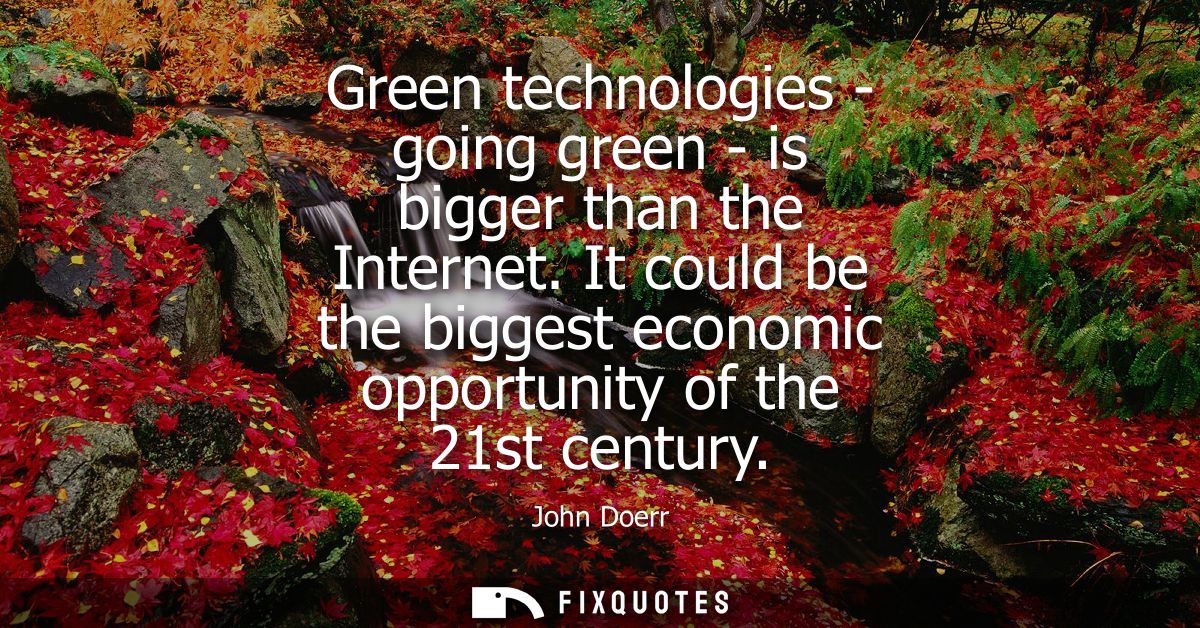
"Green technologies - going green - is bigger than the Internet. It could be the biggest economic opportunity of the 21st century"
About this Quote
The subtext is capital discipline dressed as planetary urgency. “Biggest economic opportunity” is doing double duty: it dignifies decarbonization while reassuring markets that this isn’t about sacrifice. Doerr’s phrasing also quietly rebukes the incrementalism that dominated earlier environmental discourse. “Going green” is positioned as industrial strategy, not lifestyle branding, and that matters because the bottleneck isn’t public awareness, it’s deployment at scale.
Context sharpens the pitch. Doerr helped bankroll companies like Google and later made climate a marquee cause in Silicon Valley and beyond. By invoking the Internet, he’s speaking to an audience trained to believe that technology plus venture funding can bend history quickly. It’s persuasive because it’s not asking for belief in climate science; it’s asking for belief in a familiar kind of winner-take-most transformation. The risk, of course, is that it imports the Internet era’s blind spots: growth-at-all-costs narratives and an underestimation of regulation, supply chains, and geopolitics. Still, as a recruiting slogan for capital and talent, it’s engineered to convert anxiety into ambition.
Quote Details
| Topic | Technology |
|---|---|
| Source | Verified source: Salvation (and profit) in greentech (John Doerr, 2007)
Evidence: Well, I'll tell you what. Green technologies -- going green -- is bigger than the Internet. It could be the biggest economic opportunity of the 21st century.. This wording appears in the transcript of John Doerr’s TED2007 talk, recorded at TED2007 in March 2007 and published on TED.com as “Salvation (and profit) in greentech.” The version you provided matches this passage aside from minor punctuation/formatting differences (dash style and capitalization). I did not find credible evidence of an earlier primary-source publication/speech containing this exact two-sentence formulation; most later attributions appear to quote or paraphrase this TED talk. Other candidates (1) Understanding Green Business (Nik Tehrani, 2011) compilation96.0% ... Green technologies - going green - is bigger than the Internet . It could be the biggest economic opportunity of ... |
| Cite |
Citation Formats
APA Style (7th ed.)
Doerr, John. (2026, February 14). Green technologies - going green - is bigger than the Internet. It could be the biggest economic opportunity of the 21st century. FixQuotes. https://fixquotes.com/quotes/green-technologies-going-green-is-bigger-than-99484/
Chicago Style
Doerr, John. "Green technologies - going green - is bigger than the Internet. It could be the biggest economic opportunity of the 21st century." FixQuotes. February 14, 2026. https://fixquotes.com/quotes/green-technologies-going-green-is-bigger-than-99484/.
MLA Style (9th ed.)
"Green technologies - going green - is bigger than the Internet. It could be the biggest economic opportunity of the 21st century." FixQuotes, 14 Feb. 2026, https://fixquotes.com/quotes/green-technologies-going-green-is-bigger-than-99484/. Accessed 5 Mar. 2026.