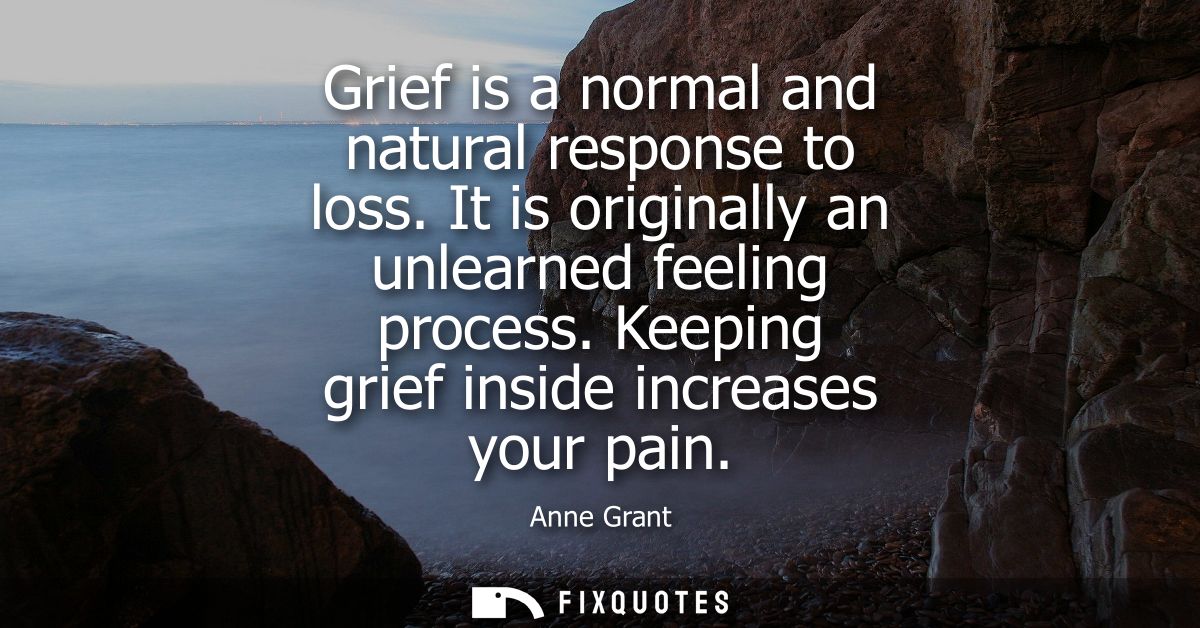
"Grief is a normal and natural response to loss. It is originally an unlearned feeling process. Keeping grief inside increases your pain"
About this Quote
The subtext is quietly insurgent. If grief is “unlearned,” then many of the rules around it are learned, and therefore optional - even suspect. Grant’s phrase “keeping grief inside” reads like an indictment of the stiff-upper-lip ideal: containment isn’t dignity, it’s self-harm. She implies a physics of feeling: pain doesn’t disappear when sealed; it concentrates.
As a poet writing in the late 18th and early 19th centuries, Grant is working in a culture shaped by high mortality, religious consolation, and social surveillance, particularly for women whose public emotional range was tightly policed. Her intent isn’t to romanticize sorrow but to legitimize its expression as a form of care. The sentence structure does that work: calm, declarative, almost clinical, as if she’s smuggling permission into advice. The rhetoric turns confession into something sturdier - a claim about human design.
Quote Details
| Topic | Sadness |
|---|---|
| Source | Help us find the source |
| Cite |
Citation Formats
APA Style (7th ed.)
Grant, Anne. (2026, January 15). Grief is a normal and natural response to loss. It is originally an unlearned feeling process. Keeping grief inside increases your pain. FixQuotes. https://fixquotes.com/quotes/grief-is-a-normal-and-natural-response-to-loss-it-39572/
Chicago Style
Grant, Anne. "Grief is a normal and natural response to loss. It is originally an unlearned feeling process. Keeping grief inside increases your pain." FixQuotes. January 15, 2026. https://fixquotes.com/quotes/grief-is-a-normal-and-natural-response-to-loss-it-39572/.
MLA Style (9th ed.)
"Grief is a normal and natural response to loss. It is originally an unlearned feeling process. Keeping grief inside increases your pain." FixQuotes, 15 Jan. 2026, https://fixquotes.com/quotes/grief-is-a-normal-and-natural-response-to-loss-it-39572/. Accessed 30 Mar. 2026.