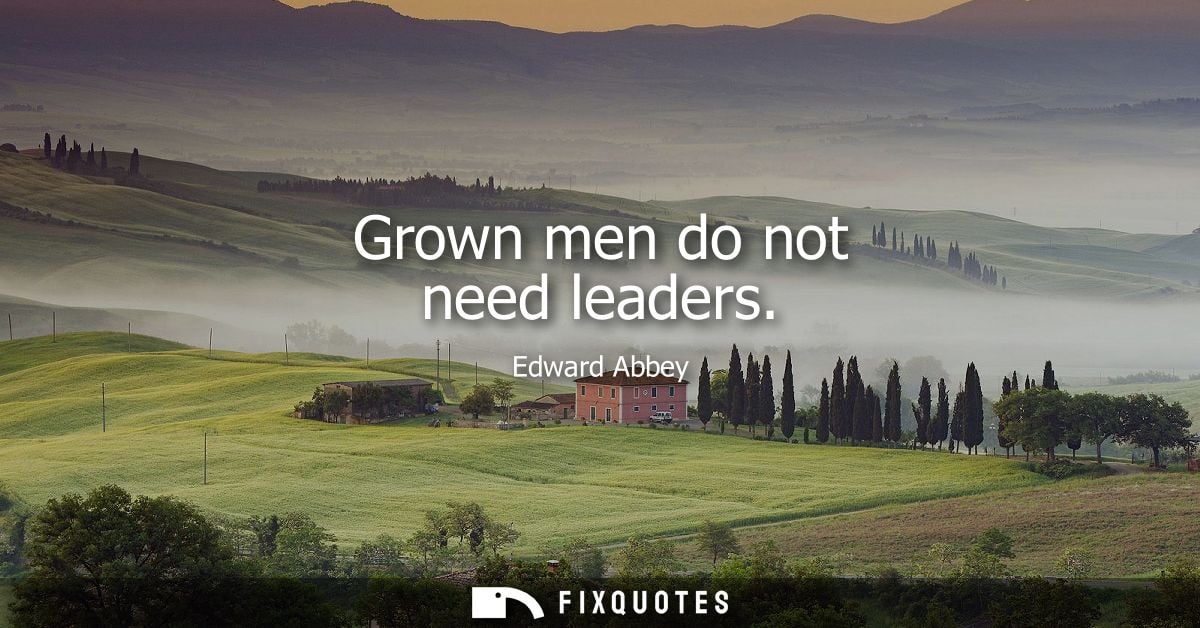
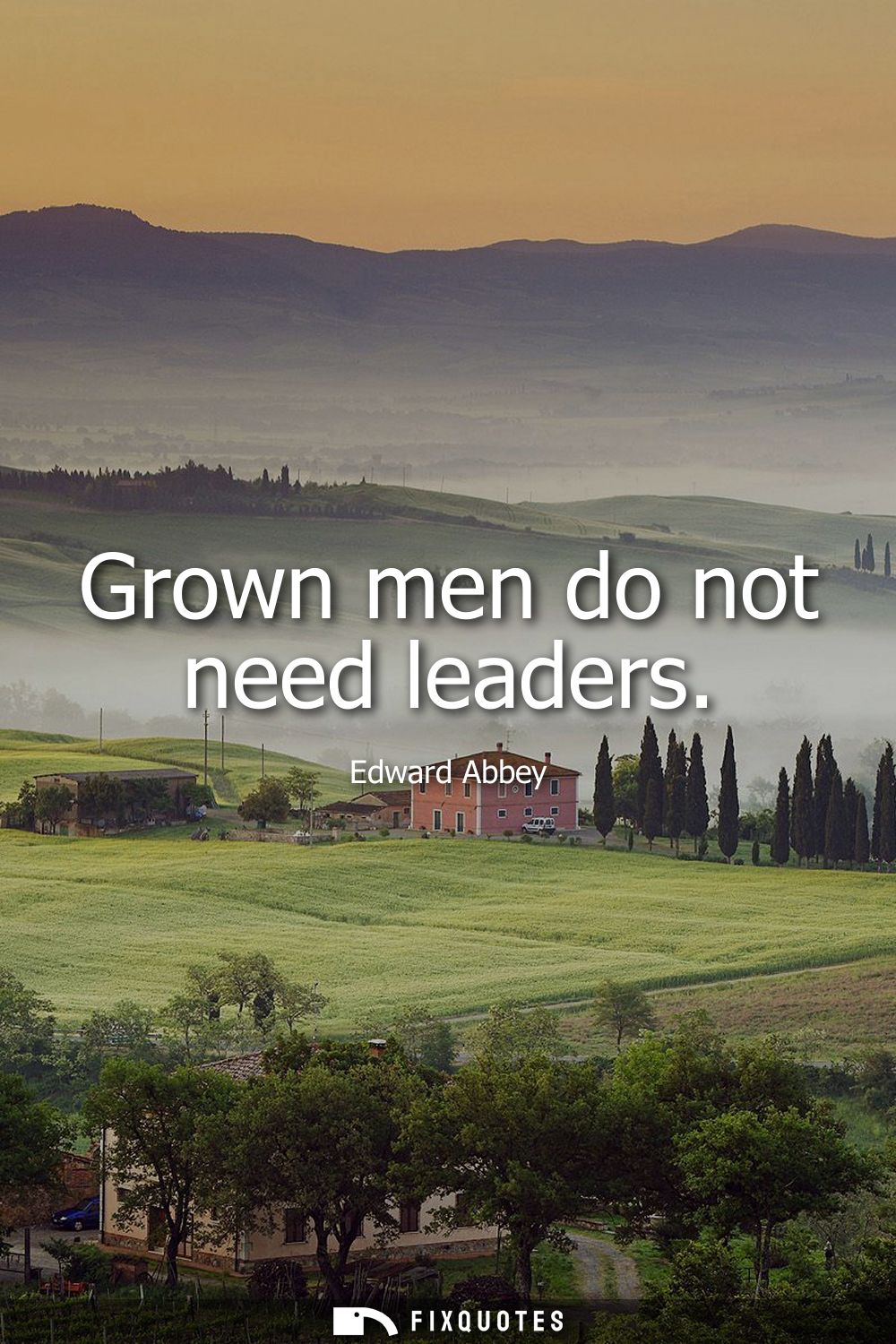
"Grown men do not need leaders"
About this Quote
Abbey’s line lands like a slap at the whole managerial mood of modern life: the assumption that adulthood automatically comes with supervision. “Grown men do not need leaders” isn’t gentle self-help; it’s a provocation aimed at citizens who’ve been trained to confuse delegation with maturity. The phrasing is deliberately blunt, almost parental in reverse: if you’re grown, act like it.
The intent is less anti-organization than anti-infantilization. Abbey’s work, especially in the context of midcentury America’s expanding bureaucracies and the rise of technocratic expertise, treats “leaders” as a symptom of a deeper sickness: people surrendering their agency because it’s easier, safer, or socially rewarded. The subtext is that leadership often functions as a moral alibi. If a “leader” chose the path, you can walk it without owning it.
There’s also a barb embedded in the gendered “men.” Abbey is speaking from an era and persona that equates adulthood with a rugged, self-reliant masculinity. Read today, it’s both clarifying and limiting: clarifying because it names a real dependency culture; limiting because it treats autonomy as a macho virtue rather than a civic one.
What makes the sentence work is its refusal to negotiate with our fondness for hierarchy. It doesn’t ask whether leaders can be good; it asks why you’re looking for one in the first place.
The intent is less anti-organization than anti-infantilization. Abbey’s work, especially in the context of midcentury America’s expanding bureaucracies and the rise of technocratic expertise, treats “leaders” as a symptom of a deeper sickness: people surrendering their agency because it’s easier, safer, or socially rewarded. The subtext is that leadership often functions as a moral alibi. If a “leader” chose the path, you can walk it without owning it.
There’s also a barb embedded in the gendered “men.” Abbey is speaking from an era and persona that equates adulthood with a rugged, self-reliant masculinity. Read today, it’s both clarifying and limiting: clarifying because it names a real dependency culture; limiting because it treats autonomy as a macho virtue rather than a civic one.
What makes the sentence work is its refusal to negotiate with our fondness for hierarchy. It doesn’t ask whether leaders can be good; it asks why you’re looking for one in the first place.
Quote Details
| Topic | Leadership |
|---|---|
| Source | Help us find the source |
| Cite |
Citation Formats
APA Style (7th ed.)
Abbey, Edward. (2026, January 17). Grown men do not need leaders. FixQuotes. https://fixquotes.com/quotes/grown-men-do-not-need-leaders-46159/
Chicago Style
Abbey, Edward. "Grown men do not need leaders." FixQuotes. January 17, 2026. https://fixquotes.com/quotes/grown-men-do-not-need-leaders-46159/.
MLA Style (9th ed.)
"Grown men do not need leaders." FixQuotes, 17 Jan. 2026, https://fixquotes.com/quotes/grown-men-do-not-need-leaders-46159/. Accessed 27 Mar. 2026.
More Quotes by Edward
Add to List