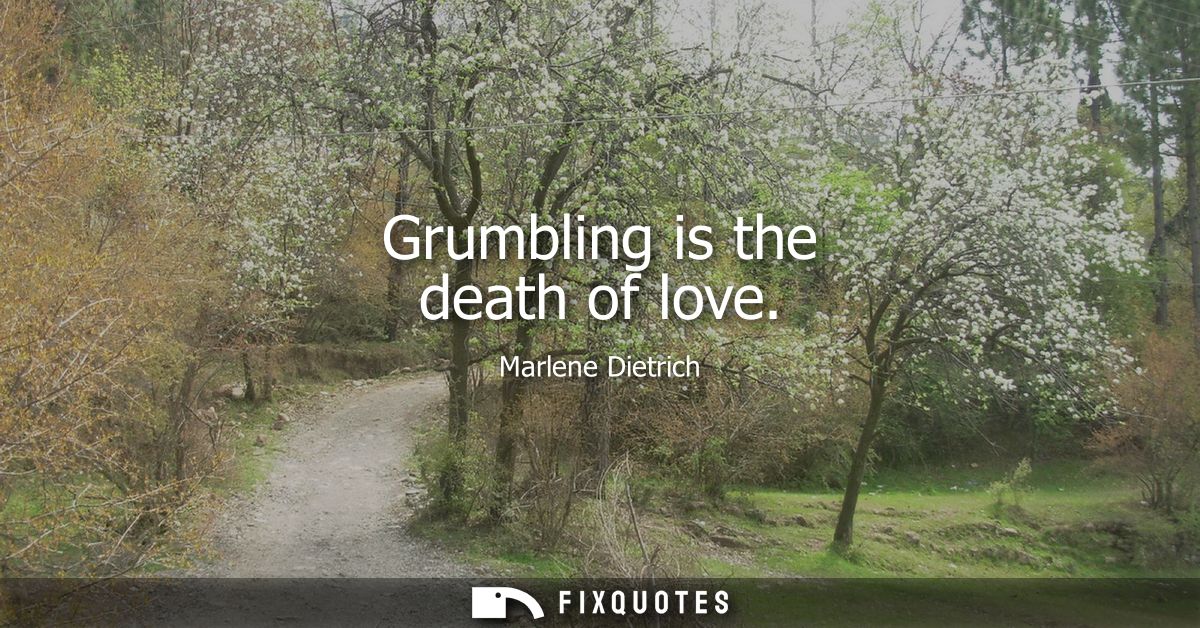
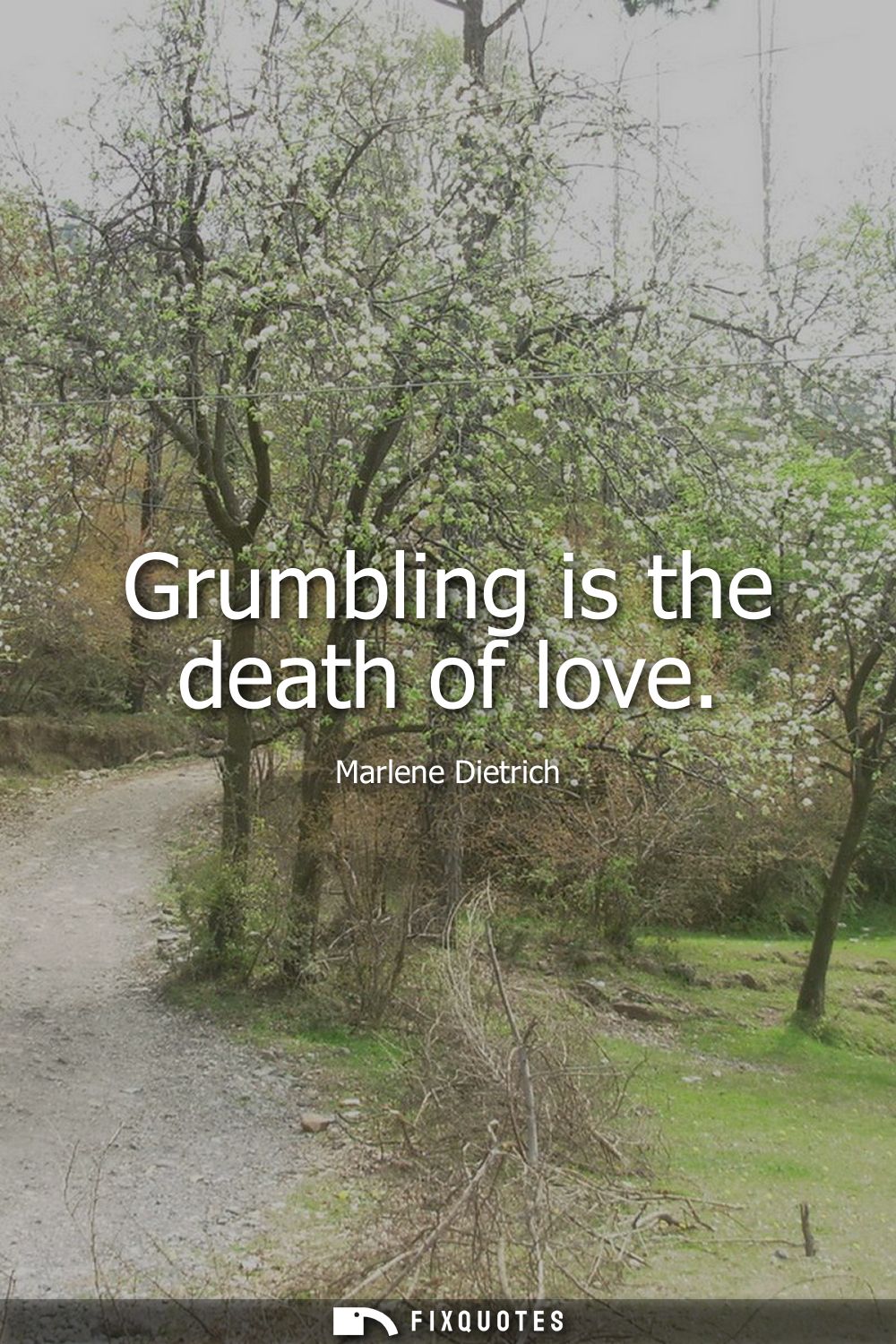
"Grumbling is the death of love"
About this Quote
Dietrich’s line lands like a cigarette flicked onto a white tablecloth: small, elegant, quietly destructive. “Grumbling” isn’t rage or betrayal; it’s the low-grade, domestic soundtrack of disappointment. By choosing that word, she targets the most corrosive kind of negativity precisely because it masquerades as harmless. Grumbling is repetitive, petty, performative. It turns intimacy into a complaints department, and love into a running audit of who failed to anticipate what.
The phrase “death of love” is melodramatic on purpose, but it isn’t romantic fluff. Dietrich, a star who built her persona on control, poise, and a famously unsentimental intelligence about desire, frames love as something that can be killed by habit. Not by one scandalous moment, but by an accumulation of tiny contempt. That’s the subtext: grumbling is often the socially acceptable way to express disdain without owning it. It keeps the relationship in a permanent minor key, where nothing is quite wrong enough to address directly, but everything is wrong enough to sour.
Coming from an actress whose public life moved between stage-managed glamour and private turbulence, the quote reads less like advice and more like an ethic of style. Don’t whine; don’t erode. Either speak plainly or stay silent, because constant low-level complaint makes affection feel like work and attention feel like debt. Dietrich’s intent is both practical and theatrical: protect love by refusing to rehearse dissatisfaction every day.
The phrase “death of love” is melodramatic on purpose, but it isn’t romantic fluff. Dietrich, a star who built her persona on control, poise, and a famously unsentimental intelligence about desire, frames love as something that can be killed by habit. Not by one scandalous moment, but by an accumulation of tiny contempt. That’s the subtext: grumbling is often the socially acceptable way to express disdain without owning it. It keeps the relationship in a permanent minor key, where nothing is quite wrong enough to address directly, but everything is wrong enough to sour.
Coming from an actress whose public life moved between stage-managed glamour and private turbulence, the quote reads less like advice and more like an ethic of style. Don’t whine; don’t erode. Either speak plainly or stay silent, because constant low-level complaint makes affection feel like work and attention feel like debt. Dietrich’s intent is both practical and theatrical: protect love by refusing to rehearse dissatisfaction every day.
Quote Details
| Topic | Love |
|---|---|
| Source | Help us find the source |
| Cite |
Citation Formats
APA Style (7th ed.)
Dietrich, Marlene. (2026, January 15). Grumbling is the death of love. FixQuotes. https://fixquotes.com/quotes/grumbling-is-the-death-of-love-164231/
Chicago Style
Dietrich, Marlene. "Grumbling is the death of love." FixQuotes. January 15, 2026. https://fixquotes.com/quotes/grumbling-is-the-death-of-love-164231/.
MLA Style (9th ed.)
"Grumbling is the death of love." FixQuotes, 15 Jan. 2026, https://fixquotes.com/quotes/grumbling-is-the-death-of-love-164231/. Accessed 28 Mar. 2026.
More Quotes by Marlene
Add to List