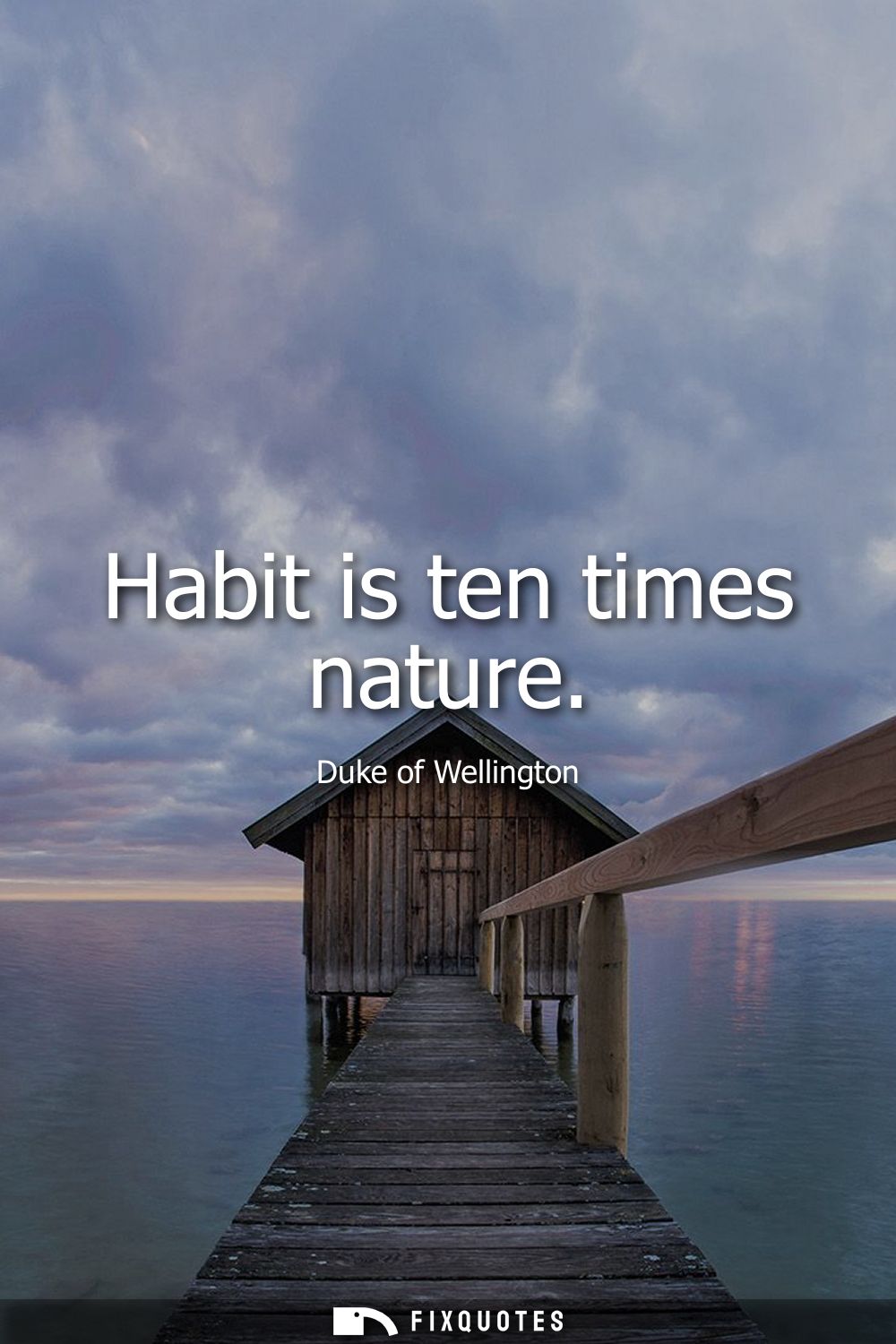
"Habit is ten times nature"
About this Quote
Habit, Wellington is implying, doesn t merely polish nature; it steamrolls it. The line carries the clipped authority of a man who watched whole armies succeed or fail on the strength of drill, not inspiration. Coming from the Duke of Wellington, it reads less like a philosophical musing than a field report: under pressure, what you have practiced is what you become.
The rhetoric is deceptively spare. "Ten times" isn t a poetic flourish so much as a commander s way of quantifying a truth people prefer to sentimentalize. Nature suggests innate talent, temperament, even national character the comforting idea that some people are just built for greatness. Habit reframes greatness as logistics. It s repeatable, enforceable, and, crucially, trainable. The subtext is quietly democratic and quietly ruthless: whatever advantages you think you were born with will be outpaced by someone who shows up every day and does the work. It also warns the other direction. Bad habits can overrun good instincts with the same brutal efficiency.
Context matters. Wellington s career was forged in the Napoleonic era, when war was becoming modern: mass mobilization, standardized training, coordinated operations. In that world, "nature" is unreliable. Courage without discipline becomes chaos; brilliance without routine becomes improvisation. The quote doubles as a governing principle, too: for elites, for institutions, for a state trying to hold itself together. Character is policy, repeated until it feels inevitable.
The rhetoric is deceptively spare. "Ten times" isn t a poetic flourish so much as a commander s way of quantifying a truth people prefer to sentimentalize. Nature suggests innate talent, temperament, even national character the comforting idea that some people are just built for greatness. Habit reframes greatness as logistics. It s repeatable, enforceable, and, crucially, trainable. The subtext is quietly democratic and quietly ruthless: whatever advantages you think you were born with will be outpaced by someone who shows up every day and does the work. It also warns the other direction. Bad habits can overrun good instincts with the same brutal efficiency.
Context matters. Wellington s career was forged in the Napoleonic era, when war was becoming modern: mass mobilization, standardized training, coordinated operations. In that world, "nature" is unreliable. Courage without discipline becomes chaos; brilliance without routine becomes improvisation. The quote doubles as a governing principle, too: for elites, for institutions, for a state trying to hold itself together. Character is policy, repeated until it feels inevitable.
Quote Details
| Topic | Habits |
|---|---|
| Source | Help us find the source |
| Cite |
Citation Formats
APA Style (7th ed.)
Wellington, Duke of. (2026, January 18). Habit is ten times nature. FixQuotes. https://fixquotes.com/quotes/habit-is-ten-times-nature-17300/
Chicago Style
Wellington, Duke of. "Habit is ten times nature." FixQuotes. January 18, 2026. https://fixquotes.com/quotes/habit-is-ten-times-nature-17300/.
MLA Style (9th ed.)
"Habit is ten times nature." FixQuotes, 18 Jan. 2026, https://fixquotes.com/quotes/habit-is-ten-times-nature-17300/. Accessed 30 Mar. 2026.
More Quotes by Duke
Add to List