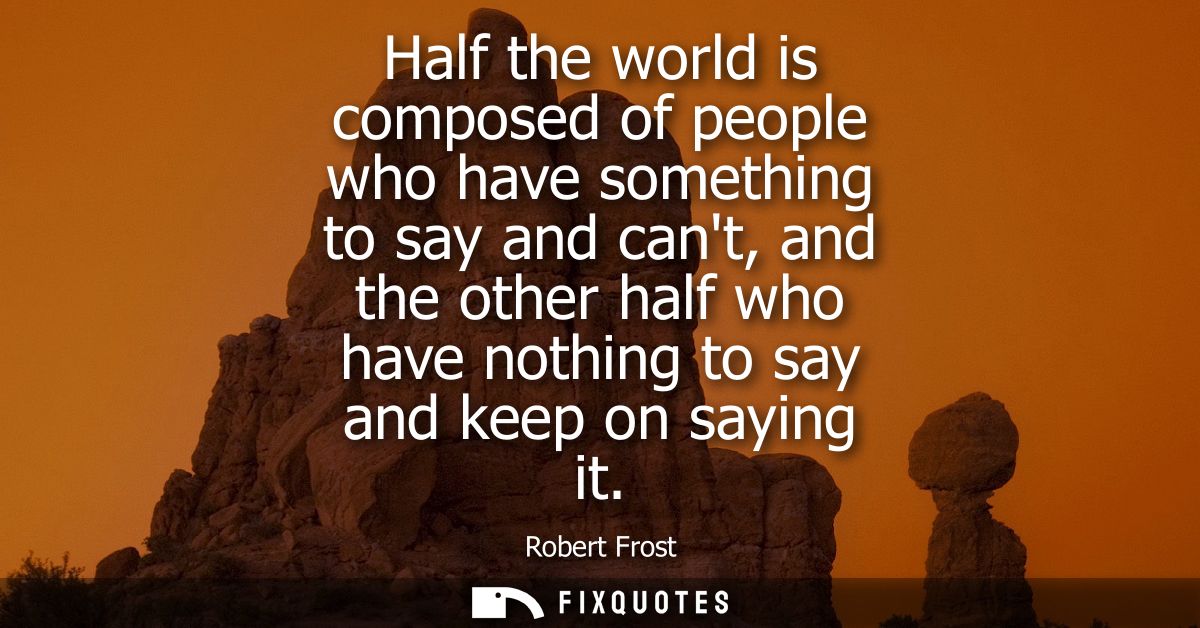
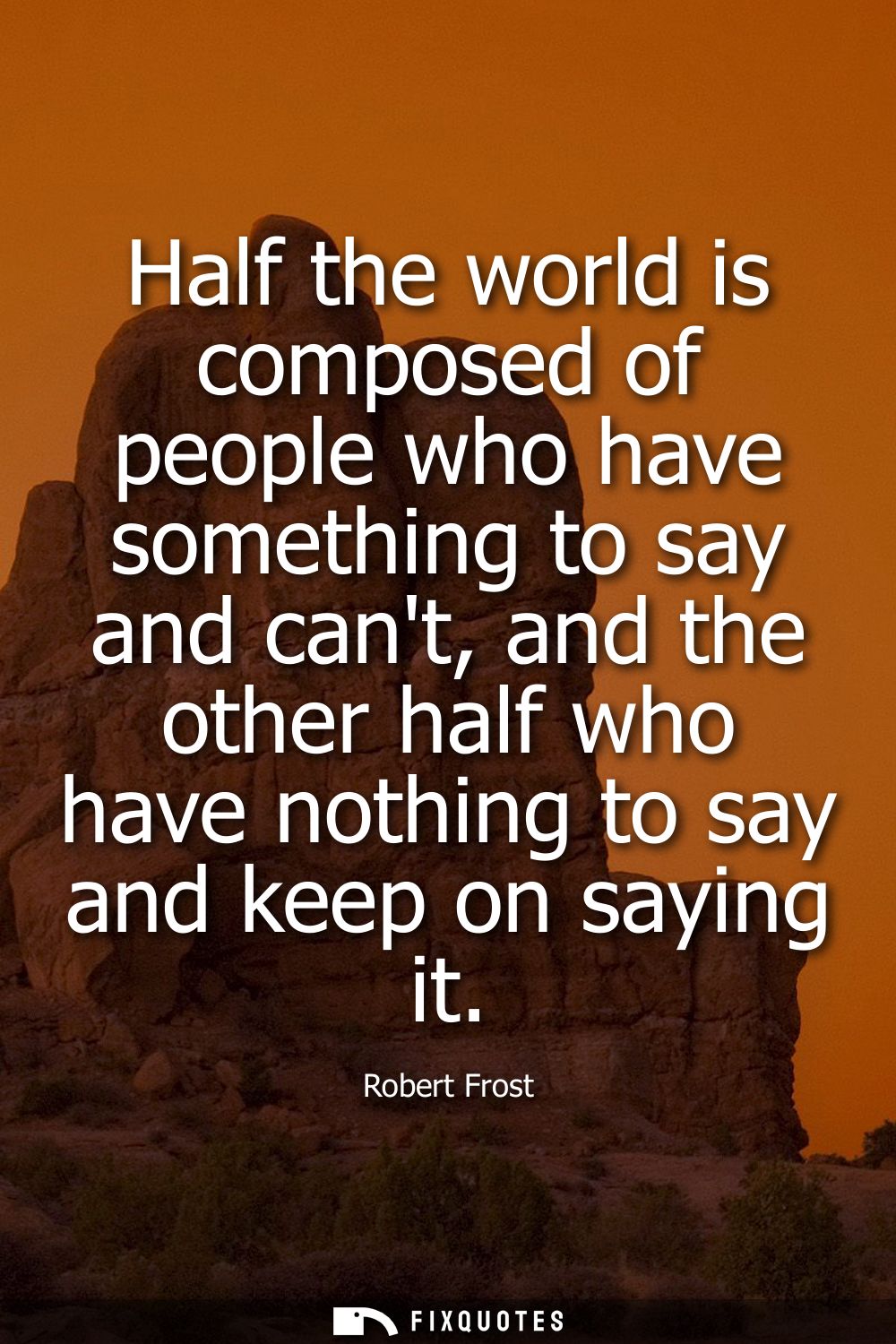
"Half the world is composed of people who have something to say and can't, and the other half who have nothing to say and keep on saying it"
About this Quote
The first group - people “who have something to say and can’t” - isn’t just the shy. It’s anyone blocked by class, education, trauma, censorship, or the plain mismatch between lived experience and available language. Frost, a poet obsessed with the limits of speech and the loneliness behind ordinary talk, knew how often meaning arrives as pressure without release. There’s compassion hiding inside the complaint: the world loses its best insights because the people who own them lack a microphone, a vocabulary, or permission.
The second group is Frost’s real target: the confidently verbose. “Nothing to say” doesn’t mean empty-headed so much as unearned certainty - opinion substituting for thought, performance for substance. The phrase “keep on saying it” paints speech as inertia, a motor that won’t shut off once attention is granted.
Context matters: Frost wrote in a century of mass media, public relations, and institutional gatekeeping, when “having a voice” became both slogan and commodity. The line still reads like a critique of our feed-driven present, where the inability to speak and the refusal to stop speaking coexist - and reinforce each other.
Quote Details
| Topic | Witty One-Liners |
|---|---|
| Source | Later attribution: Shut Up and Say Something (Karen Friedman, 2010) modern compilationISBN: 9780313385865 · ID: 8HXDEAAAQBAJ
Evidence:
... Half the world is composed of people who have something to say and can't, and the other half who have nothing to say and keep on saying it. —Robert Frost, American poet Not too long ago, I was helping a prominent doctor prepare for an ... |
| Cite |
Citation Formats
APA Style (7th ed.)
Frost, Robert. (2026, February 7). Half the world is composed of people who have something to say and can't, and the other half who have nothing to say and keep on saying it. FixQuotes. https://fixquotes.com/quotes/half-the-world-is-composed-of-people-who-have-28902/
Chicago Style
Frost, Robert. "Half the world is composed of people who have something to say and can't, and the other half who have nothing to say and keep on saying it." FixQuotes. February 7, 2026. https://fixquotes.com/quotes/half-the-world-is-composed-of-people-who-have-28902/.
MLA Style (9th ed.)
"Half the world is composed of people who have something to say and can't, and the other half who have nothing to say and keep on saying it." FixQuotes, 7 Feb. 2026, https://fixquotes.com/quotes/half-the-world-is-composed-of-people-who-have-28902/. Accessed 7 Apr. 2026.