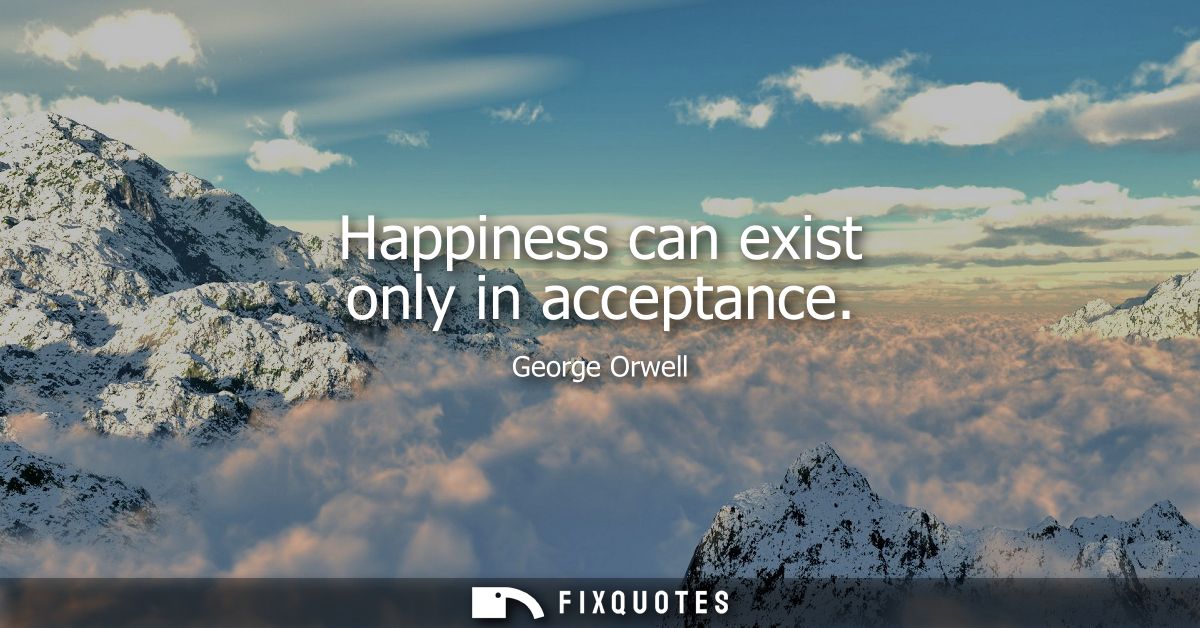
"Happiness can exist only in acceptance"
About this Quote
Orwell’s line reads like a consolation prize you’re not sure you want to accept. “Happiness can exist only in acceptance” sounds gentle on the surface, but it carries the cold logic of someone who watched ideals get crushed by history and propaganda. In Orwell’s world, refusing to accept reality isn’t romantic; it’s self-sabotage. The sentence is built like a trap: “only” slams the door on every other route to happiness (ambition, revolt, fantasy), insisting that peace is less something you earn than something you concede.
The subtext is that happiness isn’t a mood, it’s a negotiation with power and fact. Orwell had seen how totalitarian systems don’t just police behavior, they colonize the inner life; the most chilling victory isn’t forcing obedience, it’s getting people to feel “content” inside their cage. Read that way, “acceptance” becomes morally charged. Is he prescribing a stoic sanity - the adult discipline of facing what is true? Or describing a political horror: that happiness under oppression requires accepting oppression?
Context matters because Orwell is allergic to comforting lies. Across his essays and novels, he treats self-deception as the gateway drug to collective delusion. Acceptance here isn’t “think positive.” It’s the grim clarity that you can’t build a decent life on denial. But it also needles the reader: if happiness depends on acceptance, what happens to the people who can’t accept injustice without becoming complicit? Orwell leaves that tension unresolved on purpose. The line works because it refuses to let happiness stay innocent.
The subtext is that happiness isn’t a mood, it’s a negotiation with power and fact. Orwell had seen how totalitarian systems don’t just police behavior, they colonize the inner life; the most chilling victory isn’t forcing obedience, it’s getting people to feel “content” inside their cage. Read that way, “acceptance” becomes morally charged. Is he prescribing a stoic sanity - the adult discipline of facing what is true? Or describing a political horror: that happiness under oppression requires accepting oppression?
Context matters because Orwell is allergic to comforting lies. Across his essays and novels, he treats self-deception as the gateway drug to collective delusion. Acceptance here isn’t “think positive.” It’s the grim clarity that you can’t build a decent life on denial. But it also needles the reader: if happiness depends on acceptance, what happens to the people who can’t accept injustice without becoming complicit? Orwell leaves that tension unresolved on purpose. The line works because it refuses to let happiness stay innocent.
Quote Details
| Topic | Happiness |
|---|---|
| Source | Help us find the source |
| Cite |
Citation Formats
APA Style (7th ed.)
Orwell, George. (2026, January 14). Happiness can exist only in acceptance. FixQuotes. https://fixquotes.com/quotes/happiness-can-exist-only-in-acceptance-28280/
Chicago Style
Orwell, George. "Happiness can exist only in acceptance." FixQuotes. January 14, 2026. https://fixquotes.com/quotes/happiness-can-exist-only-in-acceptance-28280/.
MLA Style (9th ed.)
"Happiness can exist only in acceptance." FixQuotes, 14 Jan. 2026, https://fixquotes.com/quotes/happiness-can-exist-only-in-acceptance-28280/. Accessed 25 Mar. 2026.
More Quotes by George
Add to List