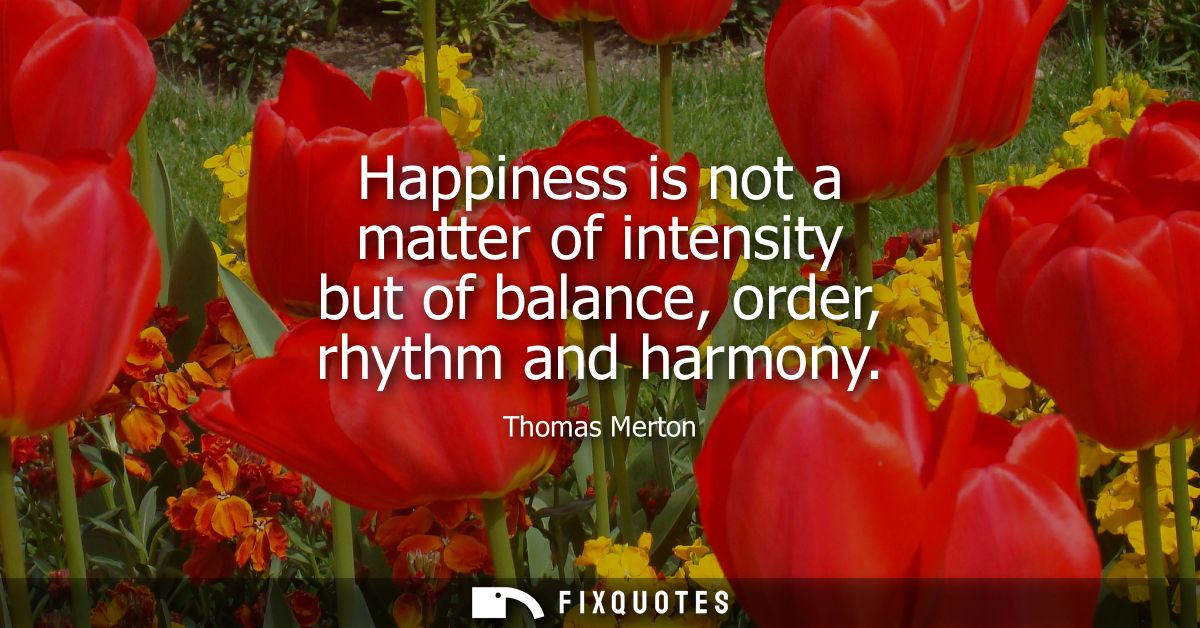
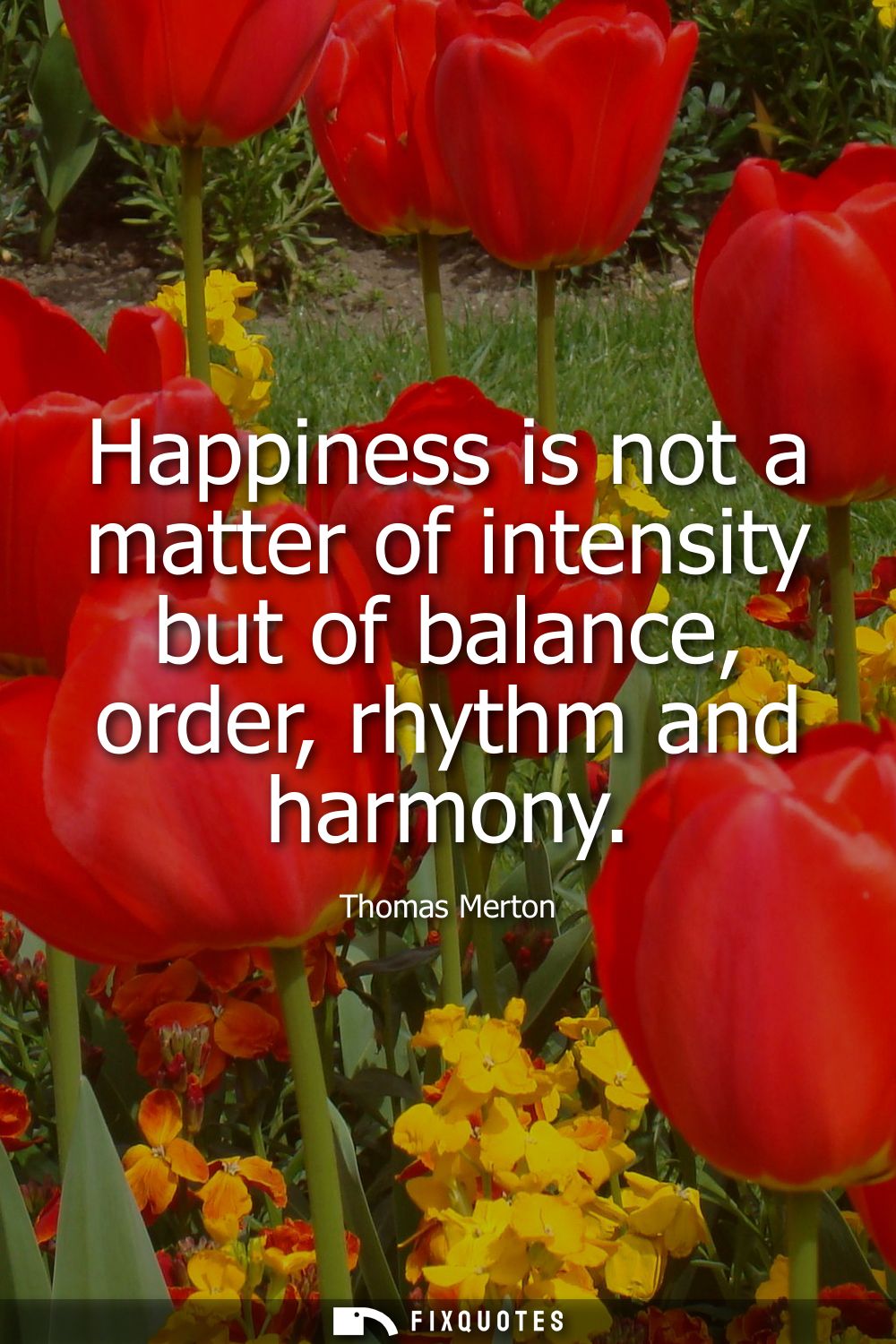
"Happiness is not a matter of intensity, but of balance, order, rhythm, and harmony"
About this Quote
The word choice matters. “Intensity” is solitary, inward, heat-without-shape. “Balance” and “order” are relational; they imply boundaries, proportion, a life with edges. “Rhythm” and “harmony” move the idea from morality to aesthetics: happiness isn’t earned by sheer virtue or willpower, it’s cultivated by aligning disparate parts of the self. Subtext: if you’re miserable, it may not be because you lack passion; it may be because your passions are ungoverned, competing, badly timed. That’s both compassionate and demanding.
Context sharpens the intent. Merton was a Trappist monk writing amid mid-century American abundance and Cold War anxiety, when consumer optimism and existential dread were oddly synchronized. His own spiritual project was to find stillness without deadness, discipline without sterility. The quote reads like advice for modern burnout: the problem isn’t that life is too small, it’s that it’s out of tune. Happiness becomes less a trophy than a practice of attention, a refusal to confuse acceleration with arrival.
Quote Details
| Topic | Happiness |
|---|---|
| Source | Help us find the source |
| Cite |
Citation Formats
APA Style (7th ed.)
Merton, Thomas. (2026, February 20). Happiness is not a matter of intensity, but of balance, order, rhythm, and harmony. FixQuotes. https://fixquotes.com/quotes/happiness-is-not-a-matter-of-intensity-but-of-2080/
Chicago Style
Merton, Thomas. "Happiness is not a matter of intensity, but of balance, order, rhythm, and harmony." FixQuotes. February 20, 2026. https://fixquotes.com/quotes/happiness-is-not-a-matter-of-intensity-but-of-2080/.
MLA Style (9th ed.)
"Happiness is not a matter of intensity, but of balance, order, rhythm, and harmony." FixQuotes, 20 Feb. 2026, https://fixquotes.com/quotes/happiness-is-not-a-matter-of-intensity-but-of-2080/. Accessed 14 Mar. 2026.