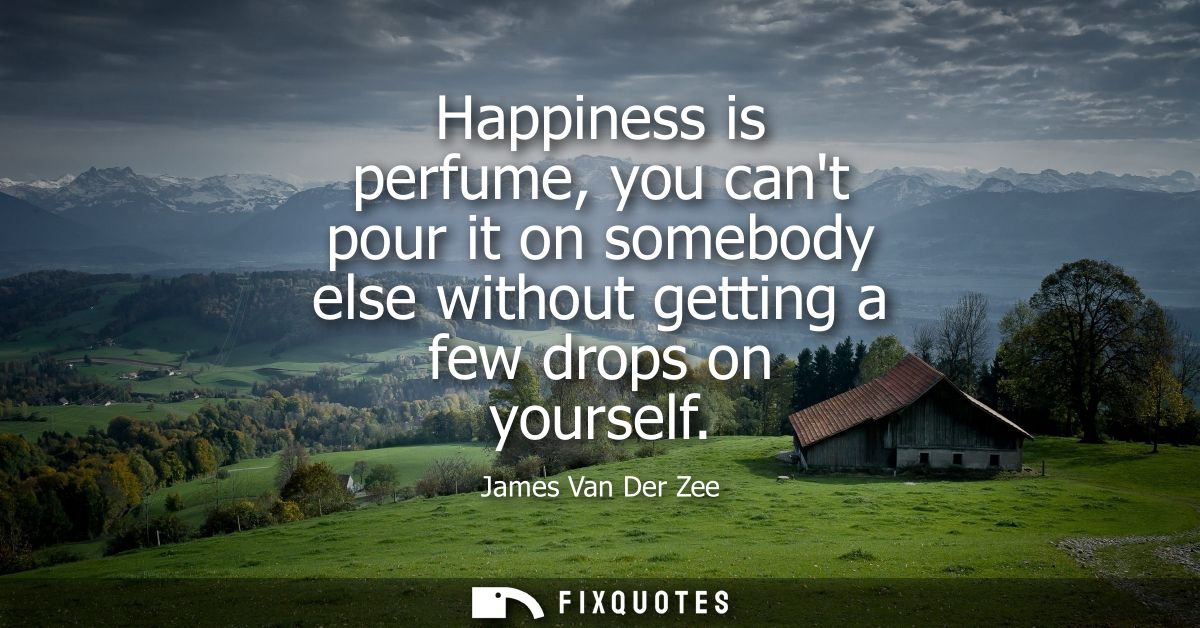
"Happiness is perfume, you can't pour it on somebody else without getting a few drops on yourself"
About this Quote
That metaphor carries a quiet moral argument without sounding preachy. It suggests altruism isn’t pure self-sacrifice; it’s also self-exposure. When you try to brighten someone else’s day, you step into a role - host, encourager, witness - and that role has rewards. The “few drops” implies modesty too: you won’t be drenched in bliss, but you will be affected. It’s a rebuke to the fantasy that emotional labor must be grim or that kindness is always depletion.
Coming from Van Der Zee, a Harlem Renaissance photographer known for dignified portraits and communal pageantry, the line feels like an artist’s ethic. Portraiture is its own kind of perfume: you frame people at their best, you offer them a version of themselves worth believing in, and you don’t walk away untouched. In a world eager to reduce Black life to hardship, his work insisted on elegance, ceremony, and aspiration. The quote’s subtext is almost strategic: happiness can be cultivated, shared, and used as a counterforce - and the sharer, inevitably, gets some of it back.
Quote Details
| Topic | Happiness |
|---|---|
| Source | Help us find the source |
| Cite |
Citation Formats
APA Style (7th ed.)
Zee, James Van Der. (2026, January 15). Happiness is perfume, you can't pour it on somebody else without getting a few drops on yourself. FixQuotes. https://fixquotes.com/quotes/happiness-is-perfume-you-cant-pour-it-on-somebody-161955/
Chicago Style
Zee, James Van Der. "Happiness is perfume, you can't pour it on somebody else without getting a few drops on yourself." FixQuotes. January 15, 2026. https://fixquotes.com/quotes/happiness-is-perfume-you-cant-pour-it-on-somebody-161955/.
MLA Style (9th ed.)
"Happiness is perfume, you can't pour it on somebody else without getting a few drops on yourself." FixQuotes, 15 Jan. 2026, https://fixquotes.com/quotes/happiness-is-perfume-you-cant-pour-it-on-somebody-161955/. Accessed 3 Apr. 2026.