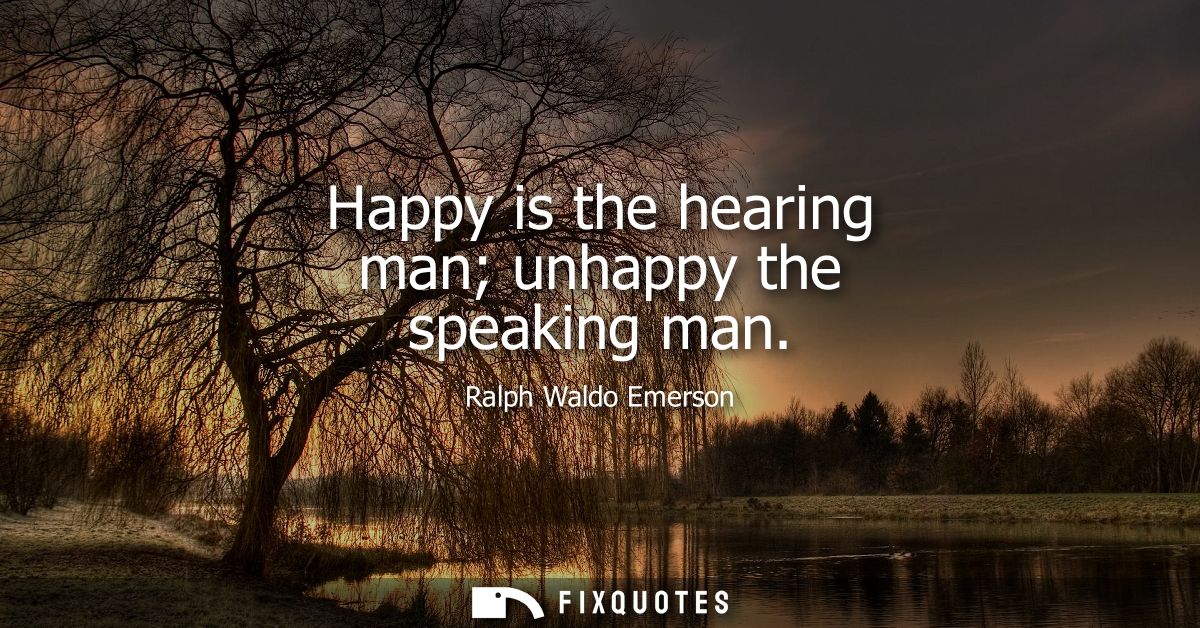
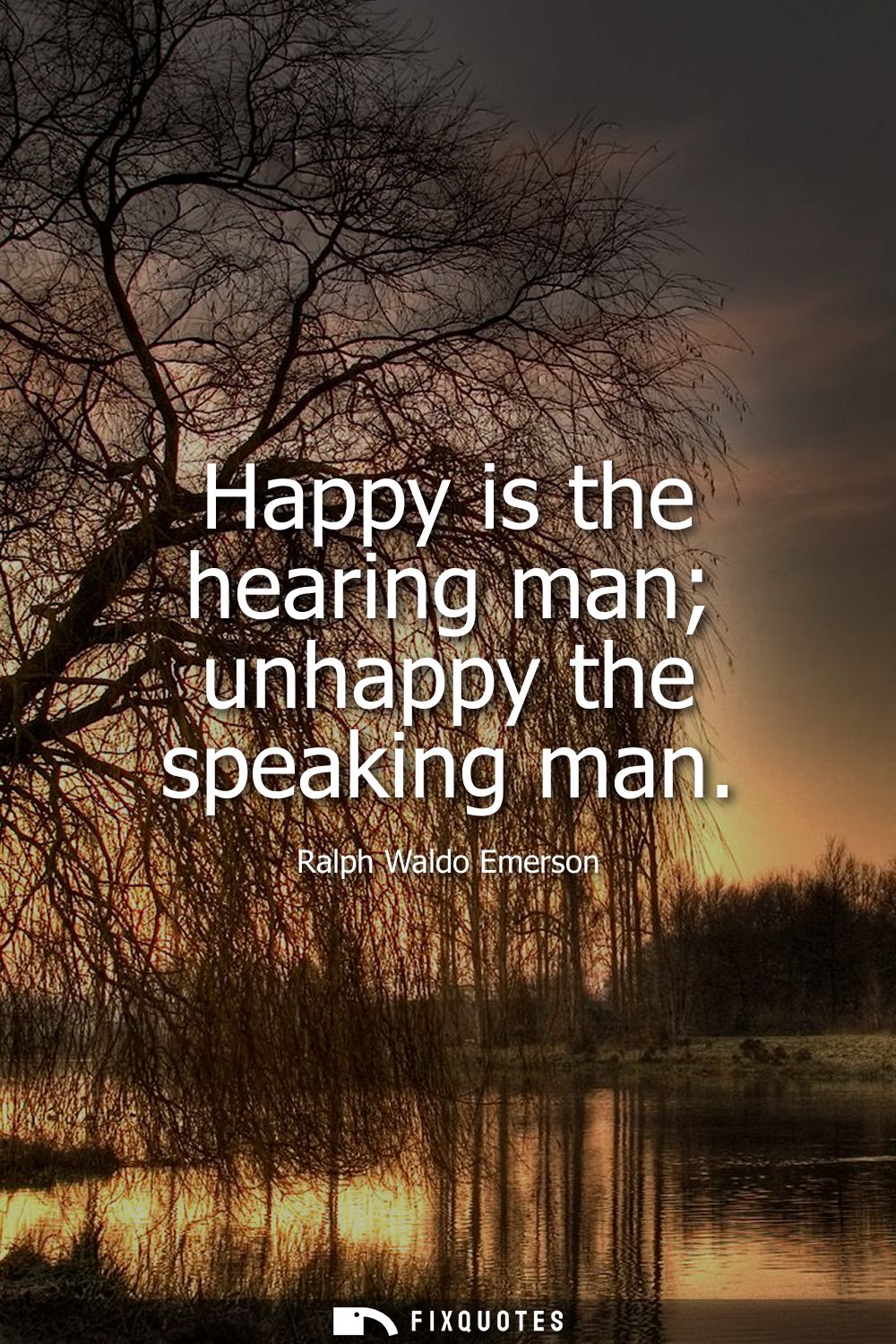
"Happy is the hearing man; unhappy the speaking man"
About this Quote
Emerson flips the usual hierarchy of self-expression with a deliberately lopsided blessing: the listener is “happy,” the talker “unhappy.” It’s a provocation aimed at a culture that equates speaking with power and authenticity. In a single line, he treats speech less like liberation and more like leakage - the moment you talk, you dilute something, you perform it, you risk turning inner life into social currency.
The subtext is classic Emersonian self-reliance with a twist. Hearing is receptive, porous, unowned; it lets the world arrive without demanding you brand it. Speaking, by contrast, puts you on the hook. Words harden thought into a public position, and that exposure invites misunderstanding, argument, and the exhausting need to keep being “the person who said that.” Emerson distrusts crowds and secondhand opinions; he also distrusts the version of oneself that gets manufactured in response to them. Silence protects the private workshop where perception becomes insight.
There’s also a moral edge: the speaking man is “unhappy” not because communication is bad, but because talk so easily slides into vanity, sermonizing, or the coercive urge to shape others. The hearing man practices a quieter authority - attention. In Emerson’s 19th-century America, thick with lecturing, pulpit rhetoric, and reform movements, this reads as an antidote to public overconfidence: the real strength is not the ability to broadcast, but the discipline to receive without rushing to dominate.
The subtext is classic Emersonian self-reliance with a twist. Hearing is receptive, porous, unowned; it lets the world arrive without demanding you brand it. Speaking, by contrast, puts you on the hook. Words harden thought into a public position, and that exposure invites misunderstanding, argument, and the exhausting need to keep being “the person who said that.” Emerson distrusts crowds and secondhand opinions; he also distrusts the version of oneself that gets manufactured in response to them. Silence protects the private workshop where perception becomes insight.
There’s also a moral edge: the speaking man is “unhappy” not because communication is bad, but because talk so easily slides into vanity, sermonizing, or the coercive urge to shape others. The hearing man practices a quieter authority - attention. In Emerson’s 19th-century America, thick with lecturing, pulpit rhetoric, and reform movements, this reads as an antidote to public overconfidence: the real strength is not the ability to broadcast, but the discipline to receive without rushing to dominate.
Quote Details
| Topic | Wisdom |
|---|---|
| Source | Help us find the source |
| Cite |
Citation Formats
APA Style (7th ed.)
Emerson, Ralph Waldo. (2026, January 15). Happy is the hearing man; unhappy the speaking man. FixQuotes. https://fixquotes.com/quotes/happy-is-the-hearing-man-unhappy-the-speaking-man-14177/
Chicago Style
Emerson, Ralph Waldo. "Happy is the hearing man; unhappy the speaking man." FixQuotes. January 15, 2026. https://fixquotes.com/quotes/happy-is-the-hearing-man-unhappy-the-speaking-man-14177/.
MLA Style (9th ed.)
"Happy is the hearing man; unhappy the speaking man." FixQuotes, 15 Jan. 2026, https://fixquotes.com/quotes/happy-is-the-hearing-man-unhappy-the-speaking-man-14177/. Accessed 22 Mar. 2026.
More Quotes by Ralph
Add to List