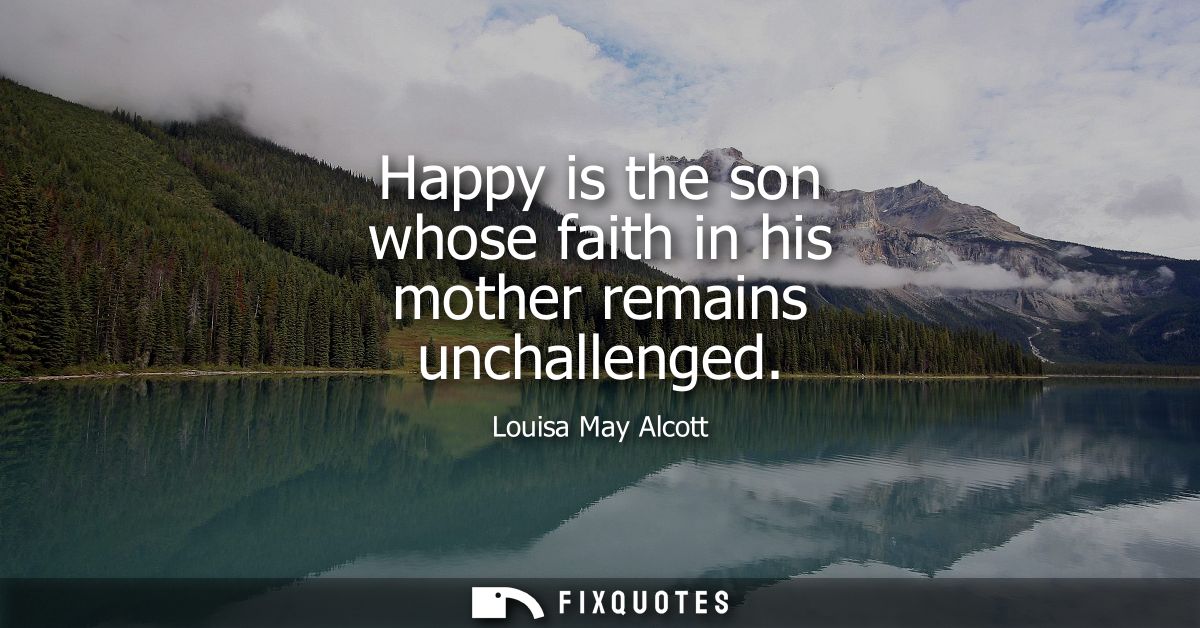
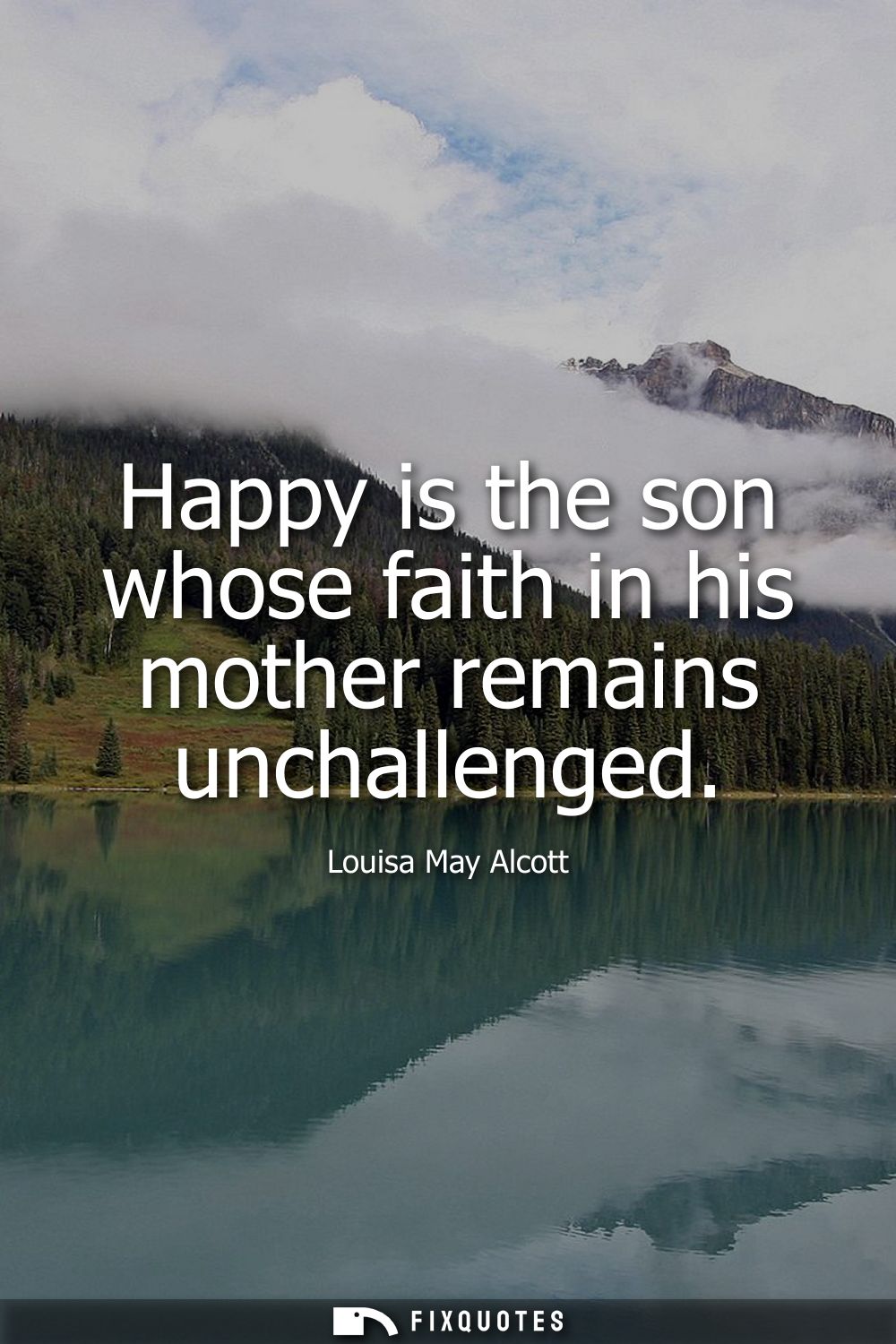
"Happy is the son whose faith in his mother remains unchallenged"
About this Quote
"Happy is the son whose faith in his mother remains unchallenged" lands like a soft blessing, then tightens into something sharper: happiness, Alcott suggests, can hinge on never having to revise your origin story. The key word is "unchallenged". She is not praising mothers as inherently saintly; she is praising the sheltering illusion of moral certainty. A mother, in this framing, is less a person than a first institution: the initial authority you trust before you know how authority fails.
Alcott writes from a 19th-century American world that sold motherhood as a civic ideal. The "true woman" was supposed to be pious, selfless, steady - a domestic anchor in a nation obsessed with virtue as social glue. Alcott’s own life complicates that sentiment: raised by an exacting transcendentalist father, she saw how ideals can strain households, how economic precarity makes virtue feel like a luxury. That’s why the line reads as both tender and rueful. It recognizes the emotional economy of childhood: believing in your mother buys you stability; losing that belief costs you more than a relationship. It costs you the feeling that the world is coherently ordered.
The subtext is gendered and quietly political. Sons are singled out because a boy’s first experience of care is also his first lesson about power without force. If that faith is "challenged" - by hypocrisy, absence, cruelty, or simply adulthood’s clearer vision - the injury isn’t just personal. It’s existential: the collapse of the one figure society insists must be reliable.
Alcott writes from a 19th-century American world that sold motherhood as a civic ideal. The "true woman" was supposed to be pious, selfless, steady - a domestic anchor in a nation obsessed with virtue as social glue. Alcott’s own life complicates that sentiment: raised by an exacting transcendentalist father, she saw how ideals can strain households, how economic precarity makes virtue feel like a luxury. That’s why the line reads as both tender and rueful. It recognizes the emotional economy of childhood: believing in your mother buys you stability; losing that belief costs you more than a relationship. It costs you the feeling that the world is coherently ordered.
The subtext is gendered and quietly political. Sons are singled out because a boy’s first experience of care is also his first lesson about power without force. If that faith is "challenged" - by hypocrisy, absence, cruelty, or simply adulthood’s clearer vision - the injury isn’t just personal. It’s existential: the collapse of the one figure society insists must be reliable.
Quote Details
| Topic | Mother |
|---|---|
| Source | Help us find the source |
| Cite |
Citation Formats
APA Style (7th ed.)
Alcott, Louisa May. (2026, January 15). Happy is the son whose faith in his mother remains unchallenged. FixQuotes. https://fixquotes.com/quotes/happy-is-the-son-whose-faith-in-his-mother-23162/
Chicago Style
Alcott, Louisa May. "Happy is the son whose faith in his mother remains unchallenged." FixQuotes. January 15, 2026. https://fixquotes.com/quotes/happy-is-the-son-whose-faith-in-his-mother-23162/.
MLA Style (9th ed.)
"Happy is the son whose faith in his mother remains unchallenged." FixQuotes, 15 Jan. 2026, https://fixquotes.com/quotes/happy-is-the-son-whose-faith-in-his-mother-23162/. Accessed 21 Mar. 2026.
More Quotes by Louisa
Add to List