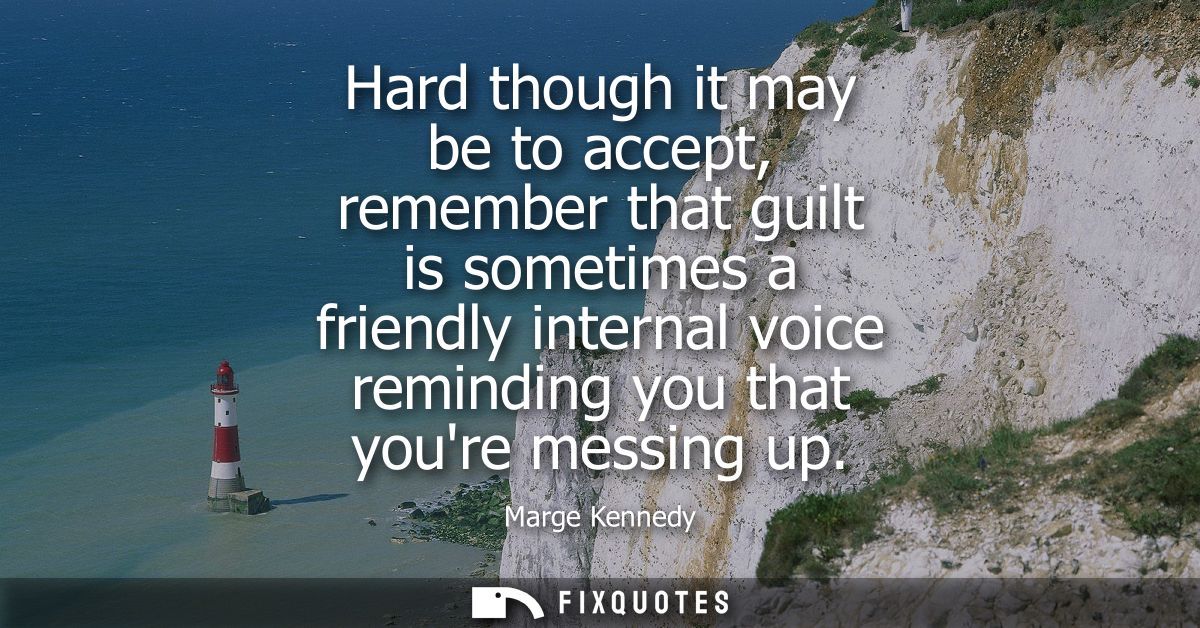
"Hard though it may be to accept, remember that guilt is sometimes a friendly internal voice reminding you that you're messing up"
About this Quote
The intent is corrective, even editorial. Kennedy is arguing for an internal accountability mechanism at a time when public discourse (especially in self-help and pop psychology) has often blurred "I feel bad" with "something bad is happening". Her subtext: if you pathologize every uncomfortable emotion, you lose a crucial signal that your behavior is misaligned with your values. The phrase "internal voice" borrows the language of conscience without the churchy baggage, and "messing up" keeps it plainspoken, stripping morality of grandiosity. It's not sin; it's error.
Contextually, Kennedy writes from the late-20th-century churn of therapeutic culture and feminist re-negotiations of duty, desire, and selfhood. The quote walks a tightrope: it validates self-compassion while refusing to let it become self-exoneration. The bite is in "sometimes". Not always. Guilt can be weaponized by others or distorted by anxiety. But when it's accurate, it's a friend doing an unglamorous job: telling you to change course before the damage becomes a story you can't edit.
Quote Details
| Topic | Learning from Mistakes |
|---|---|
| Source | Help us find the source |
| Cite |
Citation Formats
APA Style (7th ed.)
Kennedy, Marge. (2026, January 17). Hard though it may be to accept, remember that guilt is sometimes a friendly internal voice reminding you that you're messing up. FixQuotes. https://fixquotes.com/quotes/hard-though-it-may-be-to-accept-remember-that-81962/
Chicago Style
Kennedy, Marge. "Hard though it may be to accept, remember that guilt is sometimes a friendly internal voice reminding you that you're messing up." FixQuotes. January 17, 2026. https://fixquotes.com/quotes/hard-though-it-may-be-to-accept-remember-that-81962/.
MLA Style (9th ed.)
"Hard though it may be to accept, remember that guilt is sometimes a friendly internal voice reminding you that you're messing up." FixQuotes, 17 Jan. 2026, https://fixquotes.com/quotes/hard-though-it-may-be-to-accept-remember-that-81962/. Accessed 11 Mar. 2026.