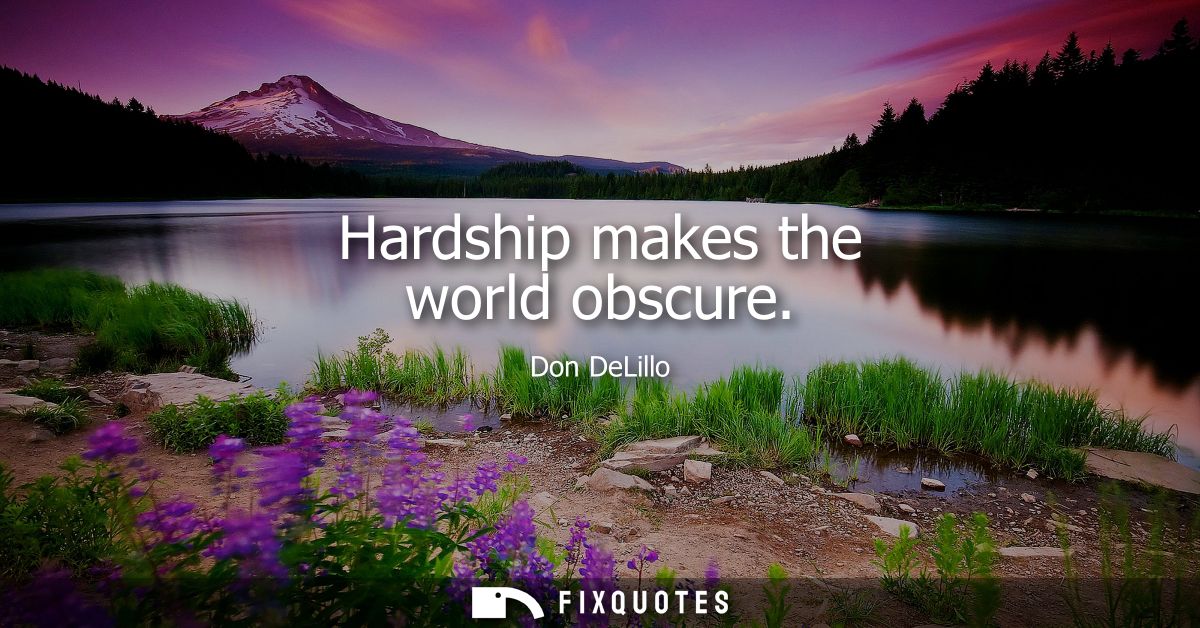
"Hardship makes the world obscure"
About this Quote
Hardship doesn’t just hurt in DeLillo’s line; it edits reality. “Obscure” is the tell: not “cruel,” not “unfair,” but visually and cognitively dimmed, as if suffering turns the world into bad reception. The sentence is blunt, almost hygienic, the way DeLillo often writes about catastrophe and consumer modernity: stripped of sentiment, calibrated to sound like a fact you didn’t want confirmed.
The intent feels diagnostic. Hardship narrows perception, making everything outside immediate survival harder to read: motives, patterns, even time itself. That’s the subtextual pivot. In DeLillo’s fiction, the world is already overloaded with signals - advertising, headlines, rumor, ideology - and hardship doesn’t cut through that noise; it amplifies it until meaning is indistinguishable from static. Obscurity becomes a psychological condition and a political one. If people are exhausted, precarious, or grieving, their ability to parse systems collapses. Power loves that. Confusion is a kind of governance.
There’s also a sly reversal embedded in the phrasing. We like to imagine adversity as clarifying, forging character, producing grit and wisdom. DeLillo rejects the motivational poster. Hardship doesn’t reveal the “real” world; it blocks it, turning life into a tunnel where only the next obligation is illuminated.
Contextually, it fits a late-20th/early-21st-century novelist preoccupied with disaster as ambiance - terrorism, media saturation, economic anxiety - where suffering isn’t ennobling, it’s disorienting. The world doesn’t become legible under pressure; it goes blurry.
The intent feels diagnostic. Hardship narrows perception, making everything outside immediate survival harder to read: motives, patterns, even time itself. That’s the subtextual pivot. In DeLillo’s fiction, the world is already overloaded with signals - advertising, headlines, rumor, ideology - and hardship doesn’t cut through that noise; it amplifies it until meaning is indistinguishable from static. Obscurity becomes a psychological condition and a political one. If people are exhausted, precarious, or grieving, their ability to parse systems collapses. Power loves that. Confusion is a kind of governance.
There’s also a sly reversal embedded in the phrasing. We like to imagine adversity as clarifying, forging character, producing grit and wisdom. DeLillo rejects the motivational poster. Hardship doesn’t reveal the “real” world; it blocks it, turning life into a tunnel where only the next obligation is illuminated.
Contextually, it fits a late-20th/early-21st-century novelist preoccupied with disaster as ambiance - terrorism, media saturation, economic anxiety - where suffering isn’t ennobling, it’s disorienting. The world doesn’t become legible under pressure; it goes blurry.
Quote Details
| Topic | Tough Times |
|---|---|
| Source | Help us find the source |
| Cite |
Citation Formats
APA Style (7th ed.)
DeLillo, Don. (2026, January 17). Hardship makes the world obscure. FixQuotes. https://fixquotes.com/quotes/hardship-makes-the-world-obscure-59244/
Chicago Style
DeLillo, Don. "Hardship makes the world obscure." FixQuotes. January 17, 2026. https://fixquotes.com/quotes/hardship-makes-the-world-obscure-59244/.
MLA Style (9th ed.)
"Hardship makes the world obscure." FixQuotes, 17 Jan. 2026, https://fixquotes.com/quotes/hardship-makes-the-world-obscure-59244/. Accessed 6 Mar. 2026.
More Quotes by Don
Add to List