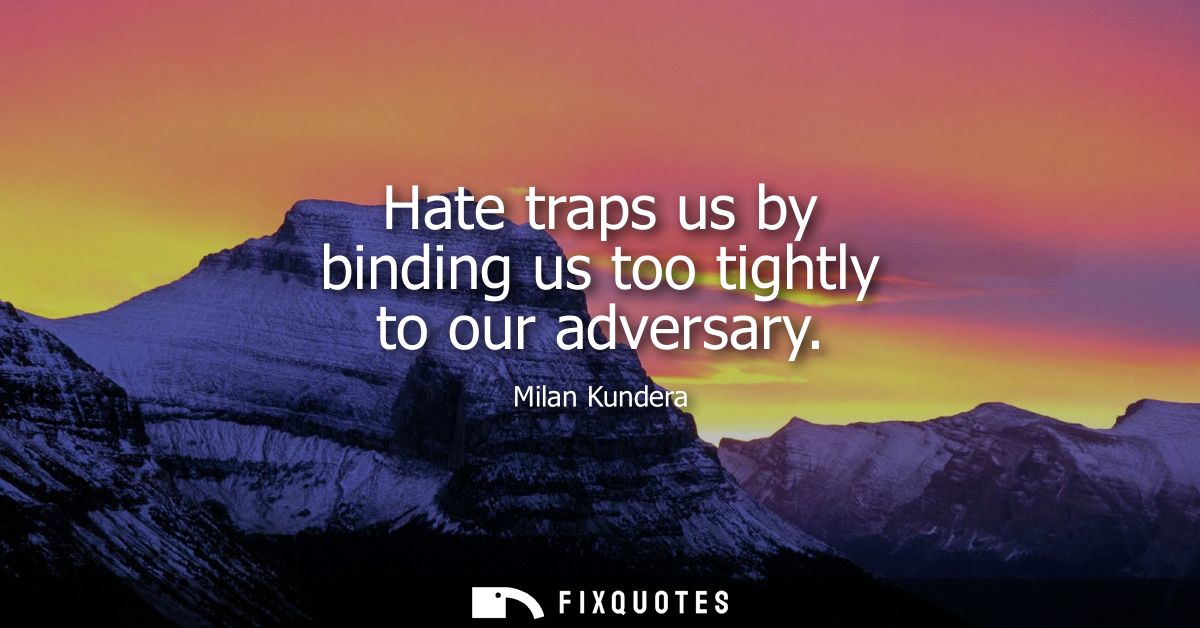
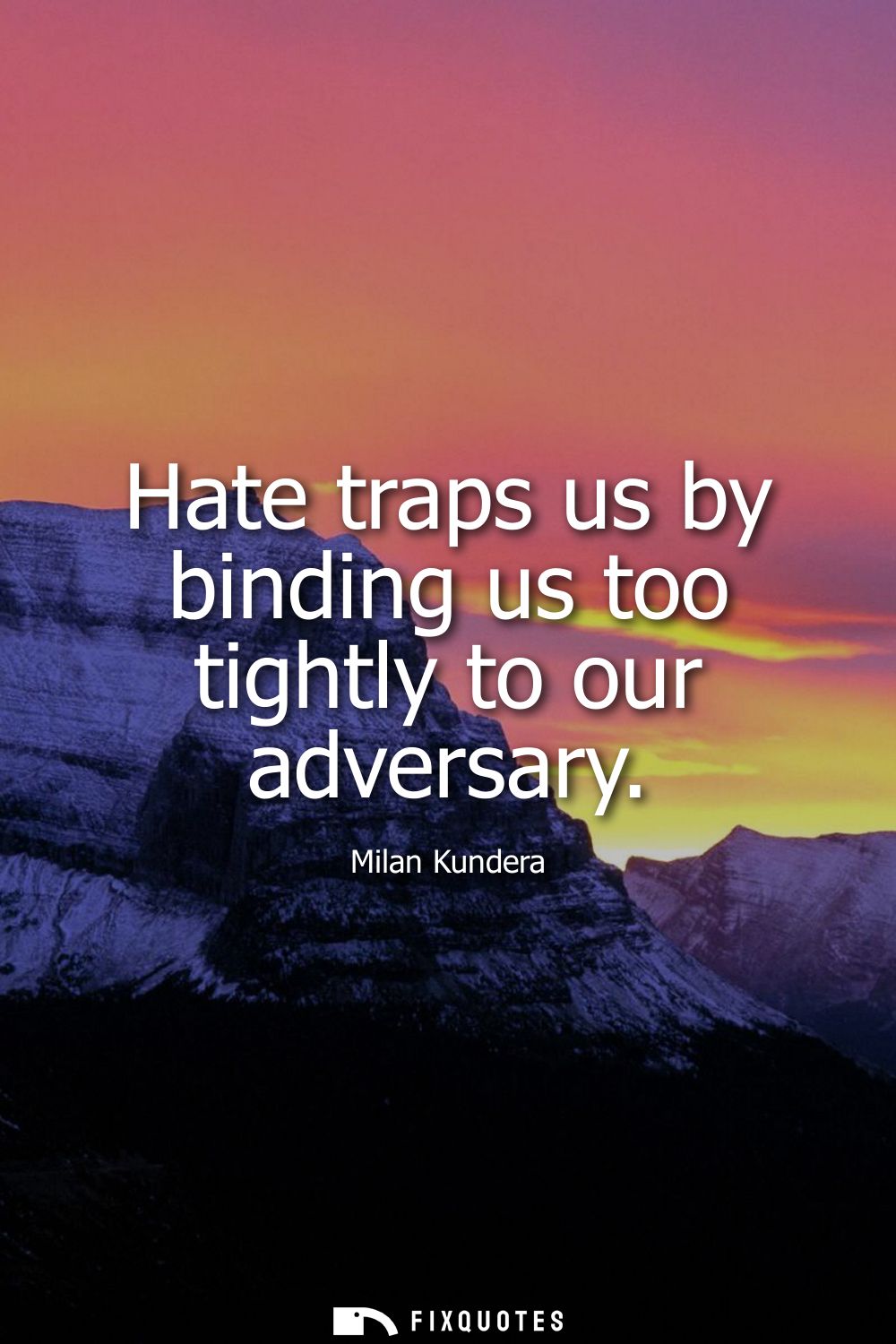
"Hate traps us by binding us too tightly to our adversary"
About this Quote
Hate, in Kundera's framing, is less a weapon than a handcuff. The sentence pivots on an unexpectedly intimate verb: binding. It suggests proximity, not distance; devotion, not disdain. You can only be "trapped" if your opponent has become structurally necessary to your inner life, if your identity is organized around resistance. That is the quiet cruelty of hate here: it offers the rush of moral clarity while smuggling in dependence.
Kundera, a novelist of entanglements and ironies, knows how emotions become political technologies. Coming out of a Central European landscape shaped by occupation, ideological policing, and the long afterlife of betrayal, he watched systems survive by recruiting feelings that feel righteous. Hate is convenient because it simplifies the world into a single face. Yet that simplification costs you freedom: it narrows your imagination to whatever keeps the adversary in frame. Even victory can be contaminated, because the triumph you seek is still measured in their terms.
The subtext is almost therapeutic but never sentimental: hatred is a form of self-forgetting disguised as engagement. It crowds out curiosity, eroticism, humor, contradiction - the messy materials Kundera prizes because they keep a person unowned. The line also carries a novelist's warning about narrative. When you hate, you let someone else become your plot. Your days start to rhyme with theirs. You become legible, predictable, governable.
Kundera's sly sting is that hate doesn't just dehumanize the other. It de-authorizes the self.
Kundera, a novelist of entanglements and ironies, knows how emotions become political technologies. Coming out of a Central European landscape shaped by occupation, ideological policing, and the long afterlife of betrayal, he watched systems survive by recruiting feelings that feel righteous. Hate is convenient because it simplifies the world into a single face. Yet that simplification costs you freedom: it narrows your imagination to whatever keeps the adversary in frame. Even victory can be contaminated, because the triumph you seek is still measured in their terms.
The subtext is almost therapeutic but never sentimental: hatred is a form of self-forgetting disguised as engagement. It crowds out curiosity, eroticism, humor, contradiction - the messy materials Kundera prizes because they keep a person unowned. The line also carries a novelist's warning about narrative. When you hate, you let someone else become your plot. Your days start to rhyme with theirs. You become legible, predictable, governable.
Kundera's sly sting is that hate doesn't just dehumanize the other. It de-authorizes the self.
Quote Details
| Topic | Forgiveness |
|---|---|
| Source | Verified source: Immortality (Milan Kundera, 1991)
Evidence: Hate traps us by binding us too tightly to our adversary. (Part One, Chapter 5). This line appears in Milan Kundera’s novel *Immortality* (English translation by Peter Kussi). The quote is spoken in narration about Agnes’s father, followed immediately by: “This is the obscenity of war: the intimacy of mutually shed blood, the lascivious proximity of two soldiers who, eye to eye, bayonet each other.” The earliest publication of the *work* is the French edition (*L’Immortalité*, Gallimard) published in 1990; the widely-cited English translation was published in 1991. I could verify the wording and in-novel location (Part One, Chapter 5) from a secondary excerpt that quotes the passage, but I did not retrieve a scan/page image from the primary printed edition in this search session, so I’m not providing an exact page number. Other candidates (1) Wrinkled Wisdom (Robert L. Searles, Jr., 2010) compilation95.0% ... Hate traps us by binding us too tightly to our adversary . Milan Kundera , age 62 ( 1991 ) He has not learned the... |
| Cite |
Citation Formats
APA Style (7th ed.)
Kundera, Milan. (2026, February 19). Hate traps us by binding us too tightly to our adversary. FixQuotes. https://fixquotes.com/quotes/hate-traps-us-by-binding-us-too-tightly-to-our-162946/
Chicago Style
Kundera, Milan. "Hate traps us by binding us too tightly to our adversary." FixQuotes. February 19, 2026. https://fixquotes.com/quotes/hate-traps-us-by-binding-us-too-tightly-to-our-162946/.
MLA Style (9th ed.)
"Hate traps us by binding us too tightly to our adversary." FixQuotes, 19 Feb. 2026, https://fixquotes.com/quotes/hate-traps-us-by-binding-us-too-tightly-to-our-162946/. Accessed 26 Mar. 2026.
More Quotes by Milan
Add to List