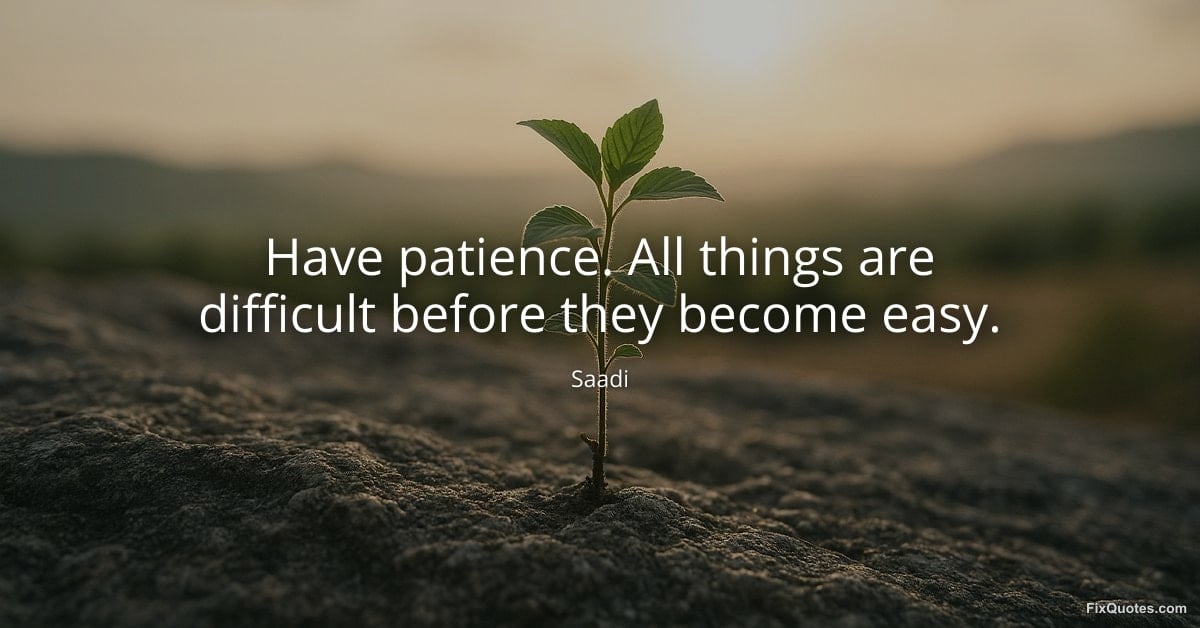
"Have patience. All things are difficult before they become easy"
About this Quote
Saadi’s line is persuasion dressed up as calm instruction: a small, portable ethic for anyone stalled at the ugly beginning of a skill, a relationship, a life change. “Have patience” isn’t a gentle suggestion so much as a corrective to the most common human error: treating early difficulty as proof of personal failure. He reframes that misery as a normal phase in the life cycle of competence.
The quiet power is in the sentence’s structure. It moves from command (“Have patience”) to a sweeping claim (“All things…”), then slips in the temporal hinge: “before.” That one word does the heavy lifting. Difficulty becomes not a verdict but a stage, and the self-blame machine loses its favorite evidence. Saadi is offering a psychological technology: endure the friction now because friction is what progress feels like up close.
The subtext is also moral. Patience, in much classical Persian poetry, isn’t mere waiting; it’s disciplined character, a way of resisting impulse, vanity, and despair. The line flatters the listener into a better identity: you’re not behind, you’re on the path. And it gently demotes talent. If “all things” are hard at first, then ease is less about giftedness than about time, repetition, and steadiness.
Context matters: Saadi wrote in a tradition where wisdom is meant to travel, memorized and traded in markets and courts alike. This aphorism works because it’s both consoling and demanding: it gives you hope, then hands you responsibility for staying long enough to earn the “easy.”
The quiet power is in the sentence’s structure. It moves from command (“Have patience”) to a sweeping claim (“All things…”), then slips in the temporal hinge: “before.” That one word does the heavy lifting. Difficulty becomes not a verdict but a stage, and the self-blame machine loses its favorite evidence. Saadi is offering a psychological technology: endure the friction now because friction is what progress feels like up close.
The subtext is also moral. Patience, in much classical Persian poetry, isn’t mere waiting; it’s disciplined character, a way of resisting impulse, vanity, and despair. The line flatters the listener into a better identity: you’re not behind, you’re on the path. And it gently demotes talent. If “all things” are hard at first, then ease is less about giftedness than about time, repetition, and steadiness.
Context matters: Saadi wrote in a tradition where wisdom is meant to travel, memorized and traded in markets and courts alike. This aphorism works because it’s both consoling and demanding: it gives you hope, then hands you responsibility for staying long enough to earn the “easy.”
Quote Details
| Topic | Perseverance |
|---|---|
| Source | Rejected source: The saint and the sinner, from the Bostan, tr. and accomp... (Sa'dî, 1839)IA: saintandsinnerf00sadgoog
Evidence: us at the last day he shall say unto the devili would to god that between me and Other candidates (2) Saadi (Saadi) compilation97.5% len co 1879 p 341 have patience all things are difficult before they become easy The 15 Invaluable Laws of Growth (10th Anniversary Edition) (John C. Maxwell, 2022)95.0% ... Saadi instructed , " Have patience . All things are difficult before they become easy . " That's wise advice . Mo... |
| Featured | This quote was our Quote of the Day on October 14, 2025 |
More Quotes by Saadi
Add to List