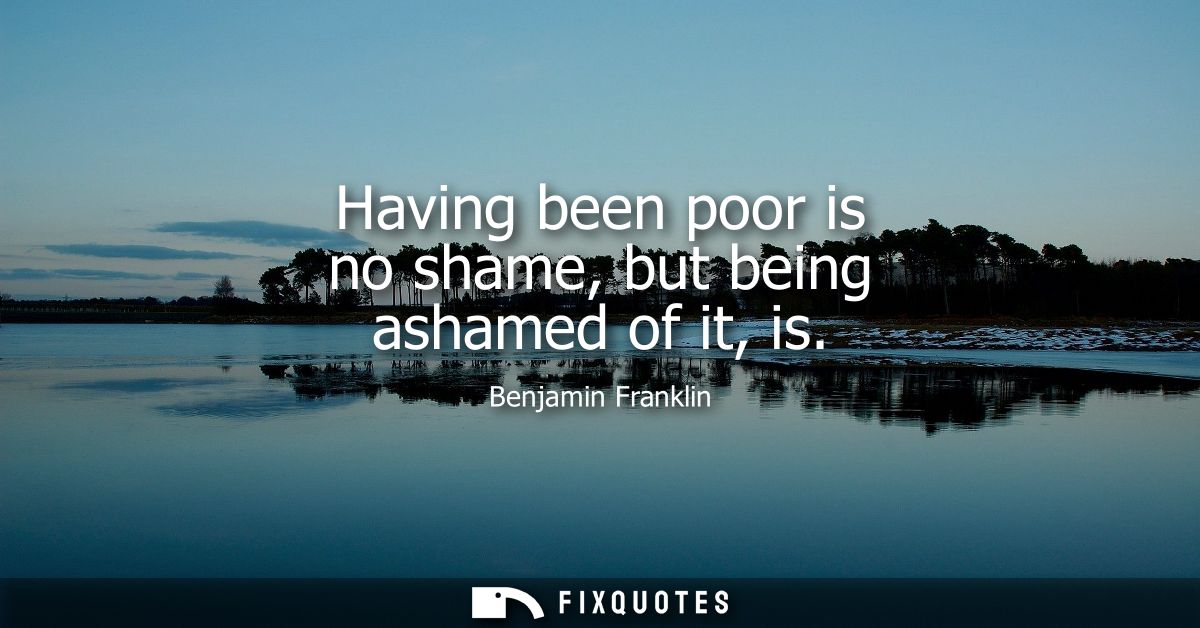
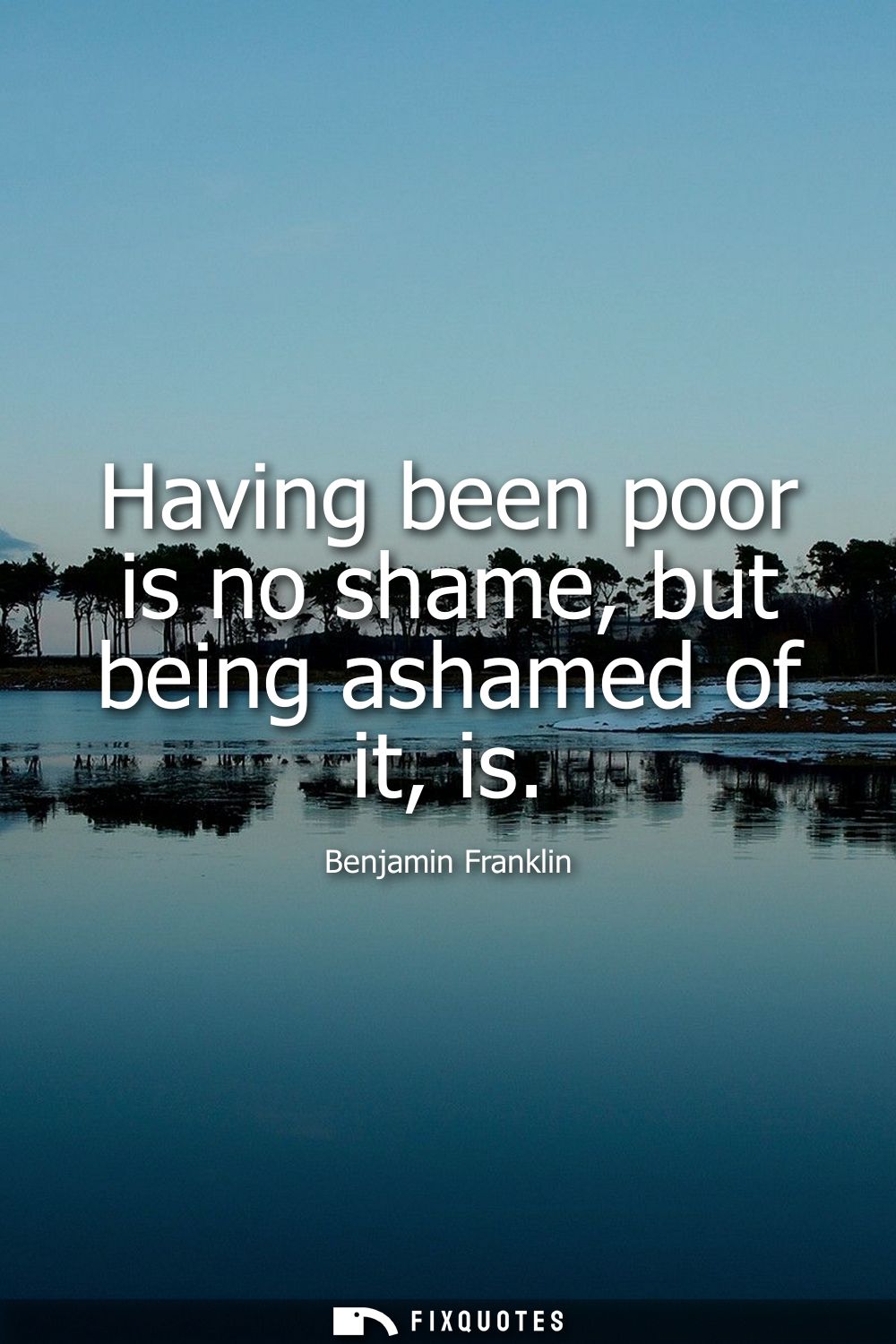
"Having been poor is no shame, but being ashamed of it is"
About this Quote
Franklin’s line is a moral scalpel disguised as homespun advice: it cuts poverty loose from disgrace, then turns the blade on the only part he thinks is truly blameworthy - the reflex to hide. The phrasing matters. “Having been poor” frames poverty as a condition that can be temporary, a chapter rather than a character. “No shame” doesn’t romanticize hardship; it simply refuses to treat economic misfortune as evidence of weak fiber. Then comes the pivot: “but being ashamed of it, is.” He relocates shame from circumstance to posture, from what happened to you to what you do with it.
The subtext is pure Franklin: status is useful, dignity is nonnegotiable, and self-respect is a kind of civic technology. In a world where credit, reputation, and social standing functioned like infrastructure, admitting you’d been poor could be risky. Franklin is offering an ethic that’s also a survival strategy: don’t let embarrassment make you dishonest, servile, or performatively “respectable.” Shame, he implies, breeds bad politics and bad economics - the quiet compromises, the grifts, the cruelty toward people still stuck where you once were.
Context sharpens it. Franklin was the archetypal self-made printer turned statesman, writing for a society that prized industriousness and distrusted inherited idleness. The line flatters the upwardly mobile while challenging their worst instinct: to launder their origin story once the money arrives. He’s not absolving poverty; he’s absolving the poor, and warning the newly comfortable not to confuse their bank balance with their worth.
The subtext is pure Franklin: status is useful, dignity is nonnegotiable, and self-respect is a kind of civic technology. In a world where credit, reputation, and social standing functioned like infrastructure, admitting you’d been poor could be risky. Franklin is offering an ethic that’s also a survival strategy: don’t let embarrassment make you dishonest, servile, or performatively “respectable.” Shame, he implies, breeds bad politics and bad economics - the quiet compromises, the grifts, the cruelty toward people still stuck where you once were.
Context sharpens it. Franklin was the archetypal self-made printer turned statesman, writing for a society that prized industriousness and distrusted inherited idleness. The line flatters the upwardly mobile while challenging their worst instinct: to launder their origin story once the money arrives. He’s not absolving poverty; he’s absolving the poor, and warning the newly comfortable not to confuse their bank balance with their worth.
Quote Details
| Topic | Humility |
|---|---|
| Source | Verified source: Poor Richard improved: Being an Almanack and Ephemeris… 1749 (Benjamin Franklin, 1749)
Evidence: Having been poor is no shame, but being ashamed of it, is.. This line appears as a stand-alone proverb in Benjamin Franklin’s almanac issue for 1749 under the “Poor Richard” / “Richard Saunders” persona (i.e., Franklin’s own publication). The Founders Online transcription identifies the bibliographic item as: “Poor Richard improved: Being an Almanack and Ephemeris … for the Year of our Lord 1749. … By Richard Saunders, Philom. Philadelphia: Printed and Sold by B, Franklin, and D. Hall.” In the transcription, the sentence occurs in the July section (near the lines where it follows “Pretty and Witty, / Will wound if they hit ye.”). Other candidates (1) The World Doesn’t Need More Quotes, But Here We Are (Sasha Finch) compilation95.0% ... Franklin noted “Having been poor is no shame but being ashamed of it is.” Family teaches us dignity long before t... |
| Cite |
Citation Formats
APA Style (7th ed.)
Franklin, Benjamin. (2026, February 16). Having been poor is no shame, but being ashamed of it is. FixQuotes. https://fixquotes.com/quotes/having-been-poor-is-no-shame-but-being-ashamed-of-34778/
Chicago Style
Franklin, Benjamin. "Having been poor is no shame, but being ashamed of it is." FixQuotes. February 16, 2026. https://fixquotes.com/quotes/having-been-poor-is-no-shame-but-being-ashamed-of-34778/.
MLA Style (9th ed.)
"Having been poor is no shame, but being ashamed of it is." FixQuotes, 16 Feb. 2026, https://fixquotes.com/quotes/having-been-poor-is-no-shame-but-being-ashamed-of-34778/. Accessed 6 Apr. 2026.
More Quotes by Benjamin
Add to List