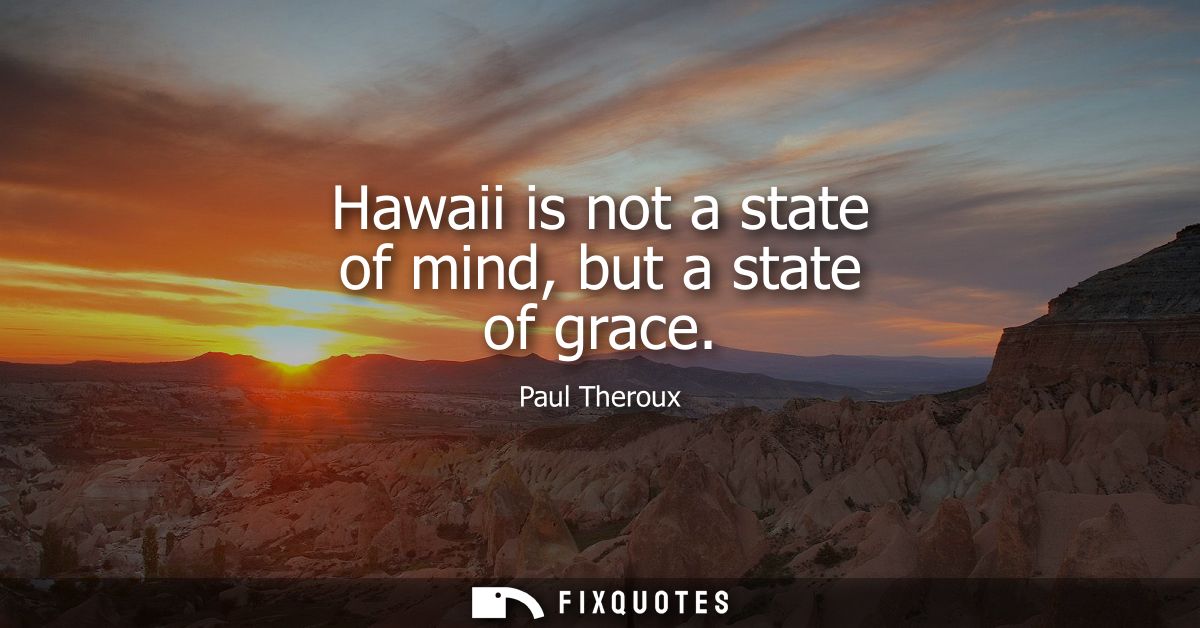
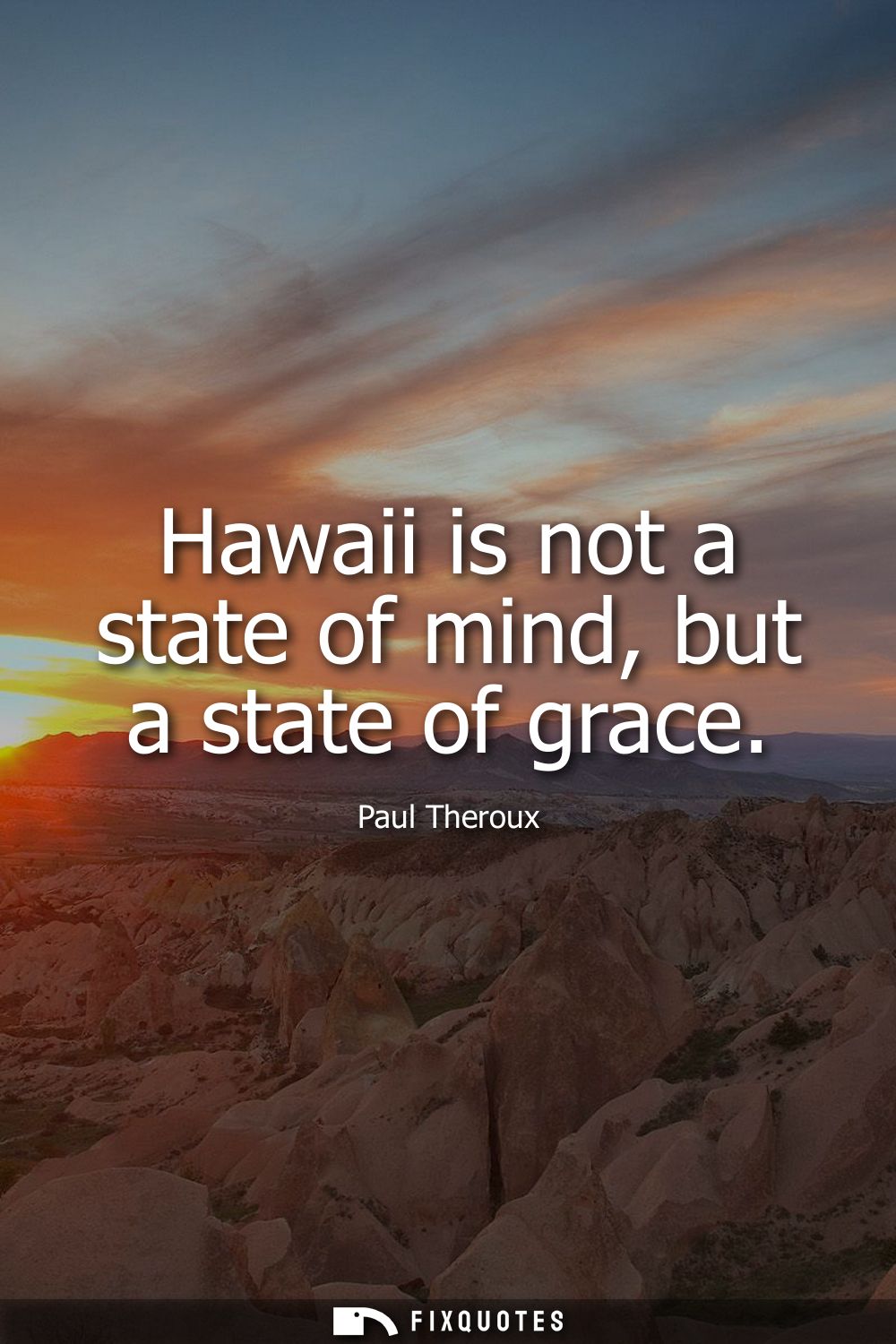
"Hawaii is not a state of mind, but a state of grace"
About this Quote
Theroux’s line snaps back at the tourist-industry cliche that turns Hawaii into a mood board: a “state of mind” you can purchase with a lei and a resort bracelet. By refusing that phrase, he rejects the idea that the islands are an attitude you adopt or a fantasy you slip into. “State of grace” is a sharper, more loaded substitute. It carries religious weight: grace is unearned, fleeting, and not fully graspable. You don’t consume it; you’re momentarily admitted to it.
The intent feels doubly Theroux: protective and skeptical. Protective of a real place that gets flattened into branding, skeptical of outsiders (especially affluent ones) who want Hawaii to function as therapy. The subtext is that Hawaii’s beauty has an ethical demand attached to it. To call it “grace” implies humility, attention, maybe even restraint. You’re a guest, not the owner of the experience.
Context matters. Theroux came up as a travel writer and novelist during the era when air travel and mass tourism made “paradise” accessible and therefore easily commodified. Hawaii, with its history of annexation, militarization, and relentless development, is one of the clearest examples of that tension: breathtaking land paired with political complexity. The sentence works because it offers a corrective without turning into a lecture. It elevates the encounter - then quietly warns you that if you treat Hawaii like a vibe, you’ll miss what’s actually there, and participate in the very erasure the line is pushing against.
The intent feels doubly Theroux: protective and skeptical. Protective of a real place that gets flattened into branding, skeptical of outsiders (especially affluent ones) who want Hawaii to function as therapy. The subtext is that Hawaii’s beauty has an ethical demand attached to it. To call it “grace” implies humility, attention, maybe even restraint. You’re a guest, not the owner of the experience.
Context matters. Theroux came up as a travel writer and novelist during the era when air travel and mass tourism made “paradise” accessible and therefore easily commodified. Hawaii, with its history of annexation, militarization, and relentless development, is one of the clearest examples of that tension: breathtaking land paired with political complexity. The sentence works because it offers a corrective without turning into a lecture. It elevates the encounter - then quietly warns you that if you treat Hawaii like a vibe, you’ll miss what’s actually there, and participate in the very erasure the line is pushing against.
Quote Details
| Topic | Travel |
|---|---|
| Source | Help us find the source |
| Cite |
Citation Formats
APA Style (7th ed.)
Theroux, Paul. (2026, January 15). Hawaii is not a state of mind, but a state of grace. FixQuotes. https://fixquotes.com/quotes/hawaii-is-not-a-state-of-mind-but-a-state-of-grace-105589/
Chicago Style
Theroux, Paul. "Hawaii is not a state of mind, but a state of grace." FixQuotes. January 15, 2026. https://fixquotes.com/quotes/hawaii-is-not-a-state-of-mind-but-a-state-of-grace-105589/.
MLA Style (9th ed.)
"Hawaii is not a state of mind, but a state of grace." FixQuotes, 15 Jan. 2026, https://fixquotes.com/quotes/hawaii-is-not-a-state-of-mind-but-a-state-of-grace-105589/. Accessed 22 Mar. 2026.
More Quotes by Paul
Add to List