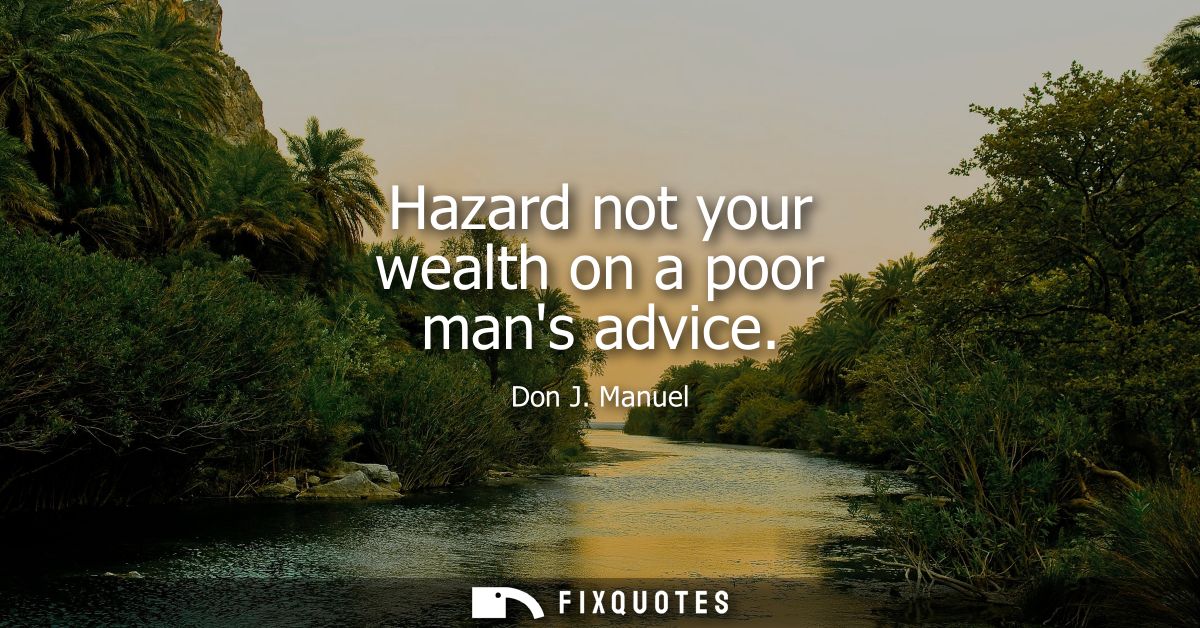
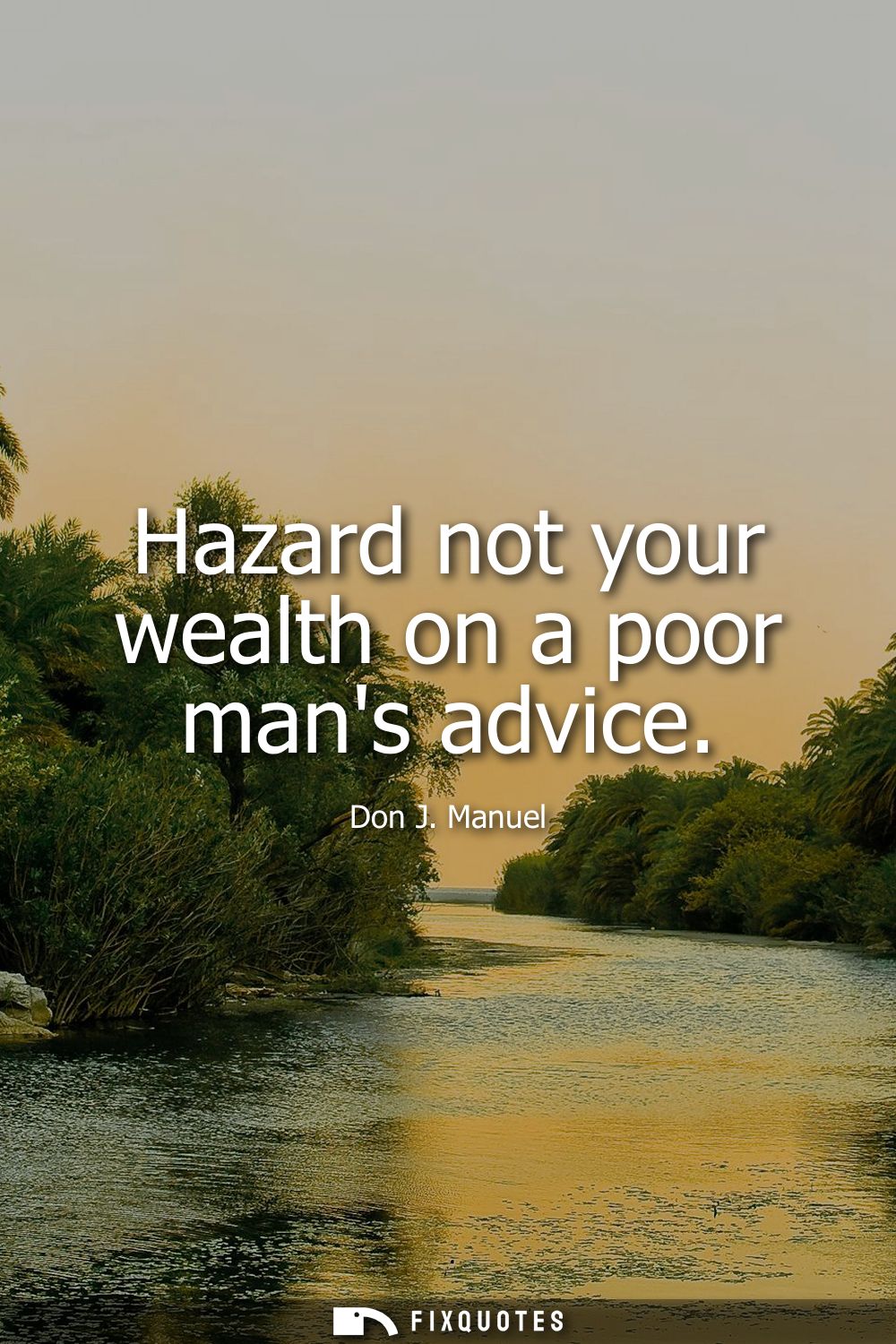
"Hazard not your wealth on a poor man's advice"
About this Quote
"Harsh, but not subtle" is the energy here: a warning dressed up as common sense, with a class edge sharp enough to draw blood. "Hazard" signals more than casual risk; it evokes gambling, shipwreck, catastrophe. The line assumes wealth is fragile not because markets are chaotic, but because the wrong counsel is contagious. The poor man, in this framing, isn’t merely inexperienced; he’s positioned as structurally incapable of understanding the stakes of capital because he doesn’t possess it.
That’s the subtext doing most of the work. The quote flatters the wealthy reader into believing their money is a specialized ecosystem only other money-keepers can navigate. It builds a closed circuit of legitimacy: wealth validates advice, and advice preserves wealth. The poor become disqualified not on evidence, but on identity. It’s less a financial principle than a social boundary, reinforcing who gets to speak with authority.
Contextually, it echoes old-world proverbs and merchant-class lore: don’t take investing tips from someone who can’t "show results". There’s a practical version of that idea (track record matters), but the phrasing chooses contempt over caution. It doesn’t say "inexperienced" or "uninformed"; it says "poor". That choice reveals the intent: risk management as class management.
The quote works because it compresses a whole ideology into a single, memorable rule. Its danger is the same as its punch: it treats poverty as proof of incompetence, rather than the outcome of systems that often punish good judgment as readily as bad luck.
That’s the subtext doing most of the work. The quote flatters the wealthy reader into believing their money is a specialized ecosystem only other money-keepers can navigate. It builds a closed circuit of legitimacy: wealth validates advice, and advice preserves wealth. The poor become disqualified not on evidence, but on identity. It’s less a financial principle than a social boundary, reinforcing who gets to speak with authority.
Contextually, it echoes old-world proverbs and merchant-class lore: don’t take investing tips from someone who can’t "show results". There’s a practical version of that idea (track record matters), but the phrasing chooses contempt over caution. It doesn’t say "inexperienced" or "uninformed"; it says "poor". That choice reveals the intent: risk management as class management.
The quote works because it compresses a whole ideology into a single, memorable rule. Its danger is the same as its punch: it treats poverty as proof of incompetence, rather than the outcome of systems that often punish good judgment as readily as bad luck.
Quote Details
| Topic | Wealth |
|---|---|
| Source | Help us find the source |
| Cite |
Citation Formats
APA Style (7th ed.)
Manuel, Don J. (2026, January 16). Hazard not your wealth on a poor man's advice. FixQuotes. https://fixquotes.com/quotes/hazard-not-your-wealth-on-a-poor-mans-advice-121247/
Chicago Style
Manuel, Don J. "Hazard not your wealth on a poor man's advice." FixQuotes. January 16, 2026. https://fixquotes.com/quotes/hazard-not-your-wealth-on-a-poor-mans-advice-121247/.
MLA Style (9th ed.)
"Hazard not your wealth on a poor man's advice." FixQuotes, 16 Jan. 2026, https://fixquotes.com/quotes/hazard-not-your-wealth-on-a-poor-mans-advice-121247/. Accessed 7 Apr. 2026.
More Quotes by Don
Add to List