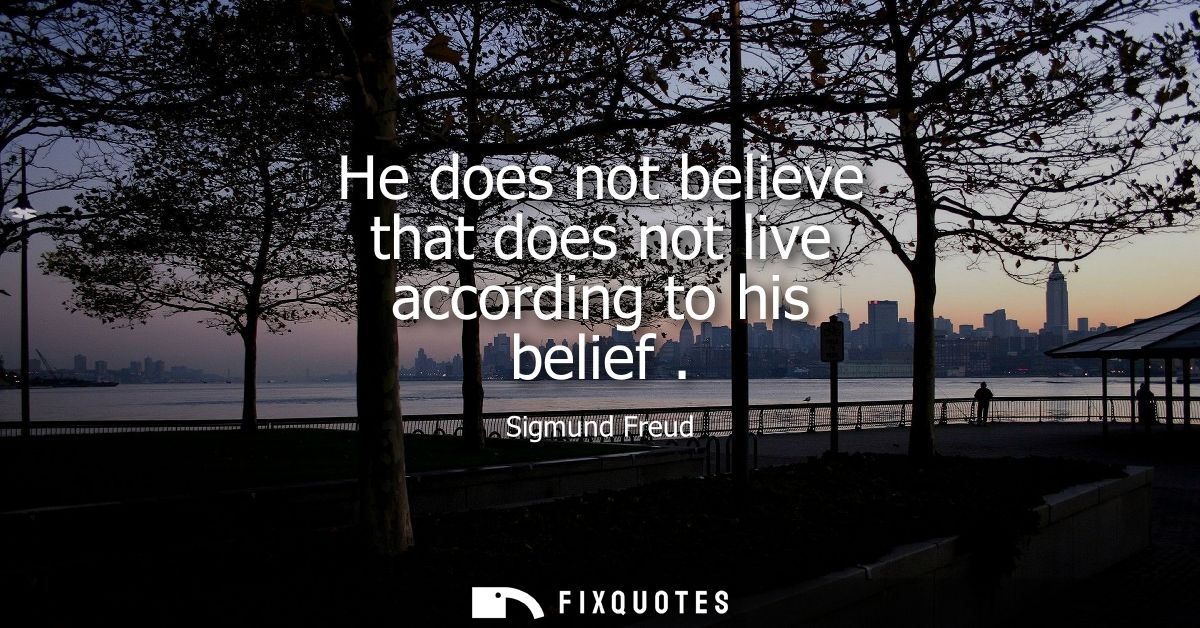
"He does not believe that does not live according to his belief "
About this Quote
Freud’s line is less a moral scold than a clinical dare: if your convictions don’t show up in your behavior, they’re not convictions at all - they’re decorations. The sharpness comes from how it relocates “belief” from the mind to the body, from what we claim to what we enact. For a psychologist who built a career on the gap between conscious self-narratives and unconscious motives, that move is the whole game.
The intent is diagnostic. Freud is implicitly suspicious of verbal professions - piety, principle, ideology - because talk is one of the ego’s favorite cover stories. People say “I believe in X” the way they say “I’m fine”: not as a report, but as a defense. If the life doesn’t match the belief, Freud reads that mismatch as evidence of repression, ambivalence, or a competing desire running the show.
The subtext is also quietly radical: it denies belief its usual private, interior status. Belief becomes something you can test in public: through habits, choices, and the small, repeatable actions that betray our true priorities. That’s why the sentence feels almost proto-behaviorist while staying deeply Freudian; it’s still about hidden forces, just measured by their footprints.
Context matters. Freud wrote in a culture thick with Victorian respectability and moral certainty, where social scripts often demanded the “right” beliefs regardless of inner life. His work repeatedly punctured that facade. This aphorism compresses the broader Freudian suspicion into one weaponized metric: don’t listen to what someone says they are - watch what their life can’t help revealing.
The intent is diagnostic. Freud is implicitly suspicious of verbal professions - piety, principle, ideology - because talk is one of the ego’s favorite cover stories. People say “I believe in X” the way they say “I’m fine”: not as a report, but as a defense. If the life doesn’t match the belief, Freud reads that mismatch as evidence of repression, ambivalence, or a competing desire running the show.
The subtext is also quietly radical: it denies belief its usual private, interior status. Belief becomes something you can test in public: through habits, choices, and the small, repeatable actions that betray our true priorities. That’s why the sentence feels almost proto-behaviorist while staying deeply Freudian; it’s still about hidden forces, just measured by their footprints.
Context matters. Freud wrote in a culture thick with Victorian respectability and moral certainty, where social scripts often demanded the “right” beliefs regardless of inner life. His work repeatedly punctured that facade. This aphorism compresses the broader Freudian suspicion into one weaponized metric: don’t listen to what someone says they are - watch what their life can’t help revealing.
Quote Details
| Topic | Honesty & Integrity |
|---|---|
| Source | Help us find the source |
| Cite |
Citation Formats
APA Style (7th ed.)
Freud, Sigmund. (2026, January 15). He does not believe that does not live according to his belief . FixQuotes. https://fixquotes.com/quotes/he-does-not-believe-that-does-not-live-according-22511/
Chicago Style
Freud, Sigmund. "He does not believe that does not live according to his belief ." FixQuotes. January 15, 2026. https://fixquotes.com/quotes/he-does-not-believe-that-does-not-live-according-22511/.
MLA Style (9th ed.)
"He does not believe that does not live according to his belief ." FixQuotes, 15 Jan. 2026, https://fixquotes.com/quotes/he-does-not-believe-that-does-not-live-according-22511/. Accessed 12 Feb. 2026.
More Quotes by Sigmund
Add to List