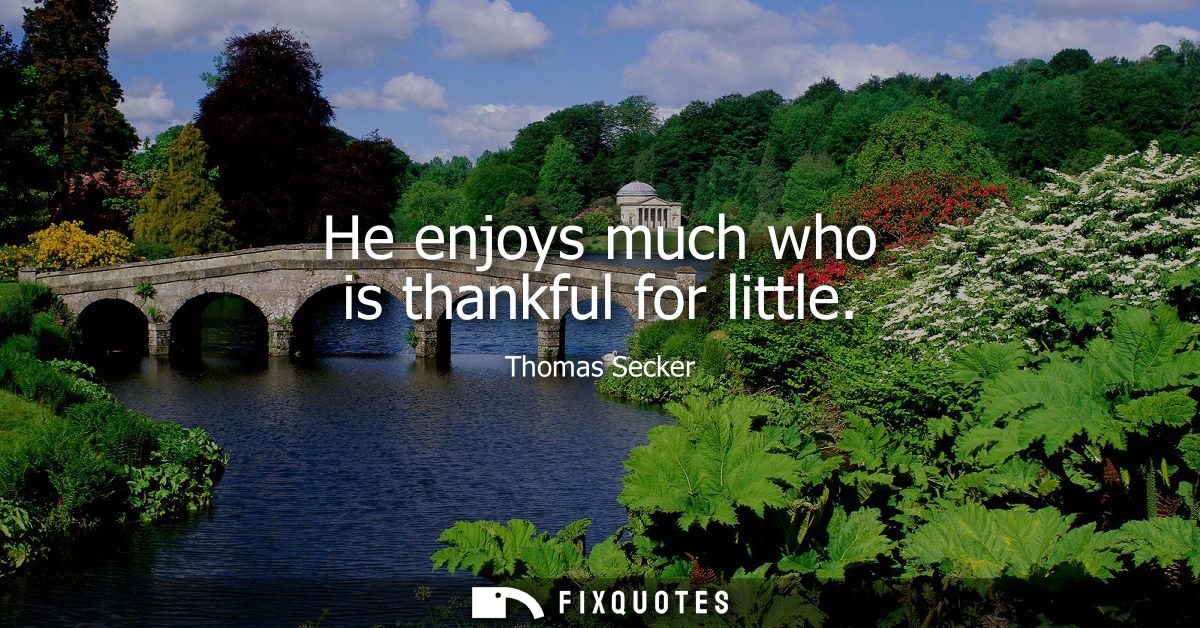
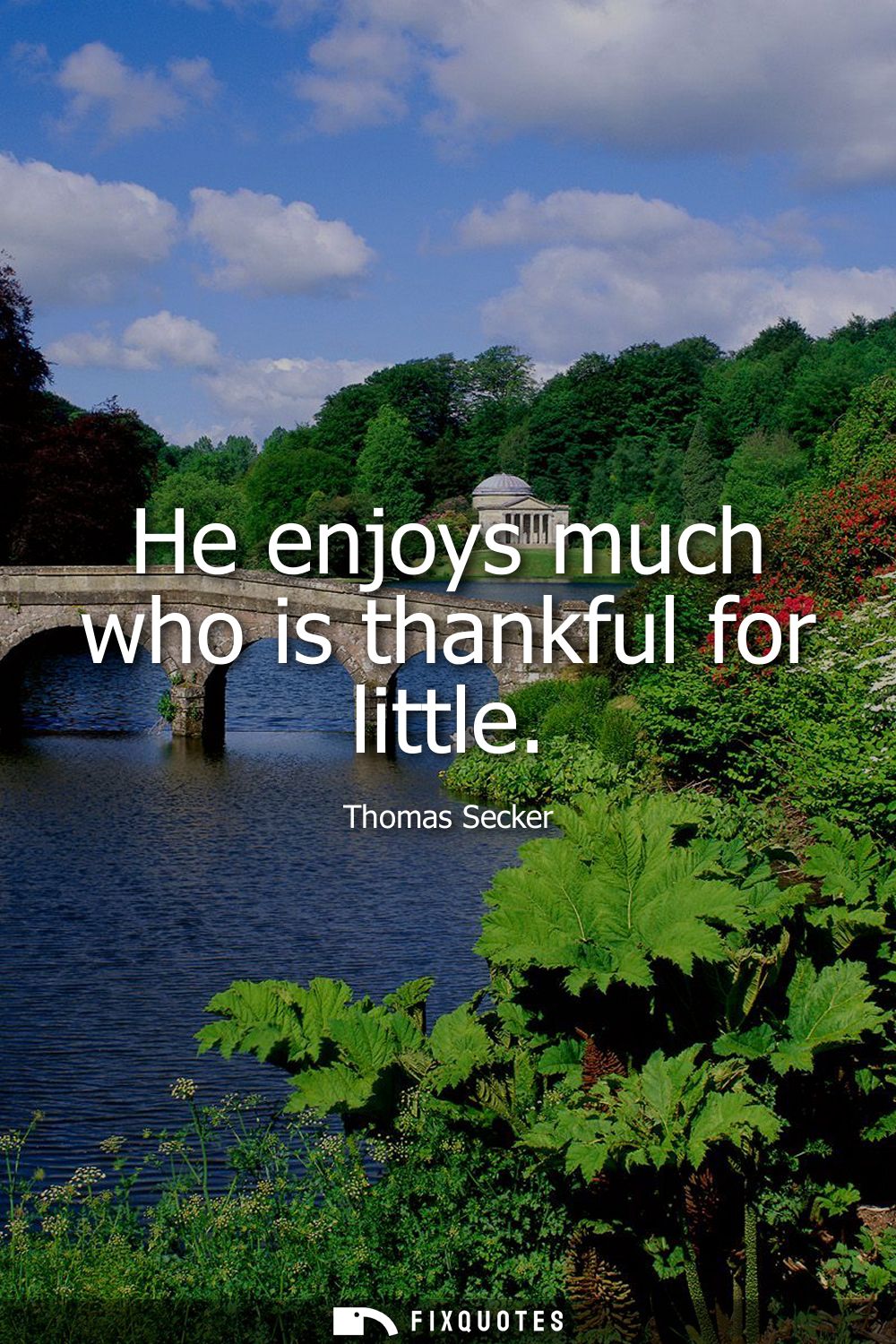
"He enjoys much who is thankful for little"
About this Quote
Gratitude, in Secker's telling, is less a feeling than a discipline: the ability to extract pleasure from modest circumstances. "Enjoys much" doesn’t mean owns more, wins more, or is entertained more. It means the internal economy is efficient. The thankful person converts small inputs into large satisfactions, a moral kind of alchemy that quietly rebukes the acquisitive mindset without naming it.
The line works because it compresses an entire theology of contentment into a clean, almost merchant-like equation. "Much" and "little" aren’t just quantities; they’re measurements of desire. Secker implies that unhappiness is frequently a problem of expectation-management, not inventory. Gratitude shrinks the appetite, and once appetite is smaller, ordinary life stops reading like deprivation.
As an Anglican clergyman in 18th-century Britain, Secker preached in a culture of expanding commerce, sharper class distinctions, and consumer temptations that could be cast as spiritual hazards. The subtext carries pastoral triage: a way to soothe envy among those with less, and a way to warn those with more that abundance doesn’t automatically purchase joy. It’s also an anti-complaint ethic, aimed at curbing the performative dissatisfaction that can become social currency.
There’s a gentle authoritarianism, too. The sentence rewards those who adapt inwardly rather than demand outward change. As comfort and consumption rise, Secker’s maxim still lands because it flatters autonomy: you can’t control the world’s allotments, but you can control the meter by which you feel them.
The line works because it compresses an entire theology of contentment into a clean, almost merchant-like equation. "Much" and "little" aren’t just quantities; they’re measurements of desire. Secker implies that unhappiness is frequently a problem of expectation-management, not inventory. Gratitude shrinks the appetite, and once appetite is smaller, ordinary life stops reading like deprivation.
As an Anglican clergyman in 18th-century Britain, Secker preached in a culture of expanding commerce, sharper class distinctions, and consumer temptations that could be cast as spiritual hazards. The subtext carries pastoral triage: a way to soothe envy among those with less, and a way to warn those with more that abundance doesn’t automatically purchase joy. It’s also an anti-complaint ethic, aimed at curbing the performative dissatisfaction that can become social currency.
There’s a gentle authoritarianism, too. The sentence rewards those who adapt inwardly rather than demand outward change. As comfort and consumption rise, Secker’s maxim still lands because it flatters autonomy: you can’t control the world’s allotments, but you can control the meter by which you feel them.
Quote Details
| Topic | Gratitude |
|---|---|
| Source | Help us find the source |
| Cite |
Citation Formats
APA Style (7th ed.)
Secker, Thomas. (2026, January 16). He enjoys much who is thankful for little. FixQuotes. https://fixquotes.com/quotes/he-enjoys-much-who-is-thankful-for-little-131436/
Chicago Style
Secker, Thomas. "He enjoys much who is thankful for little." FixQuotes. January 16, 2026. https://fixquotes.com/quotes/he-enjoys-much-who-is-thankful-for-little-131436/.
MLA Style (9th ed.)
"He enjoys much who is thankful for little." FixQuotes, 16 Jan. 2026, https://fixquotes.com/quotes/he-enjoys-much-who-is-thankful-for-little-131436/. Accessed 23 Mar. 2026.
More Quotes by Thomas
Add to List