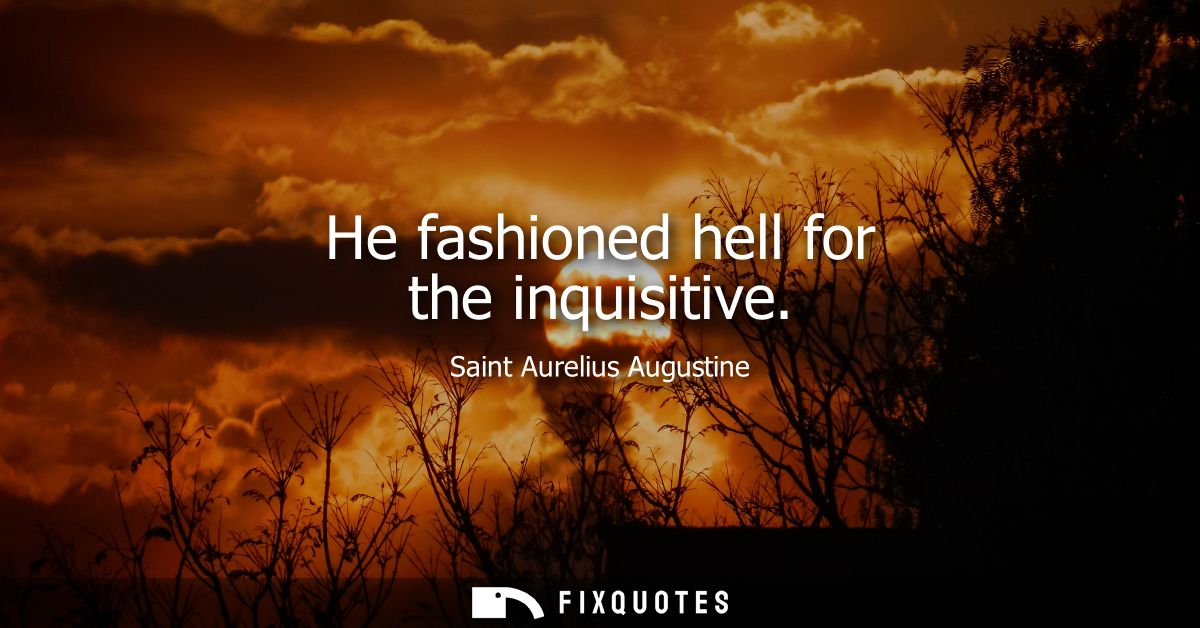
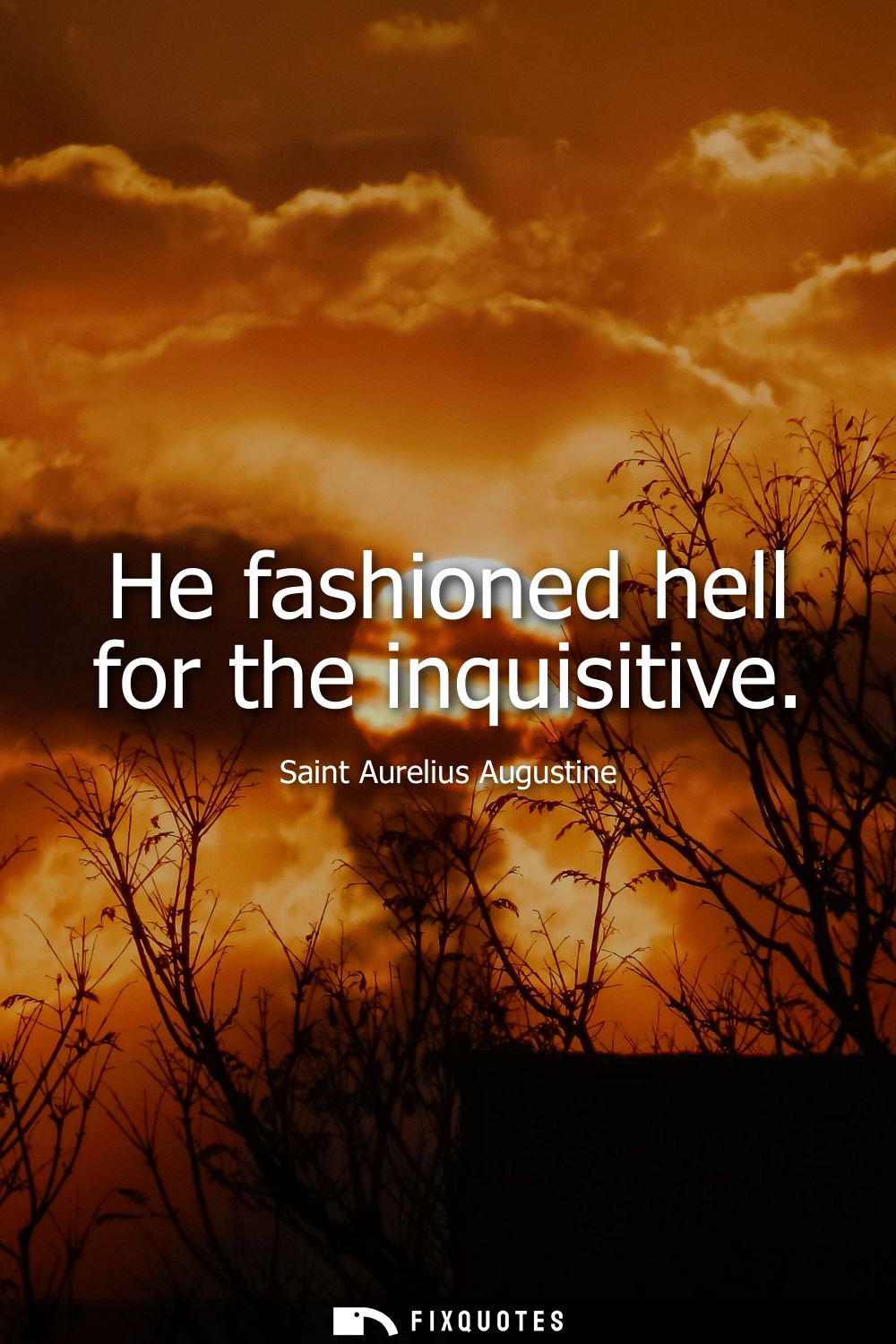
"He fashioned hell for the inquisitive"
About this Quote
A chill rides inside that line: curiosity isn’t merely a trait to be managed, it’s a liability with metaphysical consequences. Augustine’s phrasing turns “the inquisitive” from bright-minded seekers into a suspect class, the kind of people who ask one question too many and mistake intellectual appetite for spiritual progress. The verb “fashioned” matters. Hell isn’t just a place; it’s a deliberate instrument, crafted with purpose. That craftsmanship implies a universe where moral order is engineered, not improvised, and where punishment is calibrated to particular temptations.
The subtext is Augustine’s long war against restlessness: the mind that roams, samples, tests, and refuses to settle. In his world, inquiry can be a form of pride, the self enthroning itself as judge over revelation. “Inquisitive” shades toward “curiositas,” a vice in late antique Christian thought: not the disciplined search for truth but the itch to pry into what isn’t given, to treat God like a puzzle box. Hell, then, becomes a boundary marker. It’s the ultimate “no,” the cosmic enforcement of epistemic humility.
Context sharpens the intent. Augustine is writing into an era of theological dispute, competing sects, and rhetorical virtuosos selling salvation through cleverness. His own intellectual biography includes flirtations with systems that promised total explanation. So the line doubles as confession and warning: he knows how seductive the investigative mind can be, how easily it turns faith into a debate club. The sentence works because it compresses a whole anthropology into a sneer of clarity: the desire to know is powerful enough that it may need a furnace to stop it.
The subtext is Augustine’s long war against restlessness: the mind that roams, samples, tests, and refuses to settle. In his world, inquiry can be a form of pride, the self enthroning itself as judge over revelation. “Inquisitive” shades toward “curiositas,” a vice in late antique Christian thought: not the disciplined search for truth but the itch to pry into what isn’t given, to treat God like a puzzle box. Hell, then, becomes a boundary marker. It’s the ultimate “no,” the cosmic enforcement of epistemic humility.
Context sharpens the intent. Augustine is writing into an era of theological dispute, competing sects, and rhetorical virtuosos selling salvation through cleverness. His own intellectual biography includes flirtations with systems that promised total explanation. So the line doubles as confession and warning: he knows how seductive the investigative mind can be, how easily it turns faith into a debate club. The sentence works because it compresses a whole anthropology into a sneer of clarity: the desire to know is powerful enough that it may need a furnace to stop it.
Quote Details
| Topic | God |
|---|---|
| Source | Help us find the source |
| Cite |
Citation Formats
APA Style (7th ed.)
Augustine, Saint Aurelius. (2026, January 15). He fashioned hell for the inquisitive. FixQuotes. https://fixquotes.com/quotes/he-fashioned-hell-for-the-inquisitive-78008/
Chicago Style
Augustine, Saint Aurelius. "He fashioned hell for the inquisitive." FixQuotes. January 15, 2026. https://fixquotes.com/quotes/he-fashioned-hell-for-the-inquisitive-78008/.
MLA Style (9th ed.)
"He fashioned hell for the inquisitive." FixQuotes, 15 Jan. 2026, https://fixquotes.com/quotes/he-fashioned-hell-for-the-inquisitive-78008/. Accessed 29 Mar. 2026.
More Quotes by Saint
Add to List