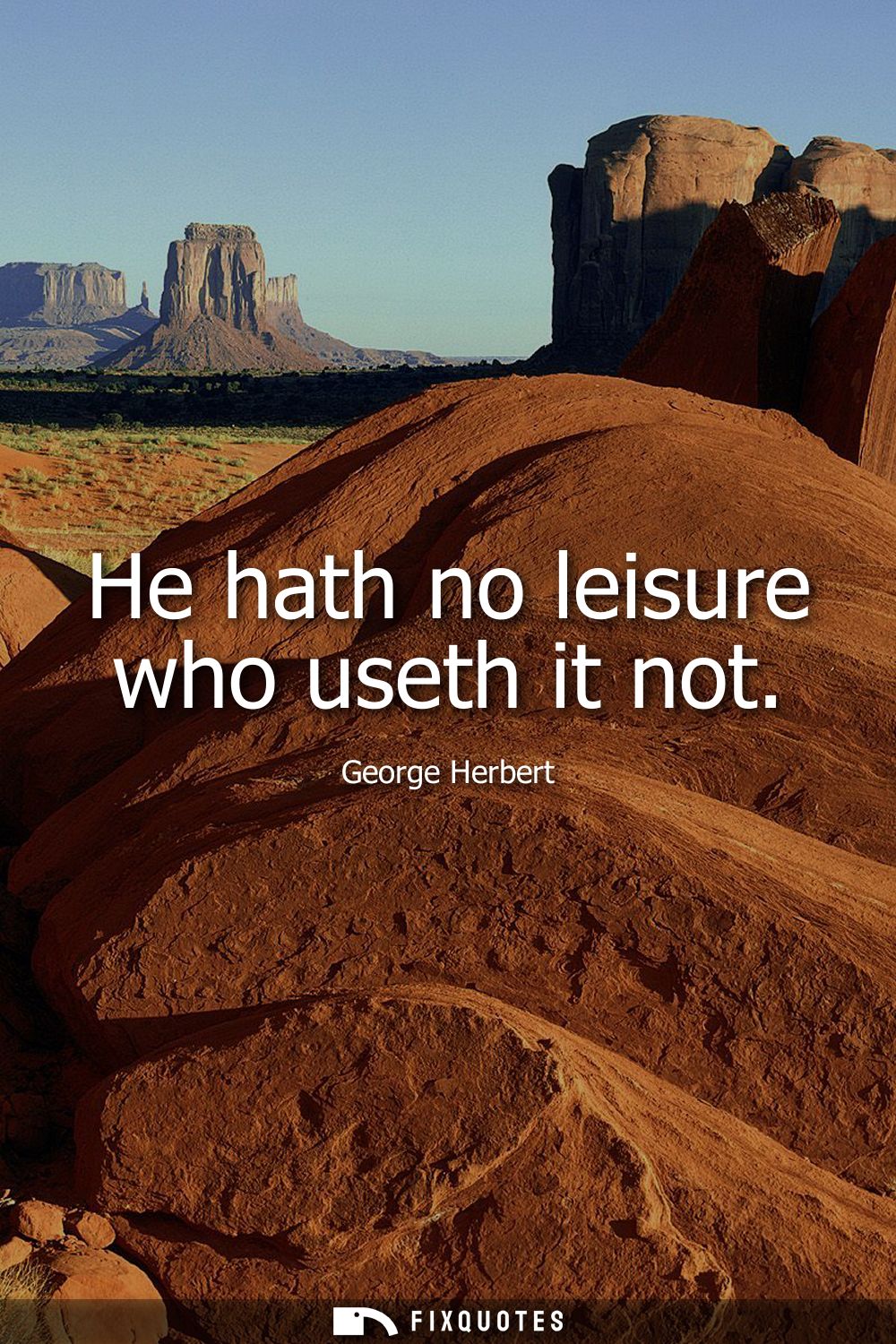
"He hath no leisure who useth it not"
About this Quote
Leisure, Herbert implies, isn’t something you get; it’s something you practice. The line reads like a proverb, but it’s really a quiet rebuke aimed at the pious, busy, self-excusing mind. “He hath no leisure who useth it not” turns time into a moral instrument: if you fail to put free moments to purpose, you don’t merely waste leisure, you forfeit the right to claim you ever had it. The sting is in the old syntax. “Hath” sounds like possession, “useth” like discipline. Leisure becomes less an indulgence than a stewardship.
Herbert writes from a world where idleness isn’t neutral. As a devotional poet and Anglican priest, he’s suspicious of the comforting story that life is simply too crowded for reflection, prayer, study, or repair. The subtext is not “work harder” in the modern productivity-guru sense; it’s closer to “stop lying to yourself about time.” He’s calling out the spiritual version of procrastination: the habit of waiting for the perfectly open hour before tending to what matters. That hour never arrives, because a life can be filled to the brim with motion and still be empty of intention.
The aphorism also plays defense against class assumptions about leisure. In Herbert’s era, “leisure” could signal privilege. He reframes it as a choice available even amid constraint: not a long vacation, but the willingness to claim small intervals and use them well. The line survives because it refuses our favorite alibi: that our chaos is purely external, rather than partly curated.
Herbert writes from a world where idleness isn’t neutral. As a devotional poet and Anglican priest, he’s suspicious of the comforting story that life is simply too crowded for reflection, prayer, study, or repair. The subtext is not “work harder” in the modern productivity-guru sense; it’s closer to “stop lying to yourself about time.” He’s calling out the spiritual version of procrastination: the habit of waiting for the perfectly open hour before tending to what matters. That hour never arrives, because a life can be filled to the brim with motion and still be empty of intention.
The aphorism also plays defense against class assumptions about leisure. In Herbert’s era, “leisure” could signal privilege. He reframes it as a choice available even amid constraint: not a long vacation, but the willingness to claim small intervals and use them well. The line survives because it refuses our favorite alibi: that our chaos is purely external, rather than partly curated.
Quote Details
| Topic | Time |
|---|---|
| Source | Help us find the source |
| Cite |
Citation Formats
APA Style (7th ed.)
Herbert, George. (2026, January 18). He hath no leisure who useth it not. FixQuotes. https://fixquotes.com/quotes/he-hath-no-leisure-who-useth-it-not-8510/
Chicago Style
Herbert, George. "He hath no leisure who useth it not." FixQuotes. January 18, 2026. https://fixquotes.com/quotes/he-hath-no-leisure-who-useth-it-not-8510/.
MLA Style (9th ed.)
"He hath no leisure who useth it not." FixQuotes, 18 Jan. 2026, https://fixquotes.com/quotes/he-hath-no-leisure-who-useth-it-not-8510/. Accessed 2 Apr. 2026.
More Quotes by George
Add to List