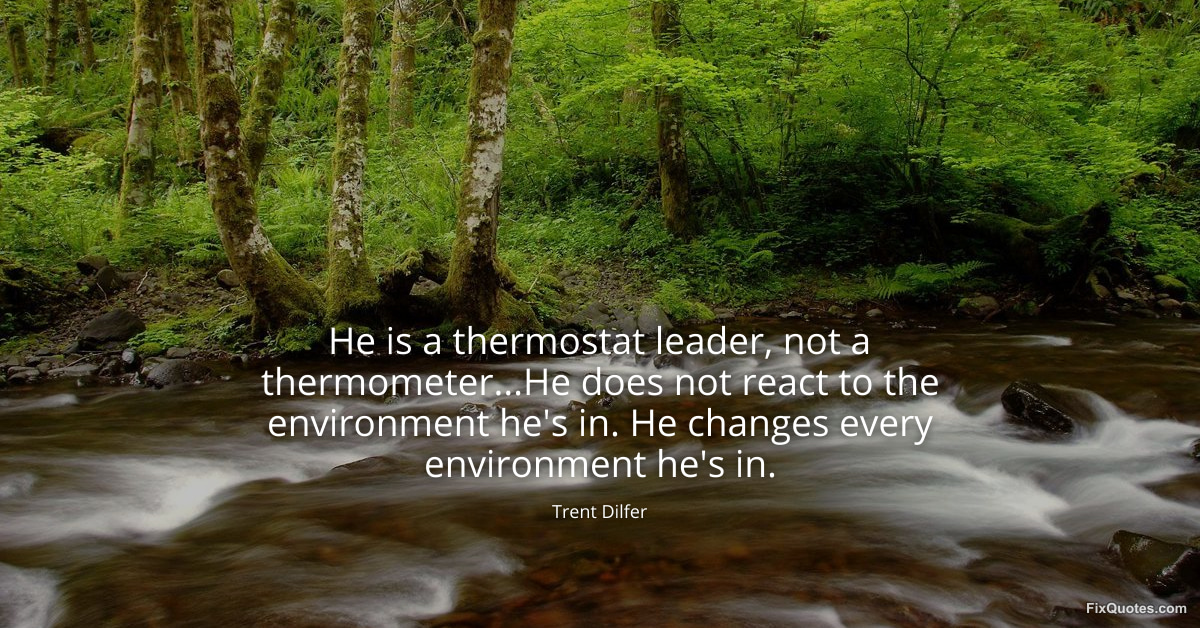
"He is a thermostat leader, not a thermometer...He does not react to the environment he's in. He changes every environment he's in"
About this Quote
The subtext is a quiet indictment of the way teams (and workplaces) often confuse “fits our culture” with “won’t disturb anyone.” Dilfer flips that. The leader he’s praising is disruptive by design, the person whose standards are so consistent they rewrite the norms around them. In sports, where “momentum” and “energy” get talked about like mystical substances, calling someone a thermostat is a way to make the intangible sound measurable: you can feel the temperature change when they walk in, when practice starts, when things go sideways.
Context matters because Dilfer is an athlete-turned-evaluator, someone whose credibility comes less from poetic language than from film-room authority. That’s why the line lands: it’s aspirational without being sentimental. It also smuggles in a hard truth about power. “He changes every environment he’s in” isn’t just praise; it’s a claim of dominance, even control. Great leaders don’t merely adapt to the culture. They make the culture adapt to them. The appeal is obvious in a results business. The risk is, it can excuse bulldozing in the name of “setting the tone.”
Quote Details
| Topic | Leadership |
|---|---|
| Source | Help us find the source |
| Cite |
Citation Formats
APA Style (7th ed.)
Dilfer, Trent. (2026, January 11). He is a thermostat leader, not a thermometer...He does not react to the environment he's in. He changes every environment he's in. FixQuotes. https://fixquotes.com/quotes/he-is-a-thermostat-leader-not-a-thermometerhe-183715/
Chicago Style
Dilfer, Trent. "He is a thermostat leader, not a thermometer...He does not react to the environment he's in. He changes every environment he's in." FixQuotes. January 11, 2026. https://fixquotes.com/quotes/he-is-a-thermostat-leader-not-a-thermometerhe-183715/.
MLA Style (9th ed.)
"He is a thermostat leader, not a thermometer...He does not react to the environment he's in. He changes every environment he's in." FixQuotes, 11 Jan. 2026, https://fixquotes.com/quotes/he-is-a-thermostat-leader-not-a-thermometerhe-183715/. Accessed 19 Mar. 2026.