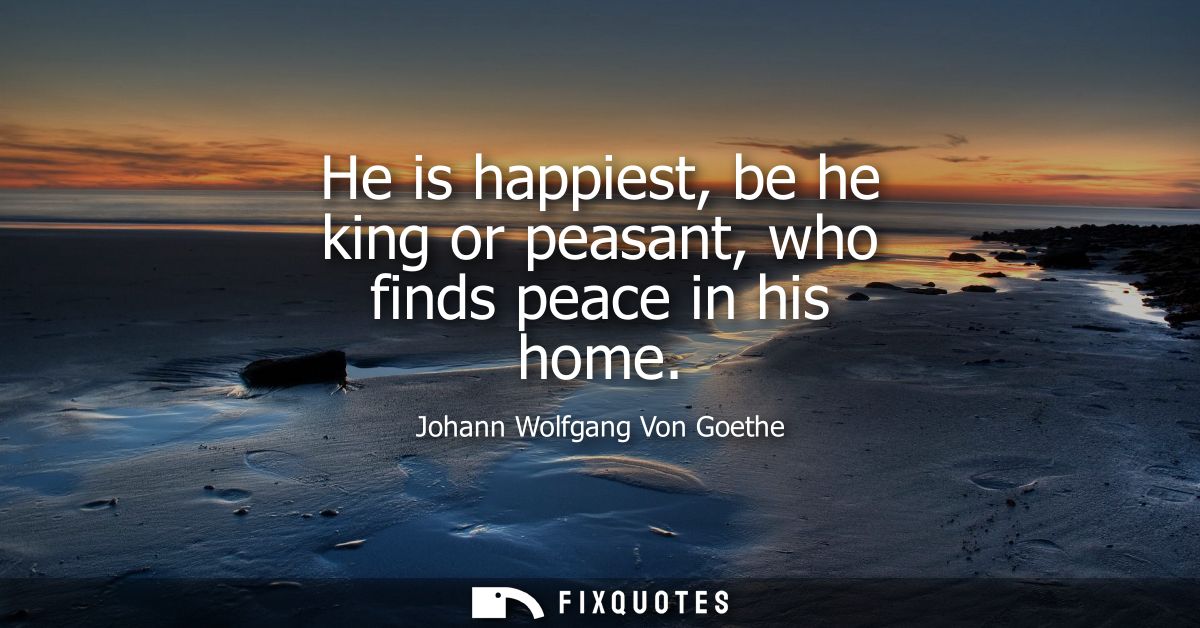
"He is happiest, be he king or peasant, who finds peace in his home"
About this Quote
The line works because it treats "home" less as architecture than as an inner jurisdiction. "Finds peace" suggests effort, cultivation, even negotiation. Peace is not inherited with a crown or denied by a rougher station; it's assembled through habits, relationships, and self-command. That phrasing also carries a moral warning: if your household is a theater of resentment, ambition won't anesthetize you. The king still brings himself to dinner.
Context matters. Goethe lived through the churn of late Enlightenment Europe into the Napoleonic era, watching grand ideologies and empires promise meaning while grinding ordinary lives. In that climate, domestic peace becomes a counter-argument to history's noise: a human-scale measure of the good life when public narratives turn volatile. As a leading voice of German letters and a statesman in Weimar, he also knew the seductions of prestige. This reads like counsel from someone who has seen "importance" up close and found it oddly porous.
The subtext is almost subversive: legitimacy isn't earned in court or marketplace but tested at home, where masks fit poorly and applause doesn't reach.
Quote Details
| Topic | Happiness |
|---|---|
| Source | Rejected source: Faust [part 1]. Translated Into English in the Original M... (Goethe, Johann Wolfgang von, 1832)EBook #14591
Evidence: pheles these are the small dependants who give me attendance hear them to deeds Other candidates (2) Compelling Conversations: Questions and Quotations on Tim... (Eric H. Roth, Toni Aberson, 2010) compilation95.0% ... He is happiest, be he king or peasant, who finds peace in his home.”—Johann Wolfgang von Goethe (1749–1832), Germ... Equality (Johann Wolfgang Von Goethe) compilation38.8% heir respect is as much to blame as a coward who hides himself from his enemy be |
| Cite |
Citation Formats
APA Style (7th ed.)
Goethe, Johann Wolfgang Von. (2026, January 13). He is happiest, be he king or peasant, who finds peace in his home. FixQuotes. https://fixquotes.com/quotes/he-is-happiest-be-he-king-or-peasant-who-finds-34164/
Chicago Style
Goethe, Johann Wolfgang Von. "He is happiest, be he king or peasant, who finds peace in his home." FixQuotes. January 13, 2026. https://fixquotes.com/quotes/he-is-happiest-be-he-king-or-peasant-who-finds-34164/.
MLA Style (9th ed.)
"He is happiest, be he king or peasant, who finds peace in his home." FixQuotes, 13 Jan. 2026, https://fixquotes.com/quotes/he-is-happiest-be-he-king-or-peasant-who-finds-34164/. Accessed 7 Feb. 2026.