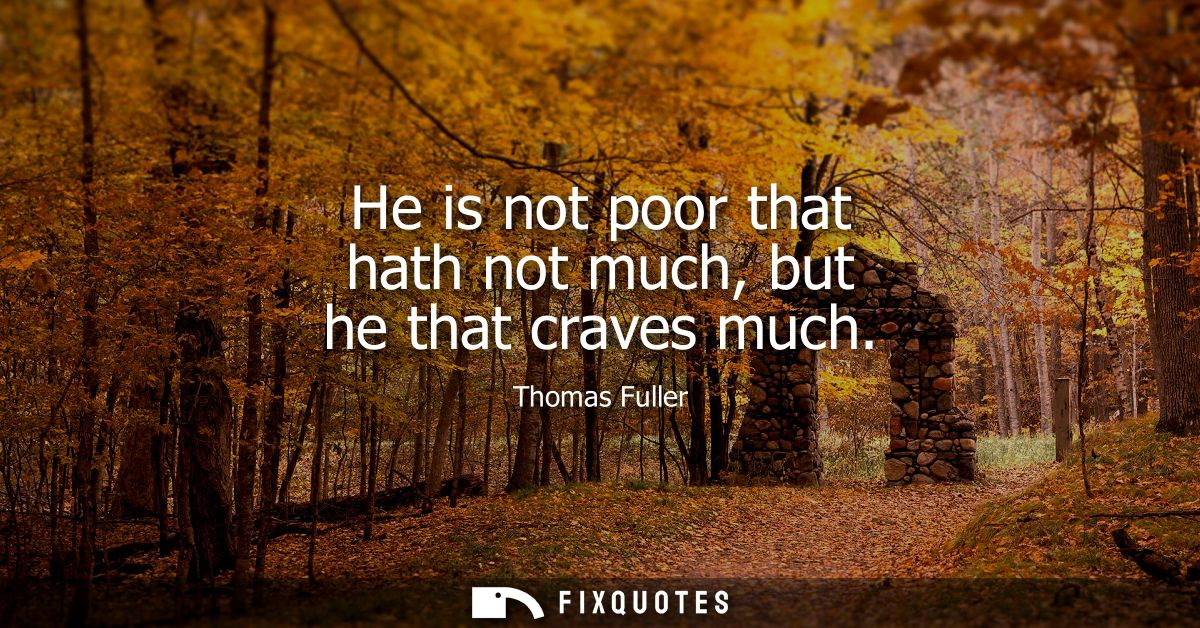
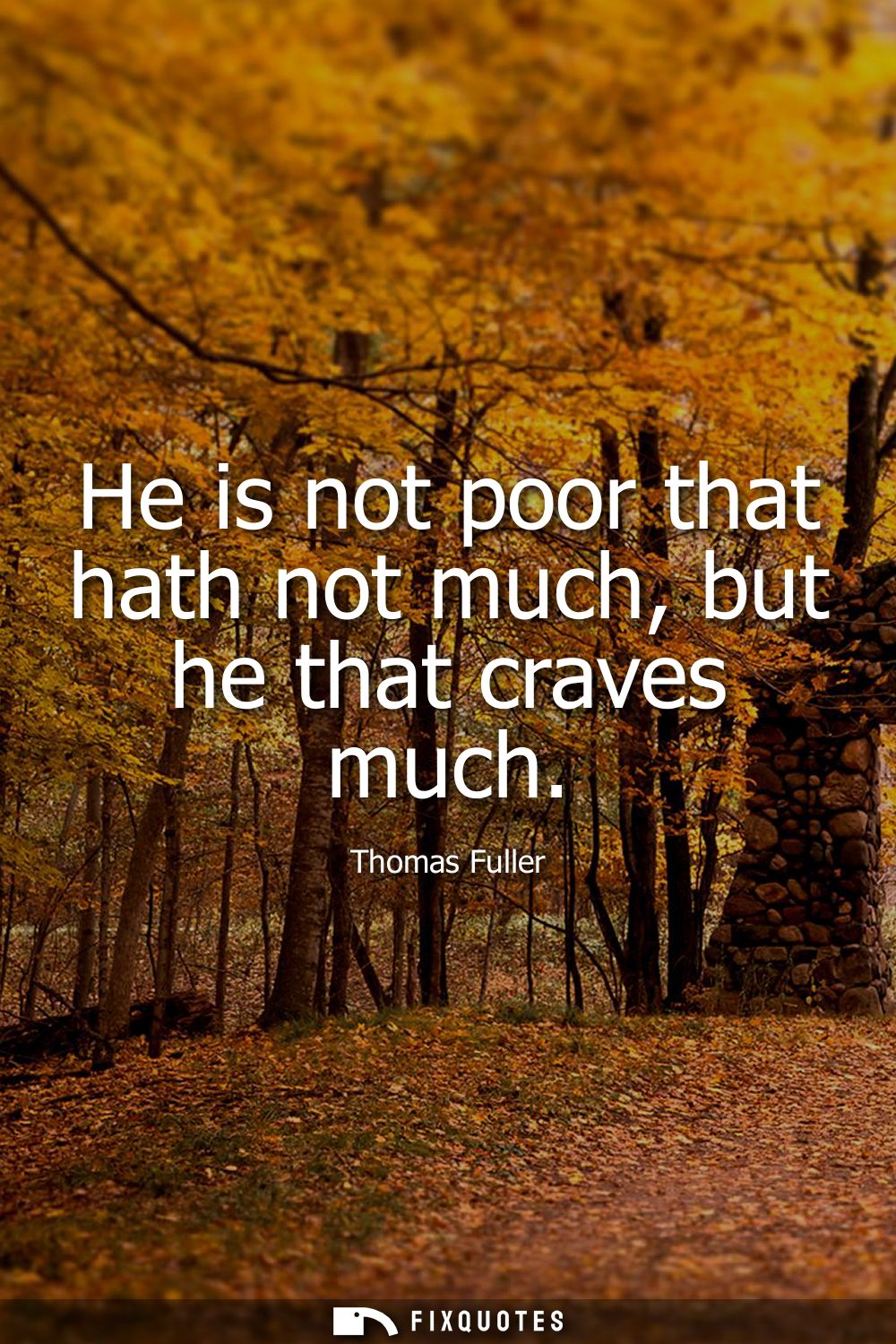
"He is not poor that hath not much, but he that craves much"
About this Quote
Poverty, Fuller insists, isn’t a number in a ledger; it’s a condition of appetite. The line flips the usual moral panic about scarcity into a critique of craving, a move that lands with the quiet authority of a clergyman who watched an England racked by civil war, political upheaval, and the anxious reshuffling of wealth and status. In a world where property could be seized, fortunes dissolved, and yesterday’s certainties turned inside out, “not much” was often a fact of life. What Fuller targets is the self-inflicted misery of wanting more than any life can hold.
The wording matters: “craves” is bodily, almost medicinal. It frames excessive desire as a kind of hunger that keeps eating the person who feeds it. “Hath” carries the older weight of possession as stewardship, not mere accumulation. The sentence is built as a corrective, an almost pastoral rebuke: you’re naming the wrong problem. That’s a subtle but pointed shift in moral accountability. If poverty is defined by craving, the rich are not exempt; they may be the poorest in Fuller's terms, because their identity depends on a moving target.
There’s also a social subtext with bite: craving destabilizes communities. It fuels envy, extractive dealings, and the relentless comparison that turns neighbors into rivals. Fuller’s intent isn’t to romanticize deprivation; it’s to warn that desire, once unmoored from sufficiency, becomes a tyranny more reliable than any king.
The wording matters: “craves” is bodily, almost medicinal. It frames excessive desire as a kind of hunger that keeps eating the person who feeds it. “Hath” carries the older weight of possession as stewardship, not mere accumulation. The sentence is built as a corrective, an almost pastoral rebuke: you’re naming the wrong problem. That’s a subtle but pointed shift in moral accountability. If poverty is defined by craving, the rich are not exempt; they may be the poorest in Fuller's terms, because their identity depends on a moving target.
There’s also a social subtext with bite: craving destabilizes communities. It fuels envy, extractive dealings, and the relentless comparison that turns neighbors into rivals. Fuller’s intent isn’t to romanticize deprivation; it’s to warn that desire, once unmoored from sufficiency, becomes a tyranny more reliable than any king.
Quote Details
| Topic | Contentment |
|---|---|
| Source | Help us find the source |
| Cite |
Citation Formats
APA Style (7th ed.)
Fuller, Thomas. (2026, January 15). He is not poor that hath not much, but he that craves much. FixQuotes. https://fixquotes.com/quotes/he-is-not-poor-that-hath-not-much-but-he-that-10317/
Chicago Style
Fuller, Thomas. "He is not poor that hath not much, but he that craves much." FixQuotes. January 15, 2026. https://fixquotes.com/quotes/he-is-not-poor-that-hath-not-much-but-he-that-10317/.
MLA Style (9th ed.)
"He is not poor that hath not much, but he that craves much." FixQuotes, 15 Jan. 2026, https://fixquotes.com/quotes/he-is-not-poor-that-hath-not-much-but-he-that-10317/. Accessed 11 Feb. 2026.
More Quotes by Thomas
Add to List