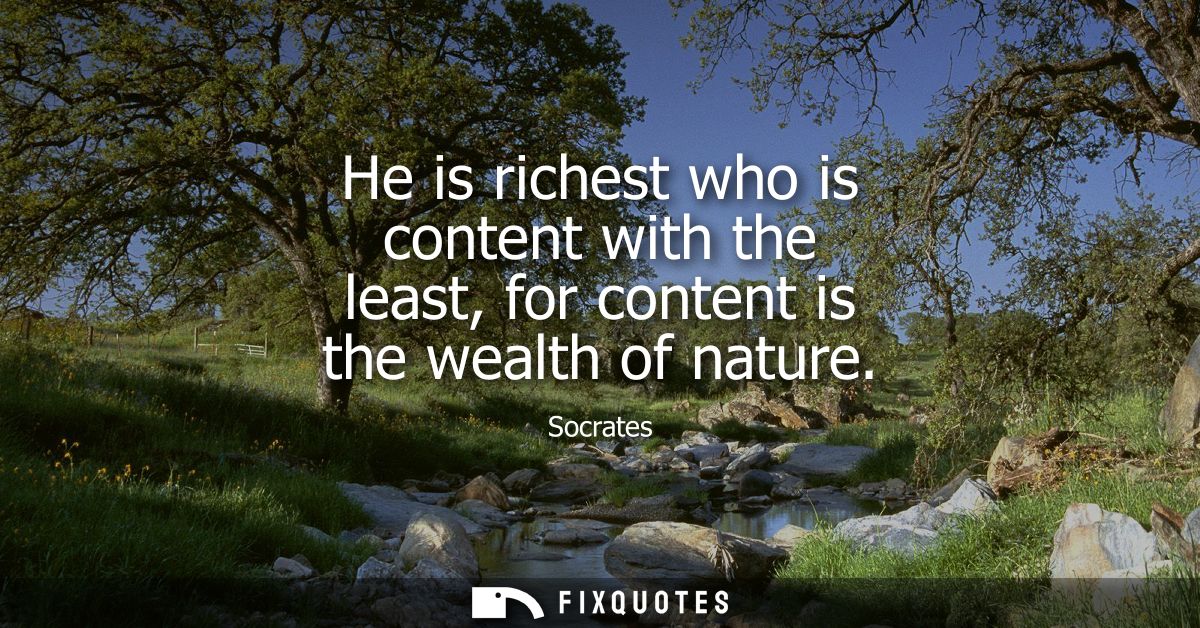
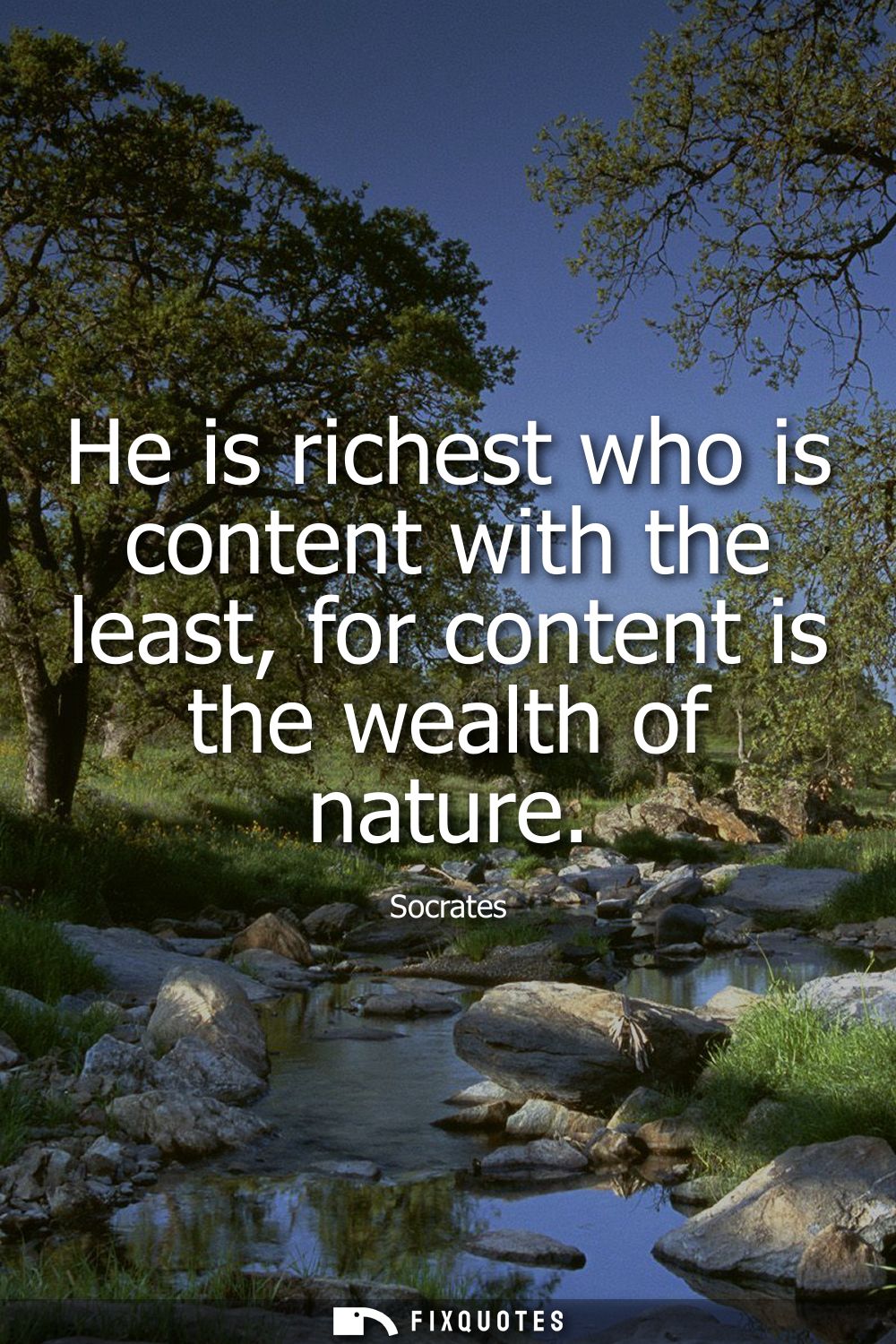
"He is richest who is content with the least, for content is the wealth of nature"
About this Quote
The intent is philosophical, but the subtext is political. If your sense of sufficiency comes from inside, you become harder to buy, flatter, or threaten. Contentment isn’t just a mood here; it’s a form of independence. That’s why “content is the wealth of nature” lands like a cold rebuke to luxury: nature offers baseline abundance (air, water, basic sustenance), while society manufactures scarcity through comparison. Socrates is arguing that many “needs” are actually social pressures wearing the mask of necessity.
The rhetoric works because it reframes deprivation as power. “Least” sounds like loss until it’s paired with “richest,” a deliberate paradox that makes the listener do the recalculation themselves. It’s also a moral provocation aimed at his fellow Athenians: if you’re anxious, greedy, or easily impressed, you’re not affluent, you’re dependent.
Read in the context of Socrates’ life - the gadfly who questioned public certainty and paid for it - contentment becomes a survival strategy for truth-telling. The fewer things you require to feel whole, the more freely you can live, speak, and choose.
Quote Details
| Topic | Contentment |
|---|---|
| Source | Later attribution: ORISON SWETT MARDEN Premium Collection - Wisdom & Empower... (Orison Swett Marden, 2023) modern compilationID: XsniEAAAQBAJ
Evidence:
... He is richest who is content with the least , for content is the wealth of nature . - SOCRATES . My crown is in my heart , not on my head , Nor decked with diamonds and Indian stones , Nor to be seen : my crown is called content ; A ... |
| Cite |
Citation Formats
APA Style (7th ed.)
Socrates. (2026, February 11). He is richest who is content with the least, for content is the wealth of nature. FixQuotes. https://fixquotes.com/quotes/he-is-richest-who-is-content-with-the-least-for-24979/
Chicago Style
Socrates. "He is richest who is content with the least, for content is the wealth of nature." FixQuotes. February 11, 2026. https://fixquotes.com/quotes/he-is-richest-who-is-content-with-the-least-for-24979/.
MLA Style (9th ed.)
"He is richest who is content with the least, for content is the wealth of nature." FixQuotes, 11 Feb. 2026, https://fixquotes.com/quotes/he-is-richest-who-is-content-with-the-least-for-24979/. Accessed 24 Mar. 2026.