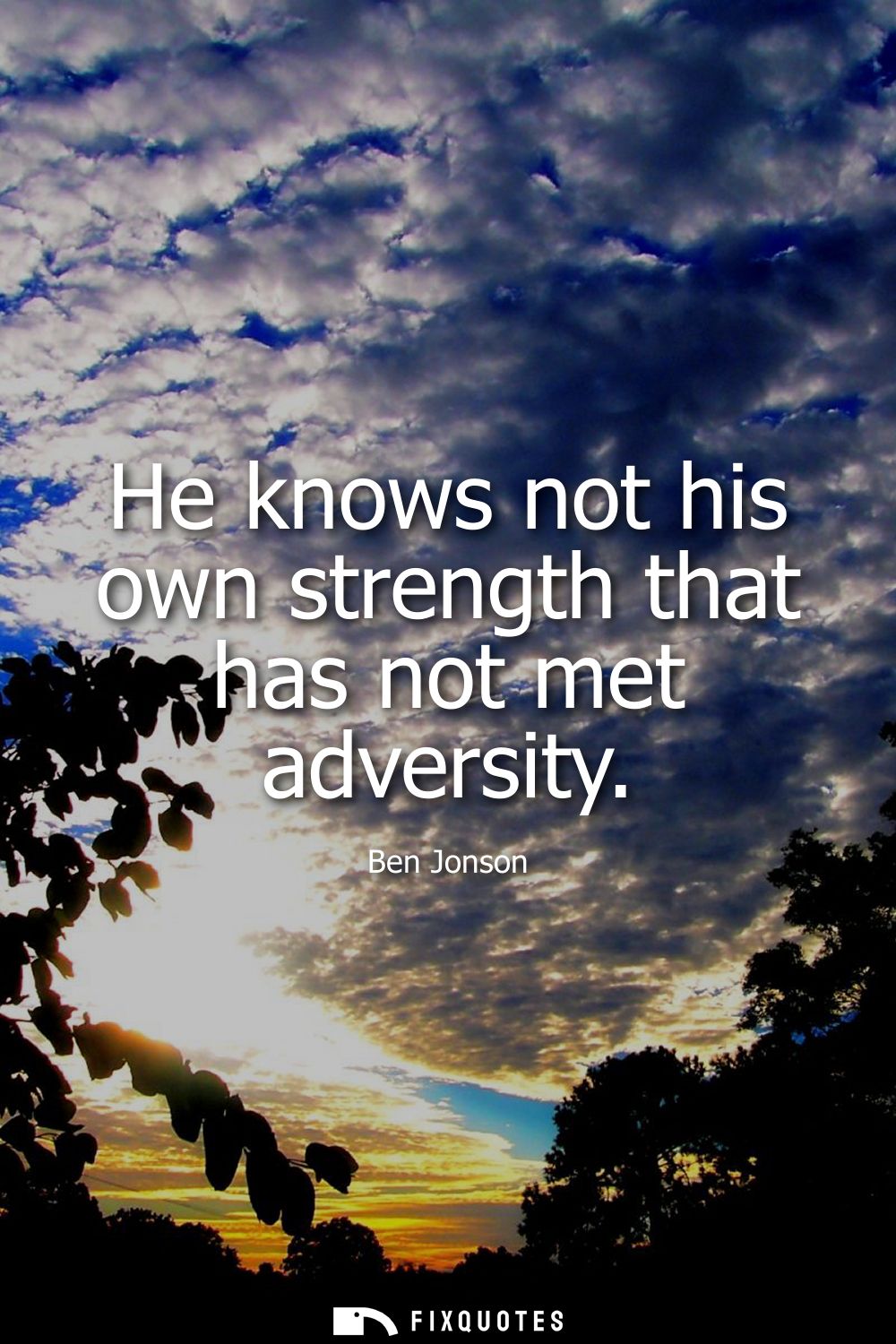
"He knows not his own strength that has not met adversity"
About this Quote
Adversity, for Jonson, is not just a misfortune to endure; it is the only honest mirror. "He knows not his own strength" opens with a quiet insult: self-assurance without testing is basically a parlor trick. The line’s snap comes from its double edge. It sounds like encouragement, but it also strips comfort from anyone coasting on reputation, privilege, or imagined grit. Strength is not a trait you declare; it’s a capacity revealed under pressure.
Jonson’s phrasing is deliberately spare and proverbial, the kind of sentence that wants to be repeated in taverns and courts alike. That matters in his world. Early modern England prized public performance - of loyalty, masculinity, religious conformity, artistic skill - while remaining politically volatile and socially stratified. Jonson himself knew the stakes: a working-class background, patronage dependencies, artistic feuds, even imprisonment. In that context, "adversity" isn’t abstract; it’s the daily weather of a life where status can tilt on a sponsor’s whim or a censor’s glare.
The subtext is almost Calvinist in its suspicion of ease. Comfort breeds illusions; hardship produces evidence. Yet Jonson avoids piety. He frames adversity as a proving ground, not a punishment, which lets the line function as social critique: the untested powerful may be the weakest people in the room. It flatters endurance while warning against the soft arrogance of the untried.
Jonson’s phrasing is deliberately spare and proverbial, the kind of sentence that wants to be repeated in taverns and courts alike. That matters in his world. Early modern England prized public performance - of loyalty, masculinity, religious conformity, artistic skill - while remaining politically volatile and socially stratified. Jonson himself knew the stakes: a working-class background, patronage dependencies, artistic feuds, even imprisonment. In that context, "adversity" isn’t abstract; it’s the daily weather of a life where status can tilt on a sponsor’s whim or a censor’s glare.
The subtext is almost Calvinist in its suspicion of ease. Comfort breeds illusions; hardship produces evidence. Yet Jonson avoids piety. He frames adversity as a proving ground, not a punishment, which lets the line function as social critique: the untested powerful may be the weakest people in the room. It flatters endurance while warning against the soft arrogance of the untried.
Quote Details
| Topic | Resilience |
|---|---|
| Source | Help us find the source |
| Cite |
Citation Formats
APA Style (7th ed.)
Jonson, Ben. (2026, January 15). He knows not his own strength that has not met adversity. FixQuotes. https://fixquotes.com/quotes/he-knows-not-his-own-strength-that-has-not-met-64081/
Chicago Style
Jonson, Ben. "He knows not his own strength that has not met adversity." FixQuotes. January 15, 2026. https://fixquotes.com/quotes/he-knows-not-his-own-strength-that-has-not-met-64081/.
MLA Style (9th ed.)
"He knows not his own strength that has not met adversity." FixQuotes, 15 Jan. 2026, https://fixquotes.com/quotes/he-knows-not-his-own-strength-that-has-not-met-64081/. Accessed 6 Apr. 2026.
More Quotes by Ben
Add to List