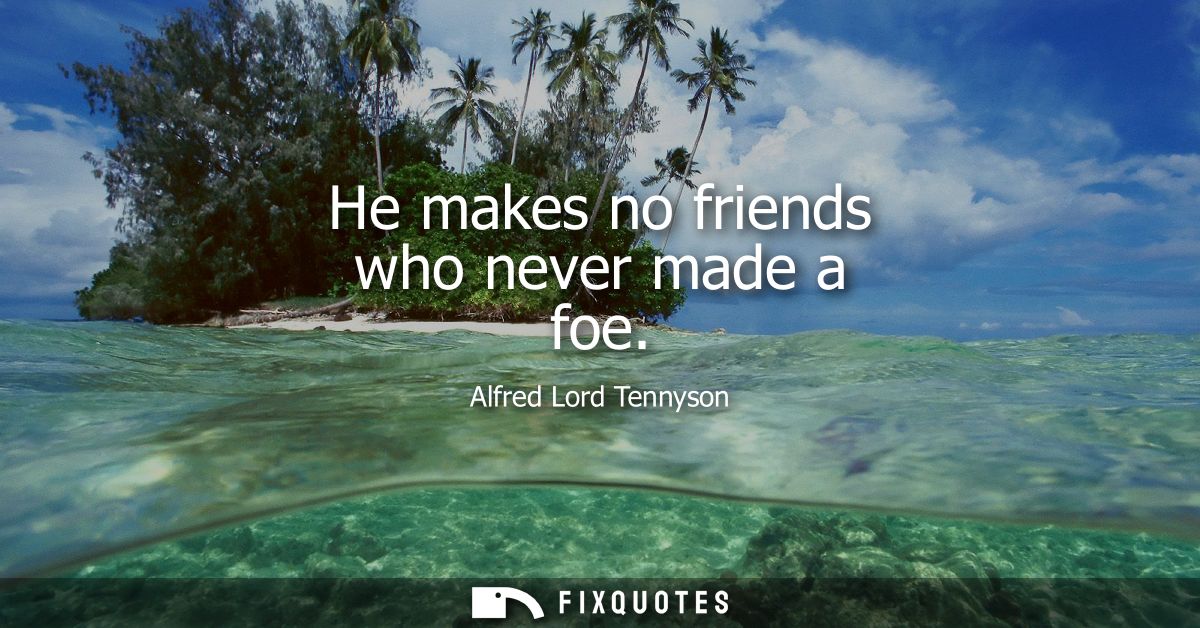
"He makes no friends who never made a foe"
About this Quote
Friendship, in Tennyson's line, is not the polite accumulation of agreeable contacts; it is the hard-won byproduct of having stakes. "He makes no friends who never made a foe" cuts against the Victorian ideal of social smoothness by treating friction as evidence of conviction. If no one ever opposes you, Tennyson suggests, you may be so careful, so accommodating, so allergic to conflict that you never actually stand for anything long enough to matter to anyone.
The subtext is a bracing moral economy: loyalty is forged where values collide. A "foe" here doesn't have to mean an enemy in the melodramatic sense; it can be the person, institution, or prevailing opinion you refuse to flatter. That refusal creates the conditions for real friendship, not as shared taste but as shared risk. People bond most deeply when they recognize one another as willing to pay a price for principle.
Context helps. Tennyson wrote in an era anxious about reputation, class boundaries, and propriety, yet also alive with public argument: reform, empire, faith, industrial upheaval. In that world, to avoid foes often meant to avoid the public sphere altogether, to retreat into manners. The line reads like a corrective to the era's social caution, a poet's reminder that consensus is not the same as community.
It works because it's built on a paradox that feels true in lived experience: the absence of enemies can signal not virtue but invisibility. The aphorism flatters no one; it dares the reader to ask whether their peace is earned or merely maintained.
The subtext is a bracing moral economy: loyalty is forged where values collide. A "foe" here doesn't have to mean an enemy in the melodramatic sense; it can be the person, institution, or prevailing opinion you refuse to flatter. That refusal creates the conditions for real friendship, not as shared taste but as shared risk. People bond most deeply when they recognize one another as willing to pay a price for principle.
Context helps. Tennyson wrote in an era anxious about reputation, class boundaries, and propriety, yet also alive with public argument: reform, empire, faith, industrial upheaval. In that world, to avoid foes often meant to avoid the public sphere altogether, to retreat into manners. The line reads like a corrective to the era's social caution, a poet's reminder that consensus is not the same as community.
It works because it's built on a paradox that feels true in lived experience: the absence of enemies can signal not virtue but invisibility. The aphorism flatters no one; it dares the reader to ask whether their peace is earned or merely maintained.
Quote Details
| Topic | Friendship |
|---|---|
| Source | Help us find the source |
| Cite |
Citation Formats
APA Style (7th ed.)
Tennyson, Alfred Lord. (2026, January 18). He makes no friends who never made a foe. FixQuotes. https://fixquotes.com/quotes/he-makes-no-friends-who-never-made-a-foe-16755/
Chicago Style
Tennyson, Alfred Lord. "He makes no friends who never made a foe." FixQuotes. January 18, 2026. https://fixquotes.com/quotes/he-makes-no-friends-who-never-made-a-foe-16755/.
MLA Style (9th ed.)
"He makes no friends who never made a foe." FixQuotes, 18 Jan. 2026, https://fixquotes.com/quotes/he-makes-no-friends-who-never-made-a-foe-16755/. Accessed 1 Apr. 2026.
More Quotes by Alfred
Add to List