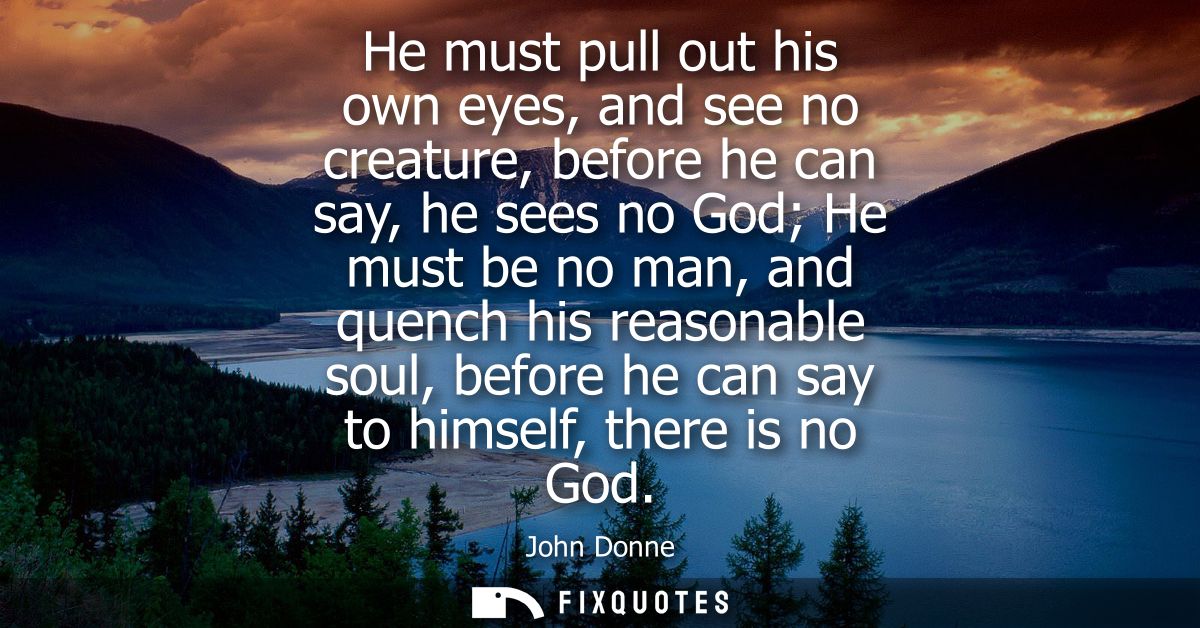
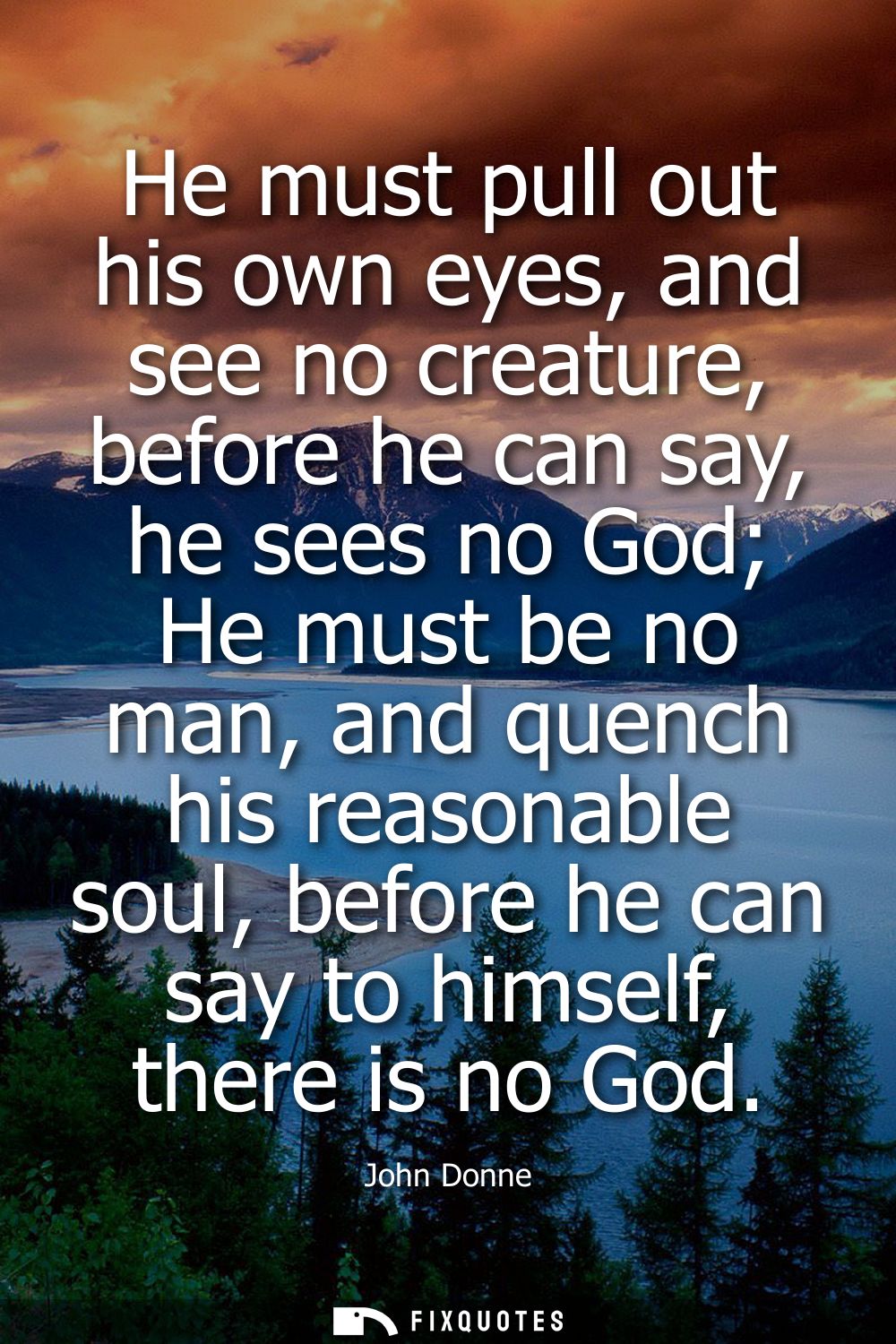
"He must pull out his own eyes, and see no creature, before he can say, he sees no God; He must be no man, and quench his reasonable soul, before he can say to himself, there is no God"
About this Quote
The intent is pastoral and prosecutorial at once. Donne writes as a preacher-poet in an England still raw from the Reformation’s ideological whiplash, where belief isn’t merely private metaphysics but public identity, loyalty, and risk. In that context, the line works like a piece of counter-propaganda: it fortifies the faithful by treating doubt not as a respectable position but as a violation of nature. You can almost hear the sermon cadence: repetition, escalation, the tightening of the noose.
The subtext is also personal. Donne’s work often circles the fear that the mind can talk itself into anything. By framing denial of God as “quenching” the soul, he acknowledges the modern problem he wants to preempt: rationality can be weaponized against faith. His solution is to redefine reason itself as a witness for God. If reason is properly alive, it points upward; if you reject God, it’s because you’ve first murdered reason. It’s an argument built less on proof than on shame, daring the skeptic to admit what kind of person they’d have to become to keep insisting “there is no God.”
Quote Details
| Topic | God |
|---|---|
| Source | Help us find the source |
| Cite |
Citation Formats
APA Style (7th ed.)
Donne, John. (2026, January 18). He must pull out his own eyes, and see no creature, before he can say, he sees no God; He must be no man, and quench his reasonable soul, before he can say to himself, there is no God. FixQuotes. https://fixquotes.com/quotes/he-must-pull-out-his-own-eyes-and-see-no-creature-8427/
Chicago Style
Donne, John. "He must pull out his own eyes, and see no creature, before he can say, he sees no God; He must be no man, and quench his reasonable soul, before he can say to himself, there is no God." FixQuotes. January 18, 2026. https://fixquotes.com/quotes/he-must-pull-out-his-own-eyes-and-see-no-creature-8427/.
MLA Style (9th ed.)
"He must pull out his own eyes, and see no creature, before he can say, he sees no God; He must be no man, and quench his reasonable soul, before he can say to himself, there is no God." FixQuotes, 18 Jan. 2026, https://fixquotes.com/quotes/he-must-pull-out-his-own-eyes-and-see-no-creature-8427/. Accessed 15 Feb. 2026.