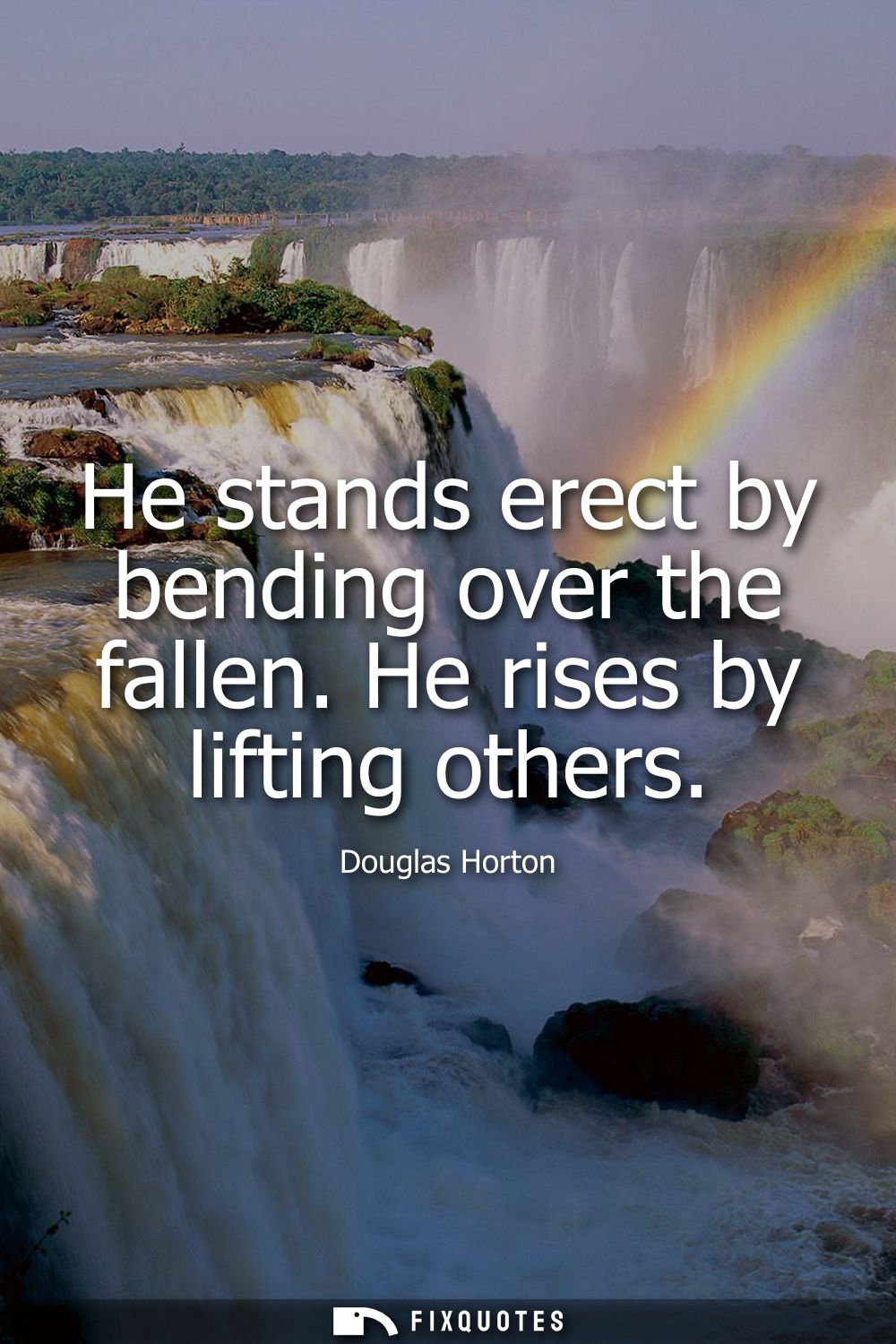
"He stands erect by bending over the fallen. He rises by lifting others"
About this Quote
As a clergyman writing in a century scarred by depression, world war, and mass displacement, Horton is speaking into a culture newly addicted to status metrics and public triumph. The subtext is anti-heroic but not anti-ambition. He doesn’t condemn rising; he redefines the mechanism. “He rises by lifting others” turns social ascent from a competitive ladder into a shared load. The implied target is a leadership style that treats people as rungs. Horton answers with an older Christian ethic: kenosis, the self-emptying move where power proves itself through service.
It also works because it’s bodily. “Stands,” “bending,” “fallen,” “rises,” “lifting” are verbs you can feel in your back and knees. That physicality makes the moral claim harder to dodge; you can picture the scene, and you can picture refusing it. Horton’s intent is quietly corrective: if your success requires someone else to stay down, you’re not standing tall, you’re just standing on someone.
Quote Details
| Topic | Servant Leadership |
|---|---|
| Source | Help us find the source |
| Cite |
Citation Formats
APA Style (7th ed.)
Horton, Douglas. (2026, January 15). He stands erect by bending over the fallen. He rises by lifting others. FixQuotes. https://fixquotes.com/quotes/he-stands-erect-by-bending-over-the-fallen-he-155353/
Chicago Style
Horton, Douglas. "He stands erect by bending over the fallen. He rises by lifting others." FixQuotes. January 15, 2026. https://fixquotes.com/quotes/he-stands-erect-by-bending-over-the-fallen-he-155353/.
MLA Style (9th ed.)
"He stands erect by bending over the fallen. He rises by lifting others." FixQuotes, 15 Jan. 2026, https://fixquotes.com/quotes/he-stands-erect-by-bending-over-the-fallen-he-155353/. Accessed 6 Mar. 2026.