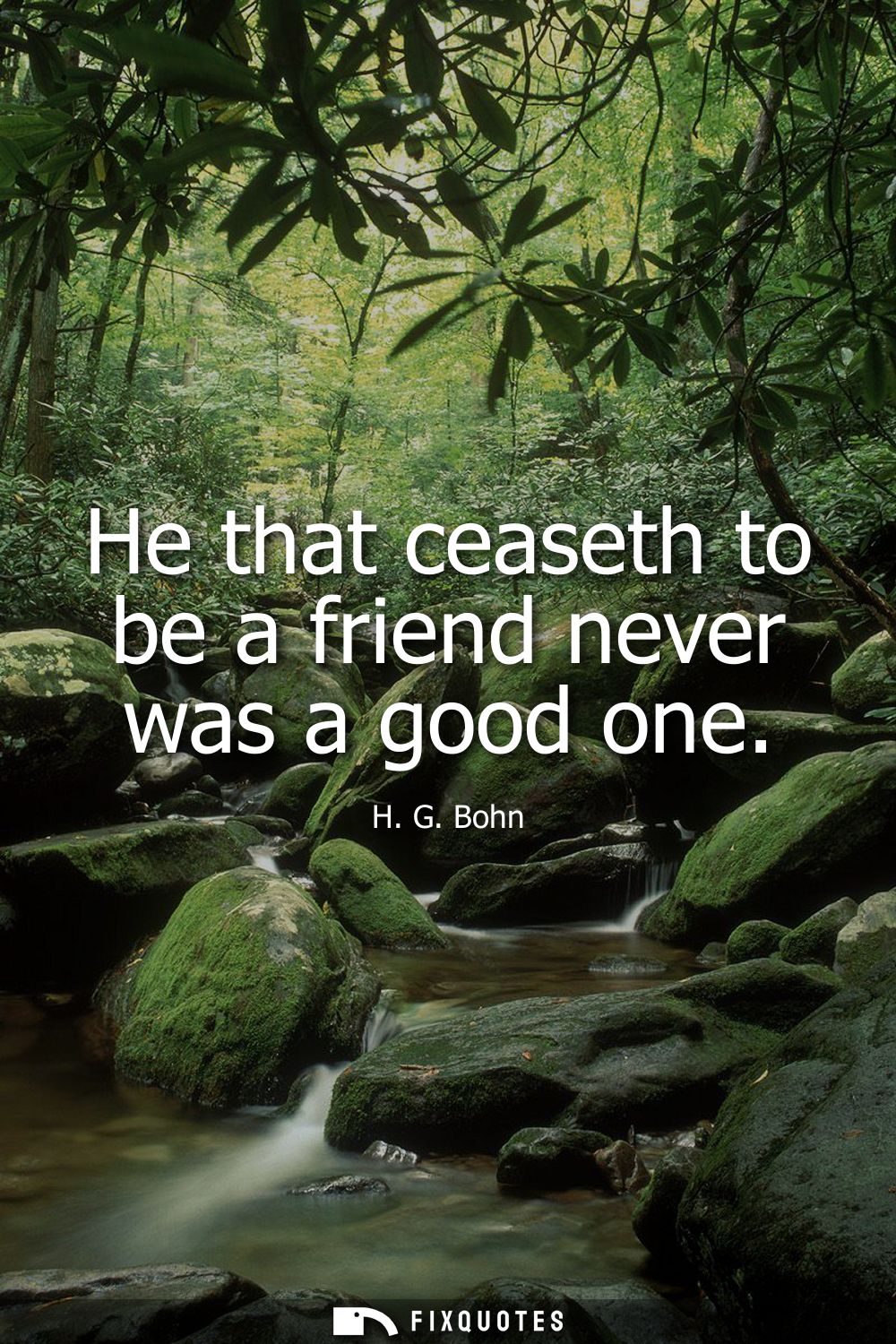
"He that ceaseth to be a friend never was a good one"
About this Quote
Friendship, in Bohn's formulation, isn’t a mood or a season; it’s a stress test. “He that ceaseth to be a friend never was a good one” draws a hard moral line between friendship as durable commitment and friendship as convenient alliance. The sentence is built like a trapdoor: if the relationship ends, the past is retroactively judged a kind of counterfeit. That absolutism is the point. It refuses the comforting story that people can “grow apart” without anyone being at fault, insisting instead that real loyalty has a spine.
Coming from a 19th-century publisher rather than a poet or philosopher, the maxim reads like the distilled ethic of a commercial world where reputation, trust, and long memory were currency. Publishing depended on networks: patrons, authors, printers, reviewers, booksellers. In such an ecosystem, the friend who disappears when the market shifts isn’t merely disappointing; he’s dangerous, proof that the bond was transactional all along. Bohn’s era also prized “character” as a public asset, something you performed consistently over time. A friendship that dissolves suggests not mutual change but moral deficiency.
The subtext is both bracing and slightly self-serving: permanence becomes the metric of virtue, and anyone who leaves can be dismissed as never authentic. That’s a neat defense against betrayal, and a neat way to avoid reckoning with complexity. Yet the line works because it captures a recognizable social truth: plenty of “friends” are really situational collaborators, and the moment the situation ends, so does the affection. Bohn packages that suspicion into a single, unforgiving verdict.
Coming from a 19th-century publisher rather than a poet or philosopher, the maxim reads like the distilled ethic of a commercial world where reputation, trust, and long memory were currency. Publishing depended on networks: patrons, authors, printers, reviewers, booksellers. In such an ecosystem, the friend who disappears when the market shifts isn’t merely disappointing; he’s dangerous, proof that the bond was transactional all along. Bohn’s era also prized “character” as a public asset, something you performed consistently over time. A friendship that dissolves suggests not mutual change but moral deficiency.
The subtext is both bracing and slightly self-serving: permanence becomes the metric of virtue, and anyone who leaves can be dismissed as never authentic. That’s a neat defense against betrayal, and a neat way to avoid reckoning with complexity. Yet the line works because it captures a recognizable social truth: plenty of “friends” are really situational collaborators, and the moment the situation ends, so does the affection. Bohn packages that suspicion into a single, unforgiving verdict.
Quote Details
| Topic | Fake Friends |
|---|---|
| Source | Help us find the source |
| Cite |
Citation Formats
APA Style (7th ed.)
Bohn, H. G. (2026, January 15). He that ceaseth to be a friend never was a good one. FixQuotes. https://fixquotes.com/quotes/he-that-ceaseth-to-be-a-friend-never-was-a-good-101423/
Chicago Style
Bohn, H. G. "He that ceaseth to be a friend never was a good one." FixQuotes. January 15, 2026. https://fixquotes.com/quotes/he-that-ceaseth-to-be-a-friend-never-was-a-good-101423/.
MLA Style (9th ed.)
"He that ceaseth to be a friend never was a good one." FixQuotes, 15 Jan. 2026, https://fixquotes.com/quotes/he-that-ceaseth-to-be-a-friend-never-was-a-good-101423/. Accessed 5 Apr. 2026.
More Quotes by G. Bohn
Add to List