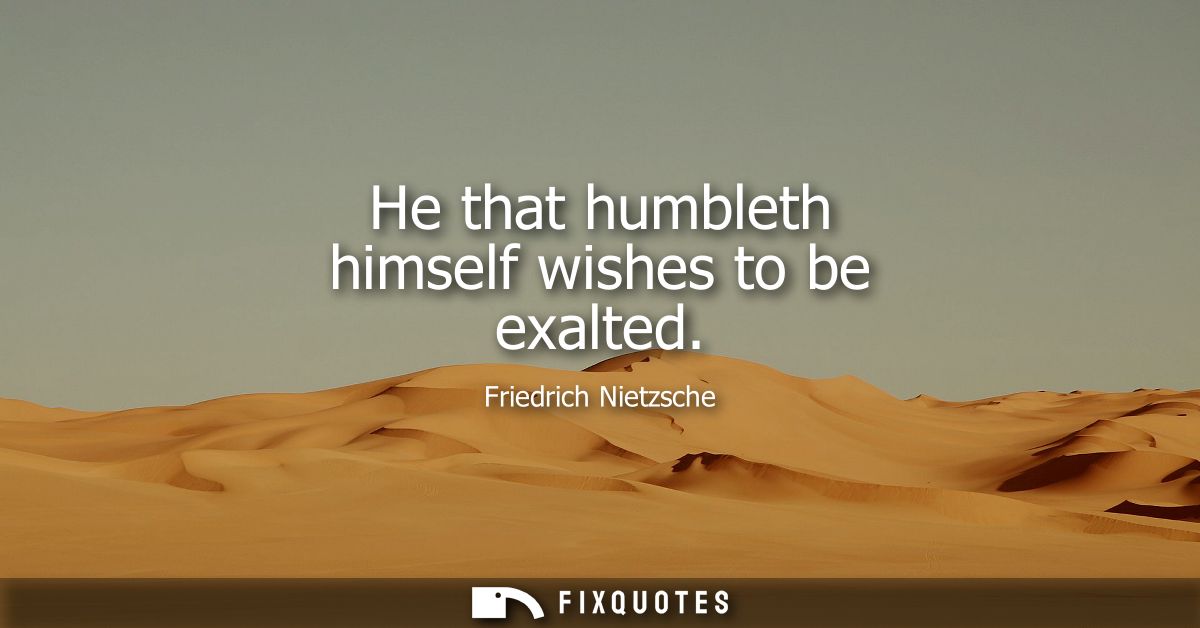
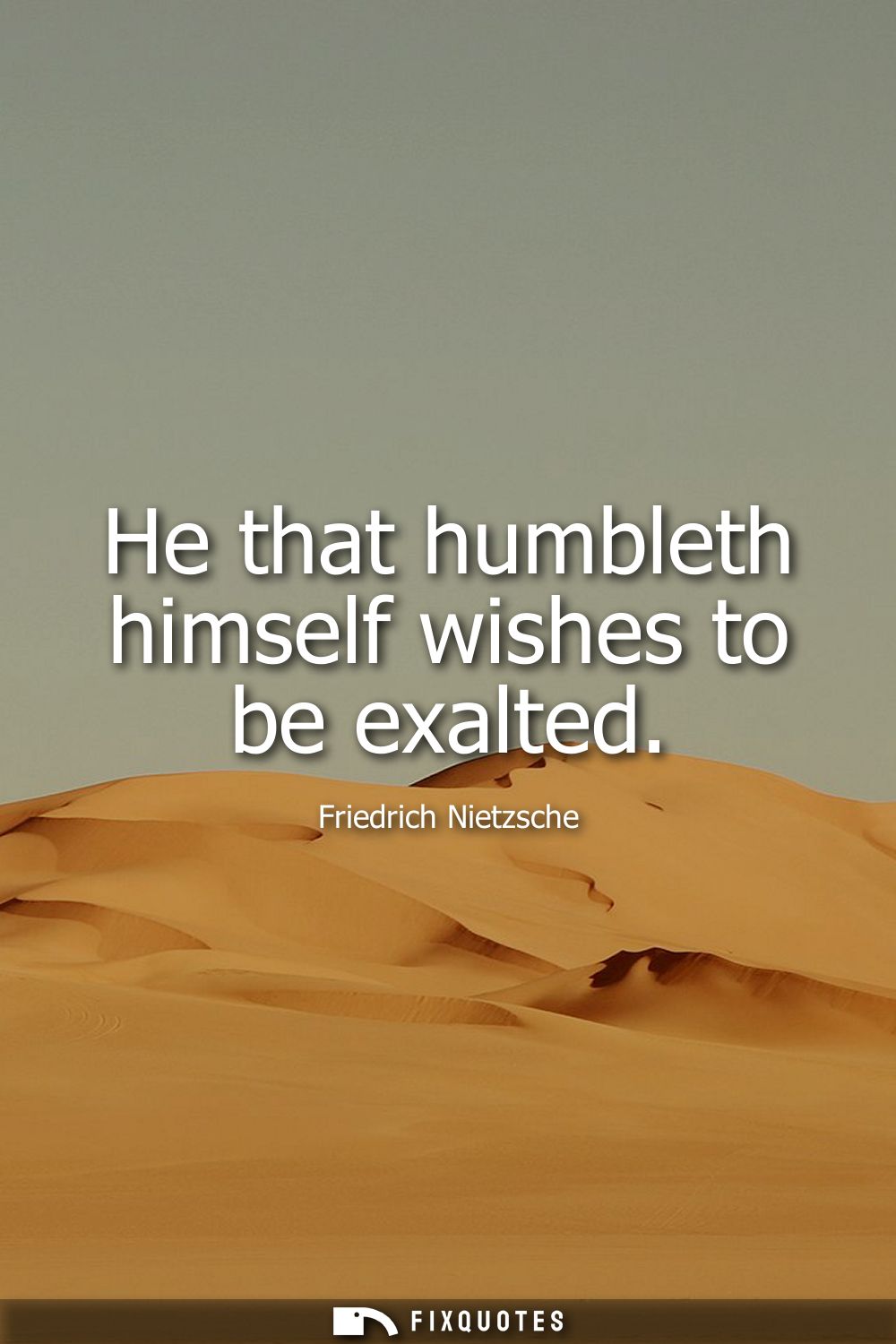
"He that humbleth himself wishes to be exalted"
About this Quote
Self-abasement, Nietzsche implies, is rarely the moral act it advertises; its real ambition is applause. "He that humbleth himself wishes to be exalted" skewers the spiritual optics of humility, the way self-lowering can function as a backdoor to status. The line twists a familiar Christian cadence (echoing the Gospel refrain that the humble will be lifted up) into a psychological accusation: humility is not the opposite of pride but one of its more sophisticated costumes.
The intent is diagnostic, not devotional. Nietzsche is tracing how moral languages become social technologies. In a culture that prizes meekness, the clever route to recognition is to perform meekness. The subtext is transactional: I diminish myself publicly so you are forced to elevate me; I renounce power in words so I can acquire it in influence. What looks like virtue becomes a strategy of moral leverage, a way to control others by obligating their admiration or guilt.
Contextually, this sits inside Nietzsche's broader war on what he calls slave morality: systems that convert weakness into righteousness and then punish strength as sin. Humility, in that framework, can be less a spiritual discipline than a ressentiment-driven tactic - the powerless recoding their condition as superiority. The line works because it’s both cynical and uncomfortably plausible: it doesn’t deny that humility exists, it suggests that in a world obsessed with moral signaling, even humility can be a bid for the podium.
The intent is diagnostic, not devotional. Nietzsche is tracing how moral languages become social technologies. In a culture that prizes meekness, the clever route to recognition is to perform meekness. The subtext is transactional: I diminish myself publicly so you are forced to elevate me; I renounce power in words so I can acquire it in influence. What looks like virtue becomes a strategy of moral leverage, a way to control others by obligating their admiration or guilt.
Contextually, this sits inside Nietzsche's broader war on what he calls slave morality: systems that convert weakness into righteousness and then punish strength as sin. Humility, in that framework, can be less a spiritual discipline than a ressentiment-driven tactic - the powerless recoding their condition as superiority. The line works because it’s both cynical and uncomfortably plausible: it doesn’t deny that humility exists, it suggests that in a world obsessed with moral signaling, even humility can be a bid for the podium.
Quote Details
| Topic | Humility |
|---|---|
| Source | Verified source: Human, All Too Human (Menschliches, Allzumenschliches) (Friedrich Nietzsche, 1878)
Evidence: Lucas 18,14 verbessert. , Wer sich selbst erniedrigt, will erhöht werden. (Part I, Section II (“Zur Geschichte der moralischen Empfindungen”), Aphorism 87). This line appears as Aphorism 87 in Part I of Nietzsche’s Human, All Too Human (original German: Menschliches, Allzumenschliches), explicitly framed as an “improvement” of Luke 18:14. The commonly-circulated English version “He that humbleth himself wishes to be exalted” is a translation/paraphrase of this aphorism (often rendered as “He who humbleth himself wants to be exalted.”). The underlying Biblical sentence being modified is Luke 18:14 (“…he that humbleth himself shall be exalted.”), but Nietzsche’s primary-source formulation is the one quoted above. Other candidates (1) Writings of Nietzsche: Volume III (Friedrich Nietzsche, 2017) compilation95.0% Friedrich Nietzsche. without any pricks of conscience. Therefore it was no sign of badness in Xerxes (whom even ... H... |
| Cite |
Citation Formats
APA Style (7th ed.)
Nietzsche, Friedrich. (2026, February 9). He that humbleth himself wishes to be exalted. FixQuotes. https://fixquotes.com/quotes/he-that-humbleth-himself-wishes-to-be-exalted-252/
Chicago Style
Nietzsche, Friedrich. "He that humbleth himself wishes to be exalted." FixQuotes. February 9, 2026. https://fixquotes.com/quotes/he-that-humbleth-himself-wishes-to-be-exalted-252/.
MLA Style (9th ed.)
"He that humbleth himself wishes to be exalted." FixQuotes, 9 Feb. 2026, https://fixquotes.com/quotes/he-that-humbleth-himself-wishes-to-be-exalted-252/. Accessed 28 Mar. 2026.
More Quotes by Friedrich
Add to List