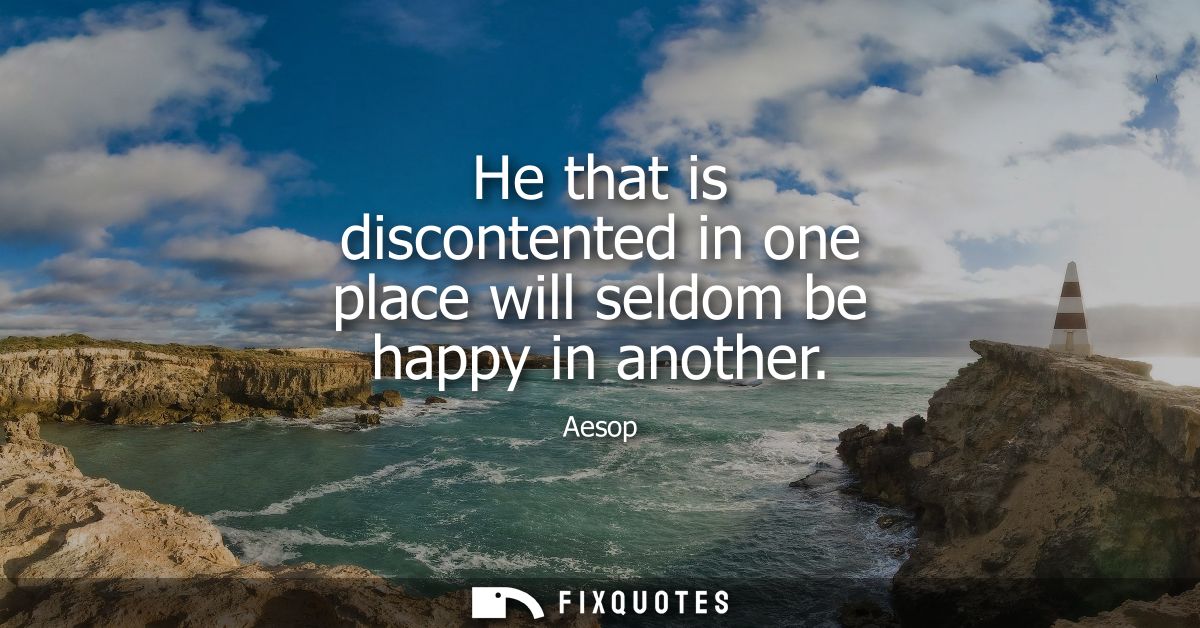
"He that is discontented in one place will seldom be happy in another"
About this Quote
Restlessness is not a geography problem; it is a character problem. Aesop’s line has the clean snap of a fable’s moral, but its real bite is psychological: if dissatisfaction is your default setting, a new backdrop won’t rewrite the script. The sentence is built like a trapdoor. “In one place” invites the listener to picture a specific town, job, household, marriage - the familiar targets of blame. Then “seldom” quietly refuses the comforting fantasy of reinvention. Not “never” (Aesop isn’t naive), but rarely, because the thing traveling with you is the mind that keeps finding fault.
The intent is corrective, aimed at the perennial human instinct to outsource discomfort onto surroundings. In Aesop’s world - crowded with animals who want shortcuts and humans who want exceptions - discontent is a moral and practical risk. It makes you manipulable. It turns you into prey for bad bargains, risky journeys, and the next shiny promise. “Another” is deliberately vague: the next village, the next master, the next era of your life. The vagueness is the point; the pattern is portable.
Subtextually, Aesop is warning against the romance of elsewhere. The quote isn’t praising complacency so much as insisting on self-scrutiny. Fix what’s internal (habits, gratitude, expectations, envy) before you torch what’s external. In a culture where survival depended on stability and reputation, constant dissatisfaction wasn’t just annoying - it was destabilizing. The aphorism still lands because it punctures a modern myth: that changing coordinates counts as changing yourself.
The intent is corrective, aimed at the perennial human instinct to outsource discomfort onto surroundings. In Aesop’s world - crowded with animals who want shortcuts and humans who want exceptions - discontent is a moral and practical risk. It makes you manipulable. It turns you into prey for bad bargains, risky journeys, and the next shiny promise. “Another” is deliberately vague: the next village, the next master, the next era of your life. The vagueness is the point; the pattern is portable.
Subtextually, Aesop is warning against the romance of elsewhere. The quote isn’t praising complacency so much as insisting on self-scrutiny. Fix what’s internal (habits, gratitude, expectations, envy) before you torch what’s external. In a culture where survival depended on stability and reputation, constant dissatisfaction wasn’t just annoying - it was destabilizing. The aphorism still lands because it punctures a modern myth: that changing coordinates counts as changing yourself.
Quote Details
| Topic | Contentment |
|---|---|
| Source | Help us find the source |
| Cite |
Citation Formats
APA Style (7th ed.)
Aesop. (2026, January 17). He that is discontented in one place will seldom be happy in another. FixQuotes. https://fixquotes.com/quotes/he-that-is-discontented-in-one-place-will-seldom-61472/
Chicago Style
Aesop. "He that is discontented in one place will seldom be happy in another." FixQuotes. January 17, 2026. https://fixquotes.com/quotes/he-that-is-discontented-in-one-place-will-seldom-61472/.
MLA Style (9th ed.)
"He that is discontented in one place will seldom be happy in another." FixQuotes, 17 Jan. 2026, https://fixquotes.com/quotes/he-that-is-discontented-in-one-place-will-seldom-61472/. Accessed 11 Feb. 2026.
More Quotes by Aesop
Add to List