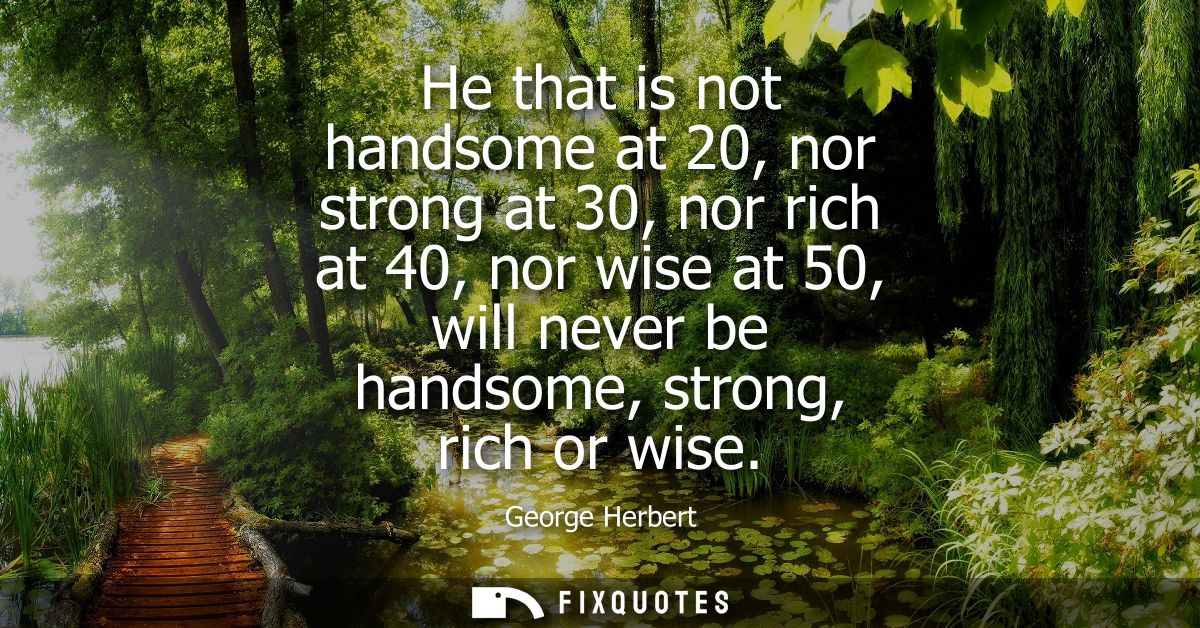
"He that is not handsome at 20, nor strong at 30, nor rich at 40, nor wise at 50, will never be handsome, strong, rich or wise"
About this Quote
Herbert, a seventeenth-century poet-priest, is writing out of an early modern world where “handsome” and “strong” aren’t just personal assets; they’re currencies in a status economy. Beauty and brawn are youth’s capital, the things that secure patronage, marriage prospects, and a place in the room. By forty, money is framed as proof you’ve learned the rules of the game. By fifty, wisdom is treated less as inner growth than as the respectable alibi of age: if you don’t have it by then, you’re not ripening; you’re merely persisting.
The subtext is both motivational and punitive. It flatters the disciplined reader - the one who invests early, manages appetites, builds reputation - and it scolds the late bloomer as morally suspect. There’s also an Anglican austerity humming underneath: time is short, vanity fades, and procrastination is a spiritual failure dressed up as self-improvement advice.
What makes it work is its merciless simplicity. Herbert doesn’t argue; he schedules. In doing so, he reveals a culture that confuses human becoming with measurable outcomes, then calls that confusion “wisdom.”
Quote Details
| Topic | Aging |
|---|---|
| Source | Later attribution: Dictionary of Proverbs (George Latimer Apperson, 2006) modern compilationISBN: 9781840223118 · ID: 7PMZJqSR4sAC
Evidence:
George Latimer Apperson Martin H. Manser, Stephen J. Curtis. Handful 7. Thy hand [ is ] never ... He that is not handsome at 20 , nor strong at 30 , nor rich at 40 , nor wise at 50 , will never be handsome , strong , rich , or wise ... |
| Cite |
Citation Formats
APA Style (7th ed.)
Herbert, George. (2026, February 17). He that is not handsome at 20, nor strong at 30, nor rich at 40, nor wise at 50, will never be handsome, strong, rich or wise. FixQuotes. https://fixquotes.com/quotes/he-that-is-not-handsome-at-20-nor-strong-at-30-8513/
Chicago Style
Herbert, George. "He that is not handsome at 20, nor strong at 30, nor rich at 40, nor wise at 50, will never be handsome, strong, rich or wise." FixQuotes. February 17, 2026. https://fixquotes.com/quotes/he-that-is-not-handsome-at-20-nor-strong-at-30-8513/.
MLA Style (9th ed.)
"He that is not handsome at 20, nor strong at 30, nor rich at 40, nor wise at 50, will never be handsome, strong, rich or wise." FixQuotes, 17 Feb. 2026, https://fixquotes.com/quotes/he-that-is-not-handsome-at-20-nor-strong-at-30-8513/. Accessed 5 Apr. 2026.