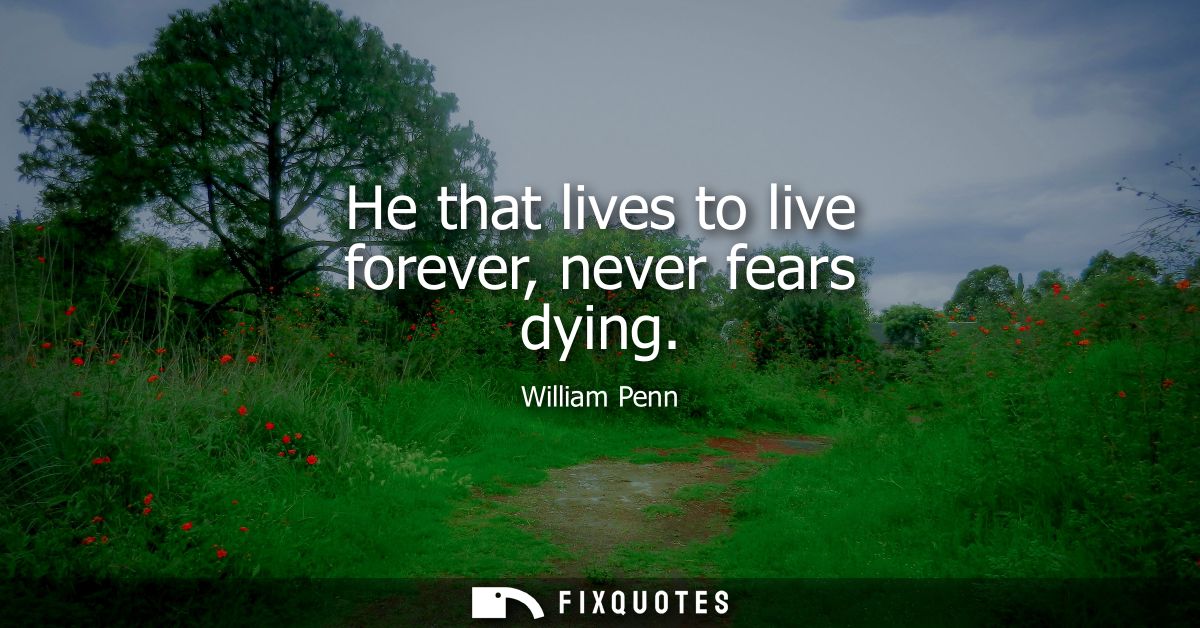
"He that lives to live forever, never fears dying"
About this Quote
Penn’s line lands with the calm authority of someone who watched friends get jailed for their beliefs and still insisted that conscience outranks the state. “He that lives to live forever” isn’t a gothic boast about immortality; it’s a political and spiritual posture. Penn, a Quaker leader, wrote in an England where dissent could cost you property, freedom, even your life. In that climate, fear wasn’t just personal weakness; it was a tool of governance. The threat of death and punishment kept people obedient. Penn’s sentence works because it yanks that lever out of the authorities’ hands.
The subtext is almost tactical: if your horizon extends beyond the immediate, coercion loses its bite. “Live forever” means living oriented toward what Quakers called the Inner Light and an afterlife that makes earthly intimidation look small. It’s also a quiet rebuke to performative bravery. Penn doesn’t romanticize martyrdom; he describes a psychological switch. Fear of dying shrinks when your identity isn’t pinned to survival, status, or the fragile story your era tells about “success.”
There’s an implied community ethic, too. Quaker refusal to swear oaths, to bow, to take up arms all depended on a certain fearlessness. Penn’s rhetoric turns that discipline into a kind of freedom: the person who has already placed their life in a larger frame becomes unusually hard to bully, buy, or break. In a world that monetized anxiety, he’s offering an escape route.
The subtext is almost tactical: if your horizon extends beyond the immediate, coercion loses its bite. “Live forever” means living oriented toward what Quakers called the Inner Light and an afterlife that makes earthly intimidation look small. It’s also a quiet rebuke to performative bravery. Penn doesn’t romanticize martyrdom; he describes a psychological switch. Fear of dying shrinks when your identity isn’t pinned to survival, status, or the fragile story your era tells about “success.”
There’s an implied community ethic, too. Quaker refusal to swear oaths, to bow, to take up arms all depended on a certain fearlessness. Penn’s rhetoric turns that discipline into a kind of freedom: the person who has already placed their life in a larger frame becomes unusually hard to bully, buy, or break. In a world that monetized anxiety, he’s offering an escape route.
Quote Details
| Topic | Mortality |
|---|---|
| Source | Help us find the source |
| Cite |
Citation Formats
APA Style (7th ed.)
Penn, William. (2026, January 16). He that lives to live forever, never fears dying. FixQuotes. https://fixquotes.com/quotes/he-that-lives-to-live-forever-never-fears-dying-103113/
Chicago Style
Penn, William. "He that lives to live forever, never fears dying." FixQuotes. January 16, 2026. https://fixquotes.com/quotes/he-that-lives-to-live-forever-never-fears-dying-103113/.
MLA Style (9th ed.)
"He that lives to live forever, never fears dying." FixQuotes, 16 Jan. 2026, https://fixquotes.com/quotes/he-that-lives-to-live-forever-never-fears-dying-103113/. Accessed 6 Feb. 2026.
More Quotes by William
Add to List