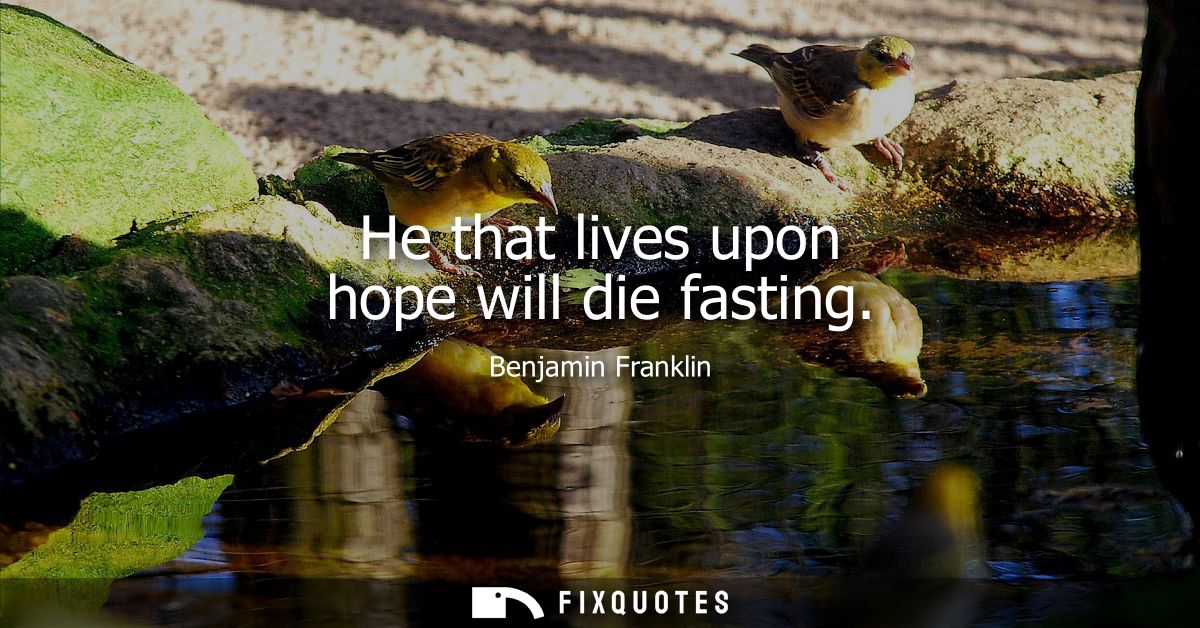
"He that lives upon hope will die fasting"
About this Quote
Franklin doesn’t bother to dress this up in enlightenment optimism; he serves it cold, like a ledger entry. "He that lives upon hope will die fasting" is a proverb with teeth, aimed at a particular American vice before it even had a name: confusing aspiration with sustenance. The sentence is built like a trap. "Lives upon" sounds almost religious, as if hope were daily bread, and then Franklin snaps it shut with the bodily fact of "die fasting". No abstract punishment, no moral thunder - just the quiet certainty of biology.
The intent is practical, even punitive: stop treating the future as a meal plan. Franklin’s political world was full of speculation, debt, and get-rich schemes in the colonies, along with the early stirrings of a culture that prized self-making. He knew how easily "hope" can become a rhetorical alibi for inaction, or for tolerating bad conditions because tomorrow might improve. In that sense, the line is less anti-hope than anti-delay: hope is a spark, not a diet.
Subtextually, it’s also a warning about power. People in charge often sell hope because it costs them nothing; the hungry pay the real price. Franklin’s genius is to translate that dynamic into a blunt physical metaphor: you can’t eat promises. The wit is that it sounds like folk wisdom, but it lands like policy advice - a small sentence arguing for labor, planning, and skepticism toward comforting forecasts.
The intent is practical, even punitive: stop treating the future as a meal plan. Franklin’s political world was full of speculation, debt, and get-rich schemes in the colonies, along with the early stirrings of a culture that prized self-making. He knew how easily "hope" can become a rhetorical alibi for inaction, or for tolerating bad conditions because tomorrow might improve. In that sense, the line is less anti-hope than anti-delay: hope is a spark, not a diet.
Subtextually, it’s also a warning about power. People in charge often sell hope because it costs them nothing; the hungry pay the real price. Franklin’s genius is to translate that dynamic into a blunt physical metaphor: you can’t eat promises. The wit is that it sounds like folk wisdom, but it lands like policy advice - a small sentence arguing for labor, planning, and skepticism toward comforting forecasts.
Quote Details
| Topic | Wisdom |
|---|---|
| Source | Verified source: Poor Richard Improved (Poor Richard’s Almanack for 1758) (Benjamin Franklin, 1758)
Evidence: Industry need not wish, as Poor Richard says, and He that lives upon Hope will die fasting. (Preface (Father Abraham’s speech); exact page varies by printing). This wording appears in the preface to Franklin’s Poor Richard improved: Being an Almanack and Ephemeris … for the Year of our Lord 1758 (often later reprinted/retitled as “The Way to Wealth”). The quote is presented as part of “Father Abraham’s” connected discourse built from earlier Poor Richard maxims. A widely noted earlier variant in the Poor Richard series is “He that lives upon Hope, dies farting” (reported as in the 1736 almanack), with “dies fasting” appearing as a later republication in 1758. Other candidates (1) The Infinite Intelligence (Afoma Eguh-Okafor MD., 2008) compilation95.0% ... Benjamin Franklin He that is of the opinion money will do everything may well be suspected of doing everything fo... |
| Cite |
Citation Formats
APA Style (7th ed.)
Franklin, Benjamin. (2026, February 15). He that lives upon hope will die fasting. FixQuotes. https://fixquotes.com/quotes/he-that-lives-upon-hope-will-die-fasting-34780/
Chicago Style
Franklin, Benjamin. "He that lives upon hope will die fasting." FixQuotes. February 15, 2026. https://fixquotes.com/quotes/he-that-lives-upon-hope-will-die-fasting-34780/.
MLA Style (9th ed.)
"He that lives upon hope will die fasting." FixQuotes, 15 Feb. 2026, https://fixquotes.com/quotes/he-that-lives-upon-hope-will-die-fasting-34780/. Accessed 26 Mar. 2026.
More Quotes by Benjamin
Add to List