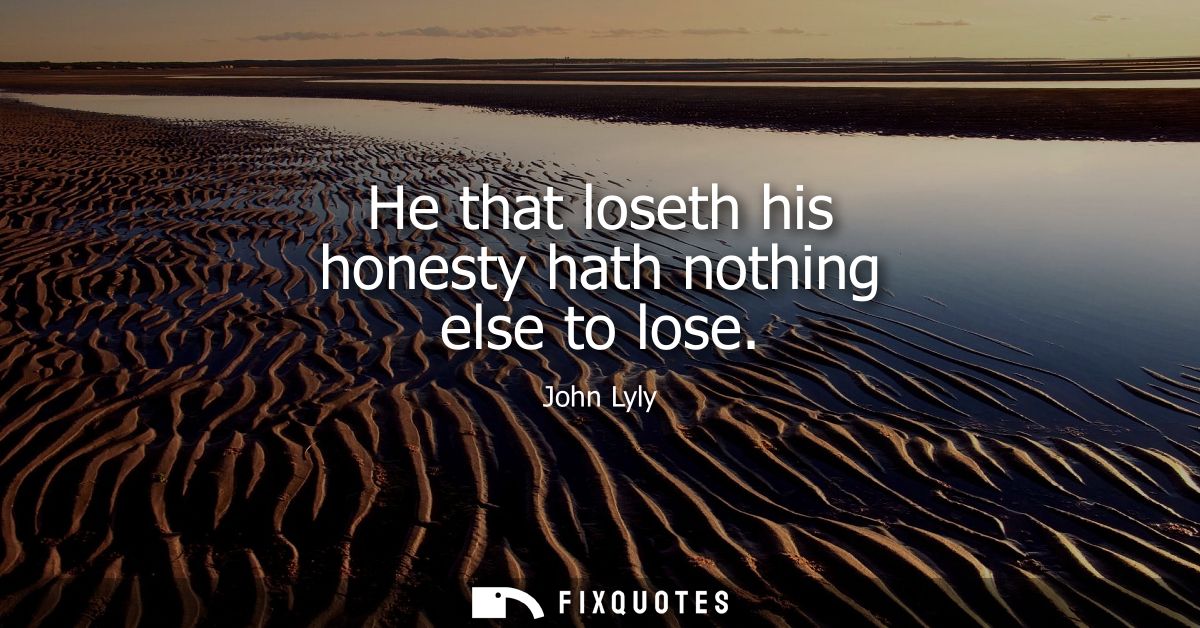
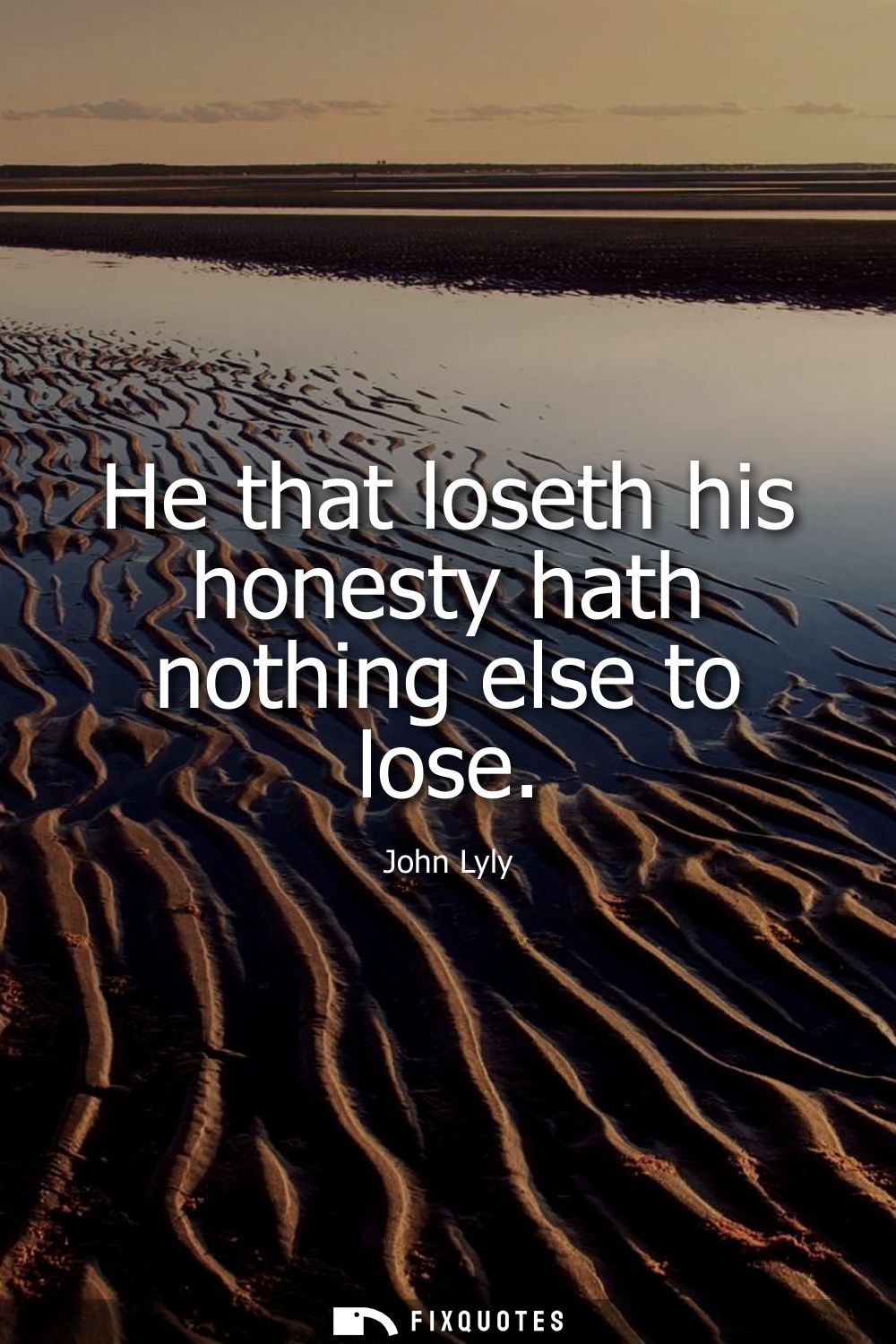
"He that loseth his honesty, hath nothing else to lose"
About this Quote
Honesty here isn’t a virtue on the shelf; it’s the load-bearing beam holding up everything else you think you own. Lyly’s line works because it treats integrity less like moral decoration and more like property law: once you’ve forfeited it, the rest of your “assets” become unsecured, socially and spiritually. The phrasing is bluntly transactional - “loseth,” “hath,” “nothing else” - as if character is a kind of account you can drain in a single bad withdrawal.
The subtext is reputational, not merely ethical. In a courtly, status-obsessed Elizabethan culture, “honesty” meant more than truth-telling; it signaled trustworthiness, sexual propriety, and social credit. Lose that, and you’re no longer legible as a stable person within the system. You can still possess money, titles, or wit, but you can’t reliably convert any of it into influence, friendship, or safety, because credibility is the currency that lets other currencies circulate.
Lyly, known for the polished artifice of Euphuism and for writing within a world of patronage, understands the cruelty of that economy. The quote is a warning disguised as a clean maxim: protect your honesty not because you’re saintly, but because it’s the last defense against becoming disposable. It also carries a darker implication: once someone is branded dishonest, society feels licensed to take everything else from them. In that sense, the line isn’t just moral instruction - it’s a map of how power punishes.
The subtext is reputational, not merely ethical. In a courtly, status-obsessed Elizabethan culture, “honesty” meant more than truth-telling; it signaled trustworthiness, sexual propriety, and social credit. Lose that, and you’re no longer legible as a stable person within the system. You can still possess money, titles, or wit, but you can’t reliably convert any of it into influence, friendship, or safety, because credibility is the currency that lets other currencies circulate.
Lyly, known for the polished artifice of Euphuism and for writing within a world of patronage, understands the cruelty of that economy. The quote is a warning disguised as a clean maxim: protect your honesty not because you’re saintly, but because it’s the last defense against becoming disposable. It also carries a darker implication: once someone is branded dishonest, society feels licensed to take everything else from them. In that sense, the line isn’t just moral instruction - it’s a map of how power punishes.
Quote Details
| Topic | Honesty & Integrity |
|---|---|
| Source | Euphues: The Anatomy of Wit (commonly cited from the 1579 text tradition) |
| Cite |
Citation Formats
APA Style (7th ed.)
Lyly, John. (2026, February 18). He that loseth his honesty, hath nothing else to lose. FixQuotes. https://fixquotes.com/quotes/he-that-loseth-his-honesty-hath-nothing-else-to-64417/
Chicago Style
Lyly, John. "He that loseth his honesty, hath nothing else to lose." FixQuotes. February 18, 2026. https://fixquotes.com/quotes/he-that-loseth-his-honesty-hath-nothing-else-to-64417/.
MLA Style (9th ed.)
"He that loseth his honesty, hath nothing else to lose." FixQuotes, 18 Feb. 2026, https://fixquotes.com/quotes/he-that-loseth-his-honesty-hath-nothing-else-to-64417/. Accessed 8 Mar. 2026.
More Quotes by John
Add to List