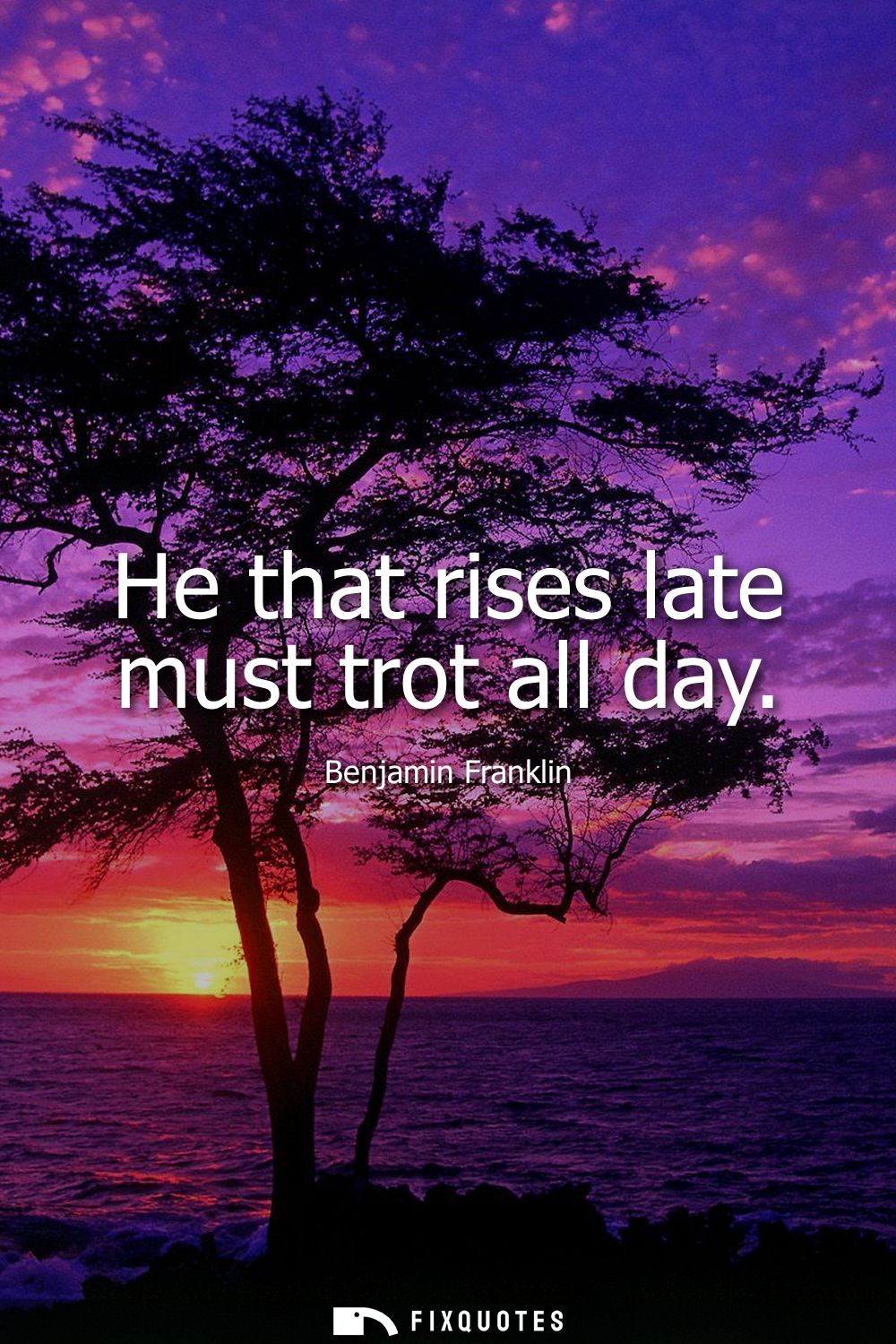
"He that rises late must trot all day"
About this Quote
Franklin doesn’t bother with moral thunder here; he reaches for the sound of hooves on hard ground. “He that rises late must trot all day” is Puritan efficiency turned into a barnyard image: if you miss the cool, quiet hours of the morning, you spend the rest of your day scrambling, sweating, and slightly humiliated by your own preventable haste. The verb choice matters. Not “work,” not “hurry,” but “trot” - a steady, undignified jog that keeps you moving without ever letting you feel ahead. It’s the rhythm of chronic catch-up.
The intent is practical discipline, but the subtext is social. Franklin is not just warning about personal fatigue; he’s sketching a civic ideal where time management equals virtue. In an 18th-century world of merchants, printers, and public men building institutions in real time, punctuality wasn’t a lifestyle hack. It was reputational currency. To rise late wasn’t merely inconvenient; it signaled softness, a failure to govern the self, and by extension a shaky claim to govern anything else.
Context sharpens the edge. Franklin’s aphorisms, especially in the Poor Richard tradition, were designed to travel: memorable enough to repeat, pointed enough to sting. The line flatters the early riser as rational and competent, while quietly shaming the laggard as someone condemned to perpetual motion with no progress. It’s self-help as social control, delivered with a wink and a whip.
The intent is practical discipline, but the subtext is social. Franklin is not just warning about personal fatigue; he’s sketching a civic ideal where time management equals virtue. In an 18th-century world of merchants, printers, and public men building institutions in real time, punctuality wasn’t a lifestyle hack. It was reputational currency. To rise late wasn’t merely inconvenient; it signaled softness, a failure to govern the self, and by extension a shaky claim to govern anything else.
Context sharpens the edge. Franklin’s aphorisms, especially in the Poor Richard tradition, were designed to travel: memorable enough to repeat, pointed enough to sting. The line flatters the early riser as rational and competent, while quietly shaming the laggard as someone condemned to perpetual motion with no progress. It’s self-help as social control, delivered with a wink and a whip.
Quote Details
| Topic | Work Ethic |
|---|---|
| Source | Help us find the source |
| Cite |
Citation Formats
APA Style (7th ed.)
Franklin, Benjamin. (2026, January 17). He that rises late must trot all day. FixQuotes. https://fixquotes.com/quotes/he-that-rises-late-must-trot-all-day-25489/
Chicago Style
Franklin, Benjamin. "He that rises late must trot all day." FixQuotes. January 17, 2026. https://fixquotes.com/quotes/he-that-rises-late-must-trot-all-day-25489/.
MLA Style (9th ed.)
"He that rises late must trot all day." FixQuotes, 17 Jan. 2026, https://fixquotes.com/quotes/he-that-rises-late-must-trot-all-day-25489/. Accessed 2 Apr. 2026.
More Quotes by Benjamin
Add to List