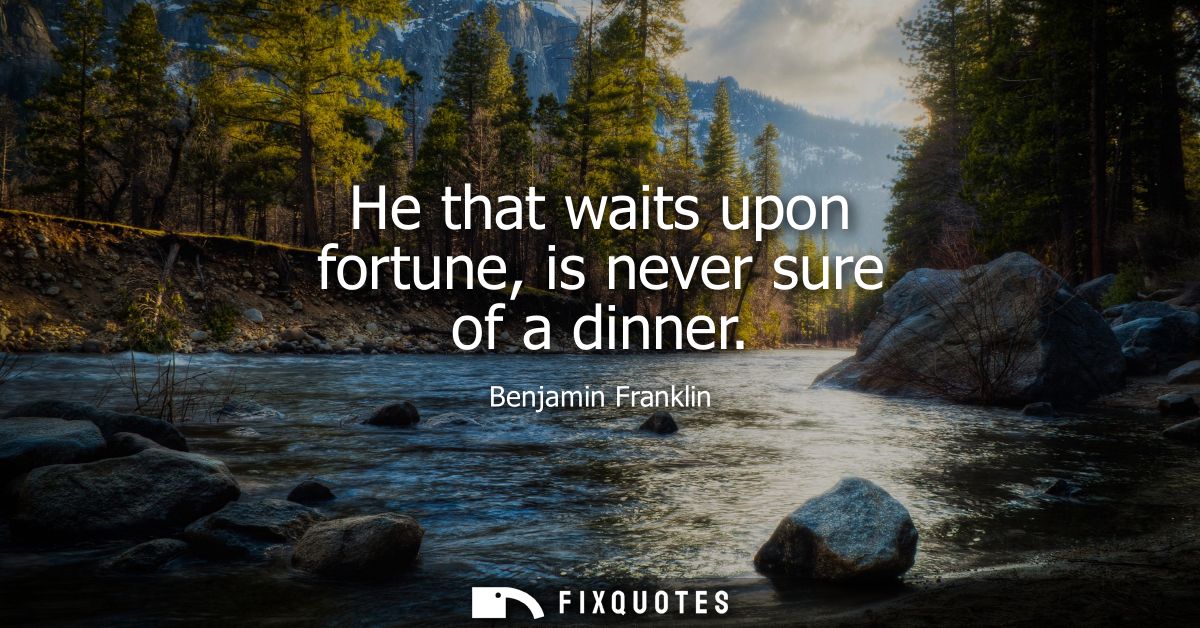
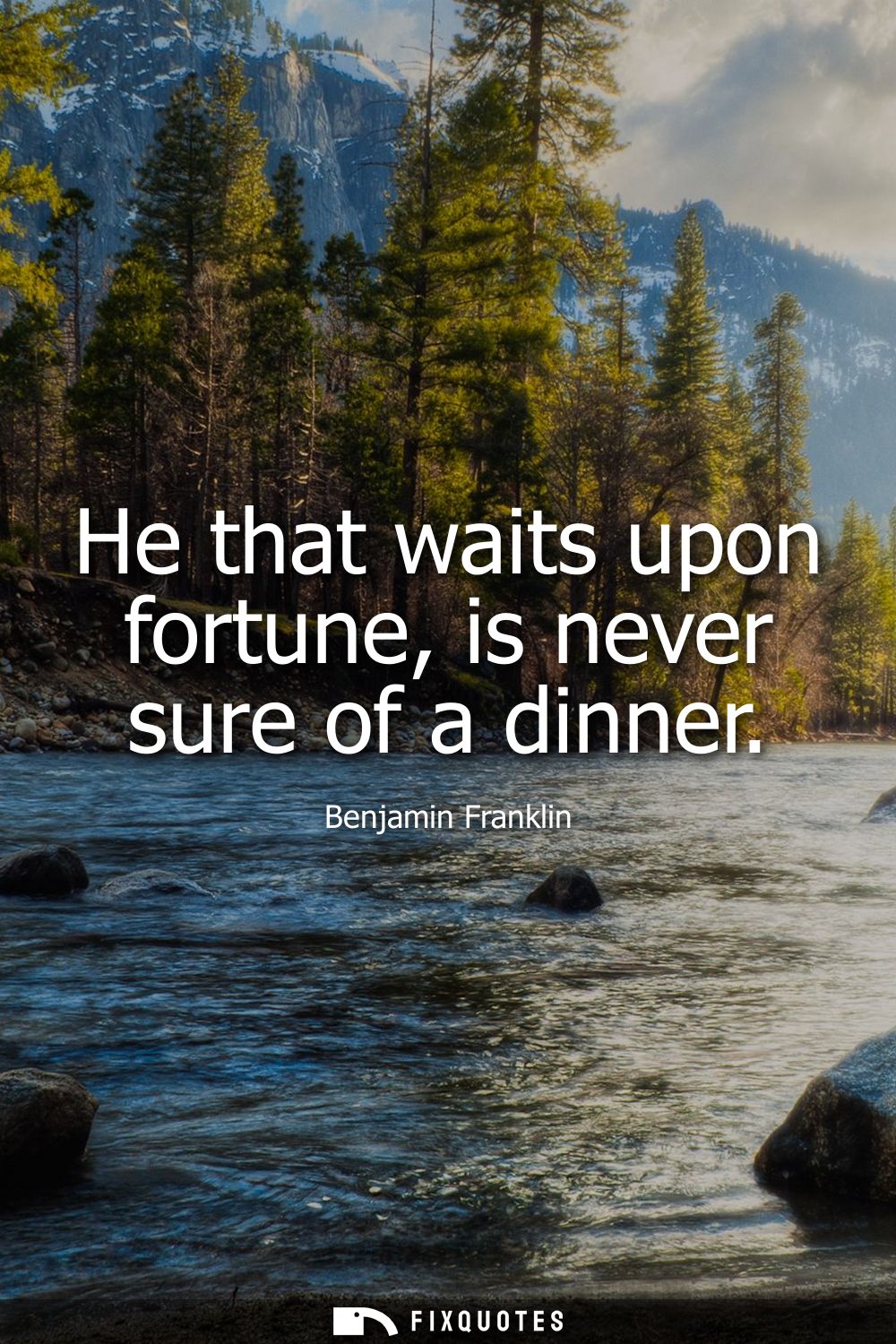
"He that waits upon fortune, is never sure of a dinner"
About this Quote
Franklin’s line lands like a proverb with teeth: if you outsource your survival to luck, you’ll stay hungry. The dinner isn’t a cute domestic detail; it’s the lowest rung of security, the basic proof that your life is being held up by something sturdier than chance. By choosing so ordinary a reward, Franklin keeps the warning practical. He’s not scolding dreamers for dreaming; he’s calling out the fantasy that outcomes arrive on schedule just because you want them.
The phrasing does a lot of quiet work. “Waits upon fortune” frames passivity as a kind of servitude, as if luck were a patron you flatter, linger near, and hope will finally notice you. Franklin’s America was full of people with reason to believe in providence and windfalls, but also full of precariousness: volatile markets, uncertain harvests, apprenticeships and trades where diligence could be the difference between solvency and shame. A politician who also thought like a printer-businessman, Franklin argues for agency in the most persuasive currency he knows: reliability.
The subtext is civic as much as personal. A republic can’t be built on wishful thinking; it needs habits, institutions, and citizens who plan, save, work, and improvise. “Never sure” is the dagger: fortune can occasionally feed you, even impress you, but it can’t be trusted. Franklin isn’t promising success. He’s promising that dependence on luck is a lifestyle with a built-in empty plate.
The phrasing does a lot of quiet work. “Waits upon fortune” frames passivity as a kind of servitude, as if luck were a patron you flatter, linger near, and hope will finally notice you. Franklin’s America was full of people with reason to believe in providence and windfalls, but also full of precariousness: volatile markets, uncertain harvests, apprenticeships and trades where diligence could be the difference between solvency and shame. A politician who also thought like a printer-businessman, Franklin argues for agency in the most persuasive currency he knows: reliability.
The subtext is civic as much as personal. A republic can’t be built on wishful thinking; it needs habits, institutions, and citizens who plan, save, work, and improvise. “Never sure” is the dagger: fortune can occasionally feed you, even impress you, but it can’t be trusted. Franklin isn’t promising success. He’s promising that dependence on luck is a lifestyle with a built-in empty plate.
Quote Details
| Topic | Work Ethic |
|---|---|
| Source | Help us find the source |
| Cite |
Citation Formats
APA Style (7th ed.)
Franklin, Benjamin. (2026, January 17). He that waits upon fortune, is never sure of a dinner. FixQuotes. https://fixquotes.com/quotes/he-that-waits-upon-fortune-is-never-sure-of-a-25491/
Chicago Style
Franklin, Benjamin. "He that waits upon fortune, is never sure of a dinner." FixQuotes. January 17, 2026. https://fixquotes.com/quotes/he-that-waits-upon-fortune-is-never-sure-of-a-25491/.
MLA Style (9th ed.)
"He that waits upon fortune, is never sure of a dinner." FixQuotes, 17 Jan. 2026, https://fixquotes.com/quotes/he-that-waits-upon-fortune-is-never-sure-of-a-25491/. Accessed 18 Mar. 2026.
More Quotes by Benjamin
Add to List