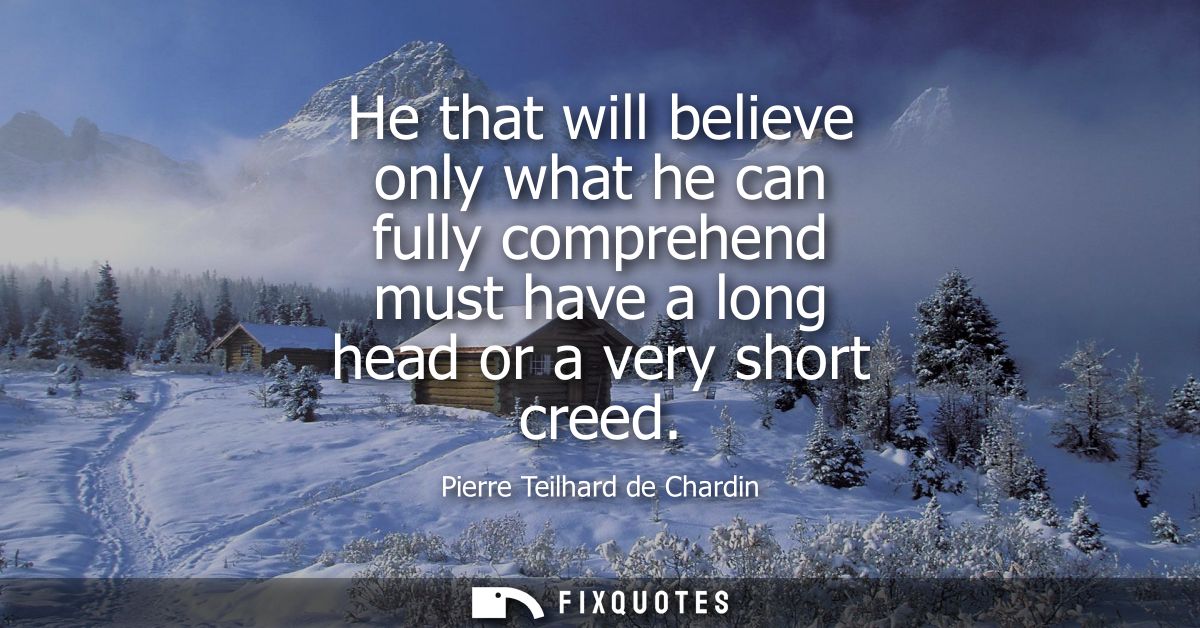
"He that will believe only what he can fully comprehend must have a long head or a very short creed"
About this Quote
Certainty is the most expensive luxury in intellectual life, and Teilhard is needling the people who insist they can’t assent to anything they can’t “fully comprehend.” The line turns on a deliberately blunt choice: either you’re a rare genius (“a long head”) or you’ll end up with a cramped worldview (“a very short creed”). It’s a compact social diagnosis disguised as a proverb: the demand for total clarity isn’t neutral rigor; it often functions as a veto against complexity, ambiguity, and growth.
The subtext is theological without being preachy. “Creed” isn’t just any belief set; it’s a jab at dogmatism that masquerades as skepticism. Teilhard, a Jesuit priest and evolutionary thinker, lived in the crossfire between Catholic doctrine and modern science. His larger project tried to reconcile faith with evolution and cosmic development, so he had a personal stake in defending a kind of responsible belief that can live with partial knowledge. In his universe, insisting on full comprehension before belief is less an epistemic principle than a refusal to participate in the unfinishedness of reality.
The phrase “must have” gives it the snap of inevitability: this isn’t a gentle suggestion, it’s a trap. And “fully” is the real culprit word. Teilhard isn’t endorsing credulity; he’s warning that making completeness the admission ticket for belief quietly disqualifies most of what matters: trust, scientific inference, moral commitment, even love. The irony is that the posture of strict rational control can end up looking like fear - fear of being wrong, or worse, of being changed.
The subtext is theological without being preachy. “Creed” isn’t just any belief set; it’s a jab at dogmatism that masquerades as skepticism. Teilhard, a Jesuit priest and evolutionary thinker, lived in the crossfire between Catholic doctrine and modern science. His larger project tried to reconcile faith with evolution and cosmic development, so he had a personal stake in defending a kind of responsible belief that can live with partial knowledge. In his universe, insisting on full comprehension before belief is less an epistemic principle than a refusal to participate in the unfinishedness of reality.
The phrase “must have” gives it the snap of inevitability: this isn’t a gentle suggestion, it’s a trap. And “fully” is the real culprit word. Teilhard isn’t endorsing credulity; he’s warning that making completeness the admission ticket for belief quietly disqualifies most of what matters: trust, scientific inference, moral commitment, even love. The irony is that the posture of strict rational control can end up looking like fear - fear of being wrong, or worse, of being changed.
Quote Details
| Topic | Faith |
|---|
More Quotes by Pierre
Add to List