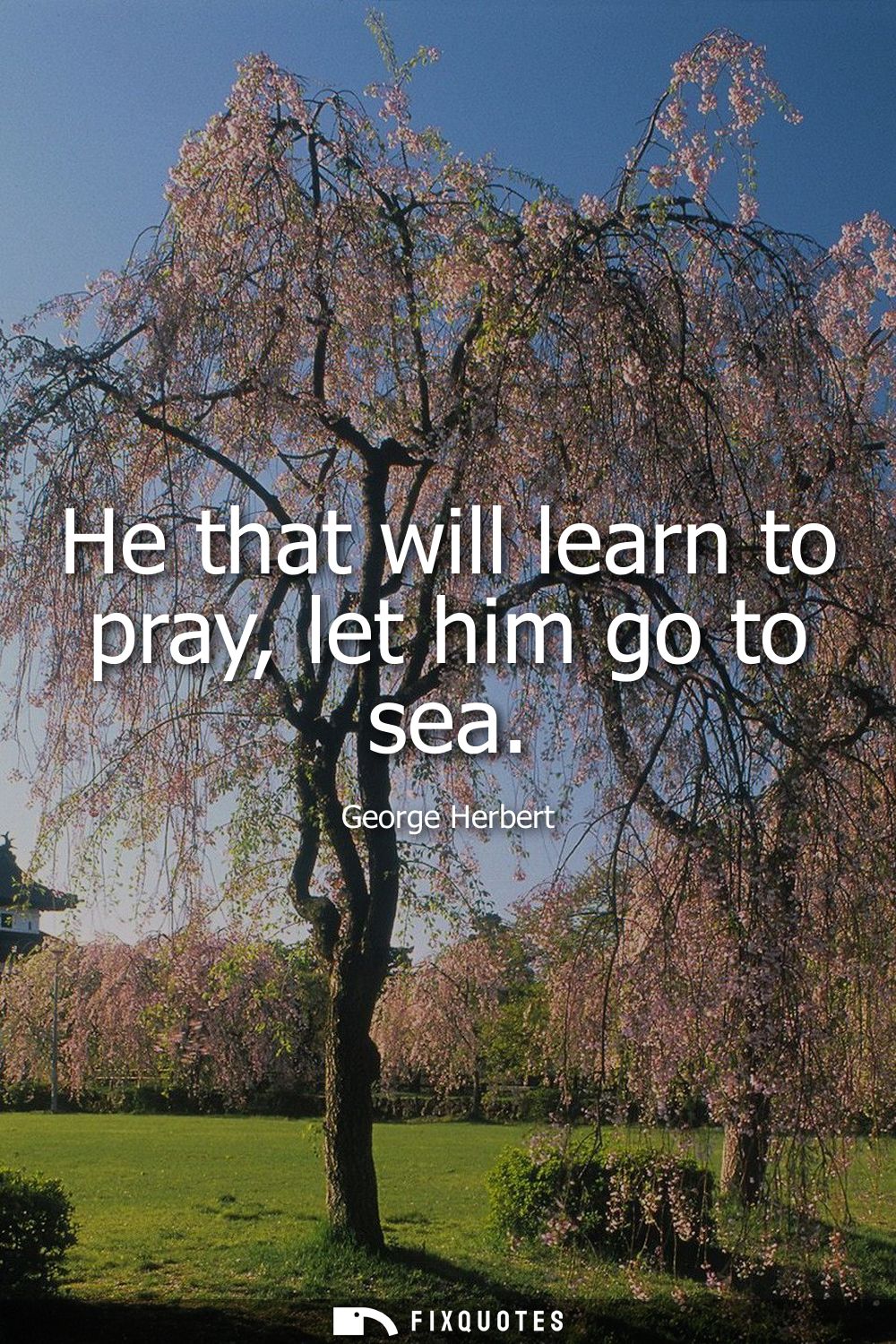
"He that will learn to pray, let him go to sea"
About this Quote
Prayer, in George Herbert's hands, isn't a scented candle mood; it's what happens when your competence finally runs out. "He that will learn to pray, let him go to sea" is a neatly barbed invitation: if you want a real education in dependence, trade the safety of land for an element that does not care about your plans. The line works because it makes prayer practical, almost involuntary. At sea, nature isn't picturesque; it's a force that can erase you. That pressure strips away the polite, performative piety Herbert often distrusted. You don't "choose" humility; it's assigned.
Herbert, a metaphysical poet and Anglican priest, wrote in a world where maritime travel was expanding England's horizons while keeping death close. Storms, disease, shipwreck, the sheer unaccountable vastness of water: the sea was a common metaphor for providence because it was the most immediate proof of human smallness. The aphorism also carries a Protestant-leaning edge: prayer isn't a sacrament you master through technique, it's a reflex learned through trial. The sea becomes a spiritual pedagogy, a harsh tutor that makes the self porous.
There's irony tucked into the paternal phrasing "let him": as if you could simply sign up for catastrophe. Herbert implies you can. Modern readers might hear a darker subtext too: comfort is bad for the soul, and a culture chasing control will have to be scared back into sincerity.
Herbert, a metaphysical poet and Anglican priest, wrote in a world where maritime travel was expanding England's horizons while keeping death close. Storms, disease, shipwreck, the sheer unaccountable vastness of water: the sea was a common metaphor for providence because it was the most immediate proof of human smallness. The aphorism also carries a Protestant-leaning edge: prayer isn't a sacrament you master through technique, it's a reflex learned through trial. The sea becomes a spiritual pedagogy, a harsh tutor that makes the self porous.
There's irony tucked into the paternal phrasing "let him": as if you could simply sign up for catastrophe. Herbert implies you can. Modern readers might hear a darker subtext too: comfort is bad for the soul, and a culture chasing control will have to be scared back into sincerity.
Quote Details
| Topic | Prayer |
|---|---|
| Source | Verified source: Herbert's Remains (includes "Jacula Prudentum") (George Herbert, 1652)
Evidence: He that will learn to pray, let him go to Sea. (Page 6 (section heading: "Jacula Prudentum.")). This is a primary-source appearance in a 1652 London printed volume attributed to George Herbert: "Herbert's remains, or, sundry pieces of that sweet singer of the temple, Mr George Herbert". The quote appears under the subsection title "Jacula Prudentum." and is printed on Page 6 in the EEBO/TCP transcription. This book is posthumous (Herbert died 1633). Many modern attributions cite "Jacula Prudentum" with a date like 1651; however, the copyable, verifiable early printed source I could directly locate and quote is the 1652 printed volume containing the "Jacula Prudentum" section. Other candidates (1) The English Poems of George Herbert (George Herbert, 1871) compilation95.0% Together with His Collection of Proverbs Entitled Jacula Prudentum George Herbert. Nothing is to be presumed on ... H... |
| Cite |
Citation Formats
APA Style (7th ed.)
Herbert, George. (2026, March 2). He that will learn to pray, let him go to sea. FixQuotes. https://fixquotes.com/quotes/he-that-will-learn-to-pray-let-him-go-to-sea-8514/
Chicago Style
Herbert, George. "He that will learn to pray, let him go to sea." FixQuotes. March 2, 2026. https://fixquotes.com/quotes/he-that-will-learn-to-pray-let-him-go-to-sea-8514/.
MLA Style (9th ed.)
"He that will learn to pray, let him go to sea." FixQuotes, 2 Mar. 2026, https://fixquotes.com/quotes/he-that-will-learn-to-pray-let-him-go-to-sea-8514/. Accessed 31 Mar. 2026.
More Quotes by George
Add to List