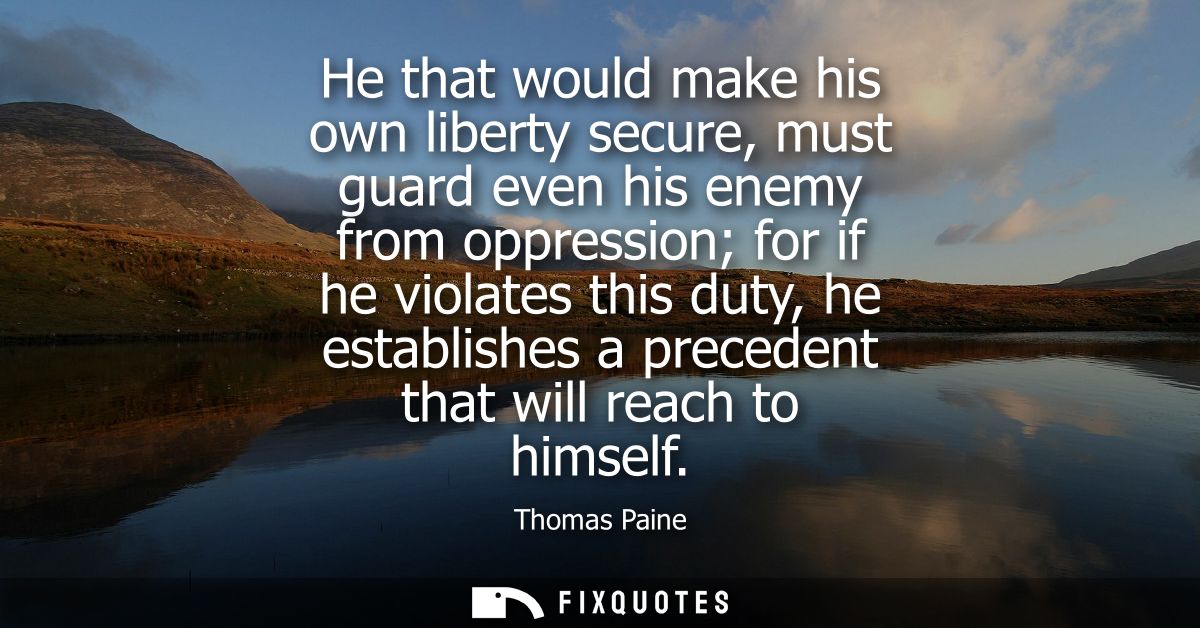
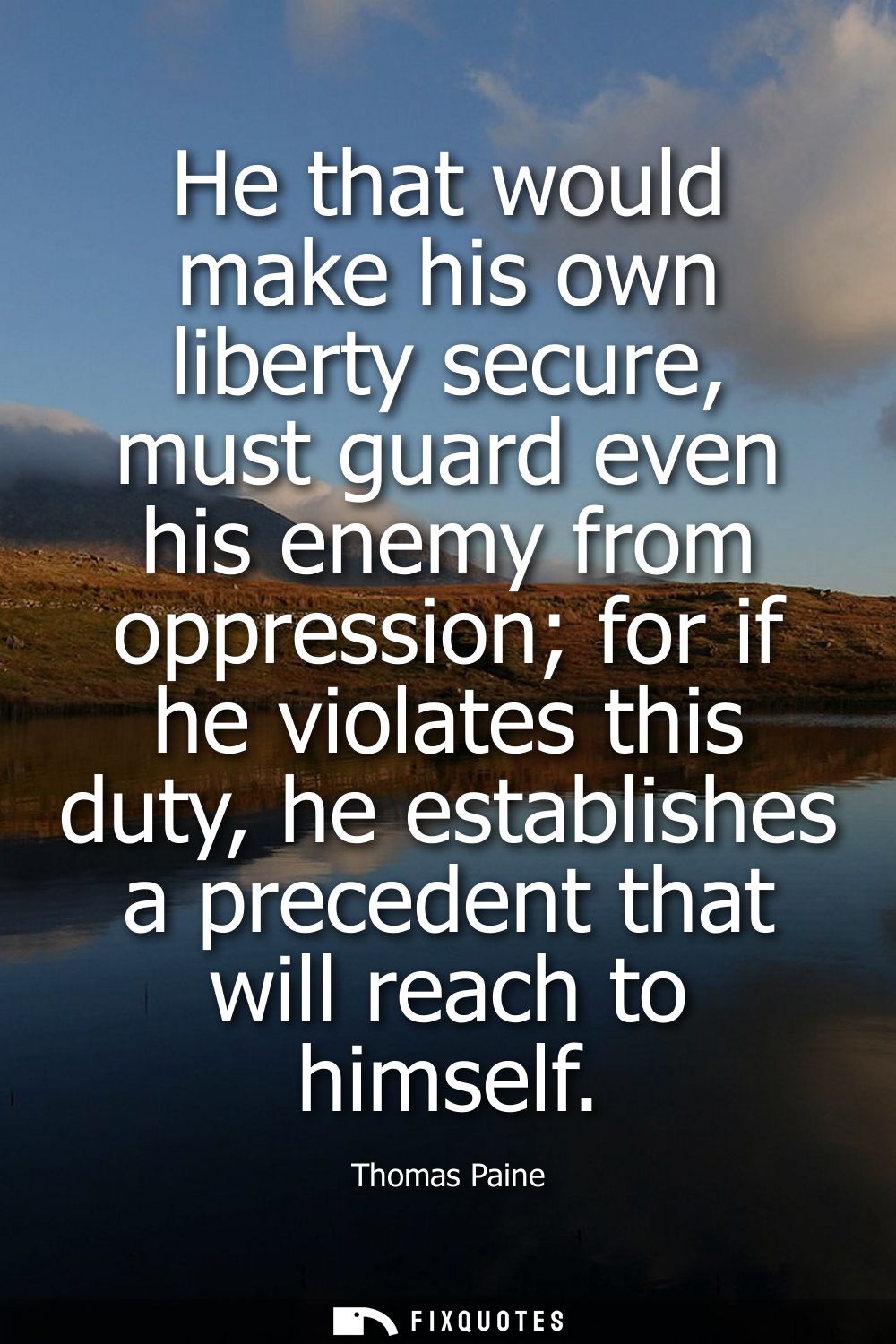
"He that would make his own liberty secure, must guard even his enemy from oppression; for if he violates this duty, he establishes a precedent that will reach to himself"
About this Quote
Paine’s phrasing does the heavy lifting. “Must guard” frames restraint as obligation, not benevolence. “Even his enemy” is the stress point: the test case for a free society isn’t how it treats allies, but how it restrains itself when anger feels justified. Then comes the cold mechanism: “precedent.” Paine is writing in an age of revolutions, when new governments were being built on paper and in blood, and when emergency measures - treason trials, censorship, mob justice - were tempting shortcuts. He’s warning that power is contagious. Once the state learns it can oppress “the bad ones,” the definition of “bad” expands with the next crisis, the next faction, the next leader.
The subtext is distrust of political purity. Paine, the radical pamphleteer who helped legitimize rebellion, also understood how quickly righteous causes grow teeth. His argument is not sentimental tolerance; it’s self-preservation by principle. Your enemy’s rights are the guardrail keeping your own liberty from becoming a temporary privilege.
Quote Details
| Topic | Freedom |
|---|---|
| Source | Verified source: Dissertation on the First Principles of Government (Thomas Paine, 1795)
Evidence: An avidity to punish is always dangerous to liberty. It leads men to stretch, to misinterpret, and to misapply even the best of laws. He that would make his own liberty secure must guard even his enemy from oppression; for if he violates this duty, he establishes a precedent that will reach to himself.. This sentence appears in Thomas Paine’s political essay/pamphlet typically titled “Dissertation on the First Principles of Government,” dated “July, 1795. PARIS” in the text. I was able to verify the wording in a primary-work transcription hosted by the Thomas Paine Historical Association (ThomasPaine.org). This confirms the quote is genuinely Paine’s. However, this web transcription does not provide the original first-edition imprint (printer/publisher) or page number; to identify the *earliest* physical publication details (place of printing, printer, and page) you would need to consult a scan or bibliographic record of the 1795 pamphlet/first printing (e.g., a library catalog entry or a digitized facsimile). Other candidates (1) Three Deaths and Enlightenment Thought (Stephen Miller, 2001) compilation98.2% ... Paine , who had become a deputy to the Convention in September ... He that would make his own liberty secure must... |
| Cite |
Citation Formats
APA Style (7th ed.)
Paine, Thomas. (2026, February 7). He that would make his own liberty secure, must guard even his enemy from oppression; for if he violates this duty, he establishes a precedent that will reach to himself. FixQuotes. https://fixquotes.com/quotes/he-that-would-make-his-own-liberty-secure-must-2105/
Chicago Style
Paine, Thomas. "He that would make his own liberty secure, must guard even his enemy from oppression; for if he violates this duty, he establishes a precedent that will reach to himself." FixQuotes. February 7, 2026. https://fixquotes.com/quotes/he-that-would-make-his-own-liberty-secure-must-2105/.
MLA Style (9th ed.)
"He that would make his own liberty secure, must guard even his enemy from oppression; for if he violates this duty, he establishes a precedent that will reach to himself." FixQuotes, 7 Feb. 2026, https://fixquotes.com/quotes/he-that-would-make-his-own-liberty-secure-must-2105/. Accessed 12 Feb. 2026.