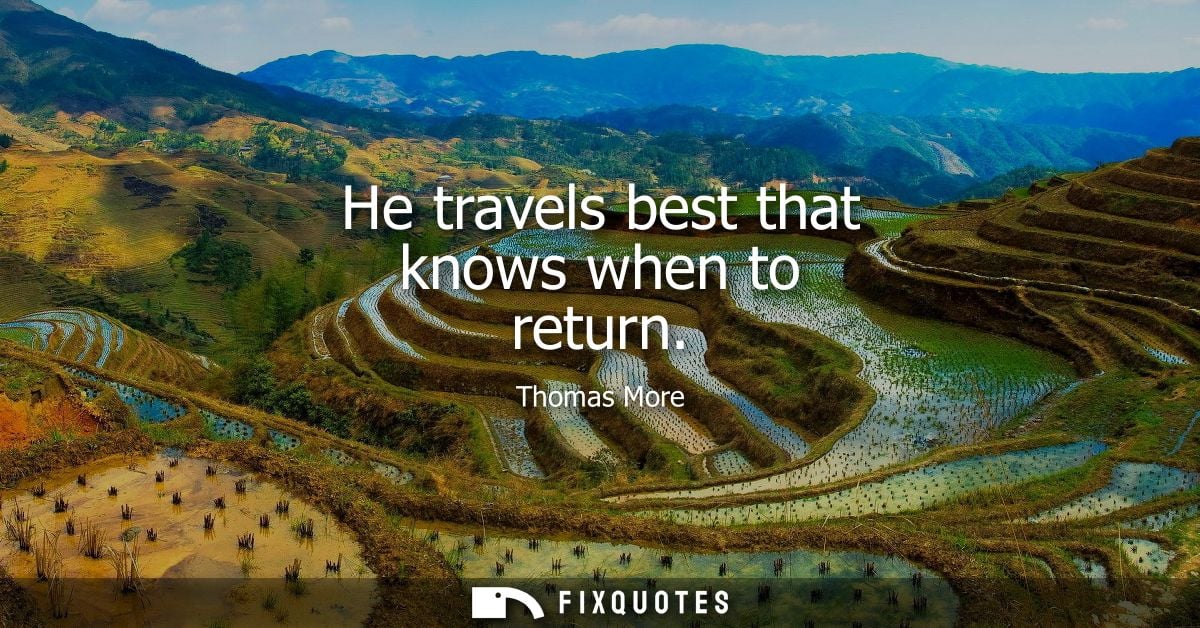
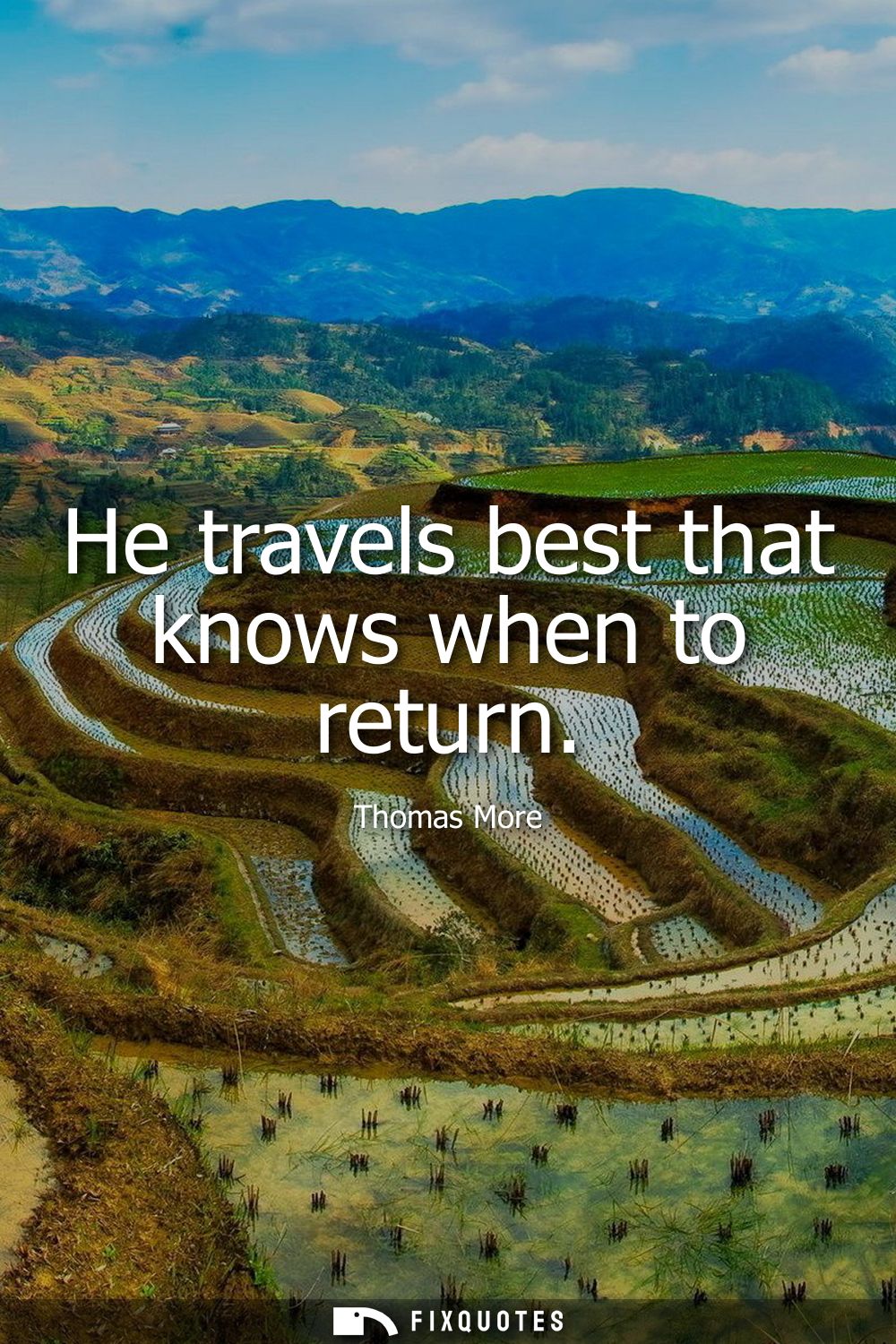
"He travels best that knows when to return"
About this Quote
A perfect line from a man who knew that movement can be both liberation and liability. Thomas More lived at the hinge point between medieval stability and Renaissance restlessness: new worlds opening, new ideas circulating, old loyalties cracking under Henry VIII's consolidating power. In that environment, travel is not just geography. It's ambition, curiosity, dissent, even flirtation with heresy. "He travels best" sounds like praise for the brave cosmopolitan, but the clause that matters is the quiet brake: "that knows when to return."
The intent is moral as much as practical. More is skeptical of the traveler who treats motion as virtue in itself - the kind of person who mistakes novelty for wisdom. The subtext is about limits: knowing where you belong, what you owe, and when exploration becomes evasion. Return isn't framed as defeat; it's the measure of judgment. A good traveler gathers experience, then reintegrates it into a life with responsibilities. A bad one drifts, unaccountable, intoxicated by distance.
Context sharpens the edge. More's world punished the wrong kind of intellectual travel. Straying too far from sanctioned doctrine or loyalty could cost you your career, your freedom, your head - More would later pay that price. So the line carries a double meaning: cultivate breadth, but keep an exit strategy; test the world, but don't forget the home base that confers identity and safety. It's Renaissance humanism with a seatbelt: curiosity, tempered by self-knowledge and political reality.
The intent is moral as much as practical. More is skeptical of the traveler who treats motion as virtue in itself - the kind of person who mistakes novelty for wisdom. The subtext is about limits: knowing where you belong, what you owe, and when exploration becomes evasion. Return isn't framed as defeat; it's the measure of judgment. A good traveler gathers experience, then reintegrates it into a life with responsibilities. A bad one drifts, unaccountable, intoxicated by distance.
Context sharpens the edge. More's world punished the wrong kind of intellectual travel. Straying too far from sanctioned doctrine or loyalty could cost you your career, your freedom, your head - More would later pay that price. So the line carries a double meaning: cultivate breadth, but keep an exit strategy; test the world, but don't forget the home base that confers identity and safety. It's Renaissance humanism with a seatbelt: curiosity, tempered by self-knowledge and political reality.
Quote Details
| Topic | Wisdom |
|---|---|
| Source | Help us find the source |
| Cite |
Citation Formats
APA Style (7th ed.)
More, Thomas. (2026, January 16). He travels best that knows when to return. FixQuotes. https://fixquotes.com/quotes/he-travels-best-that-knows-when-to-return-84759/
Chicago Style
More, Thomas. "He travels best that knows when to return." FixQuotes. January 16, 2026. https://fixquotes.com/quotes/he-travels-best-that-knows-when-to-return-84759/.
MLA Style (9th ed.)
"He travels best that knows when to return." FixQuotes, 16 Jan. 2026, https://fixquotes.com/quotes/he-travels-best-that-knows-when-to-return-84759/. Accessed 12 Feb. 2026.
More Quotes by Thomas
Add to List